
The First Interview Is Now With a Machine: How AI Screening Is Changing the Job Hunt
Every week, qualified people apply for jobs they could do well and hear nothing back. No interview, no feedback, often no rejection email at all. In most cases the decision was not made by a person. It was made by software, in the first minutes after the application arrived.
Hiring has quietly changed shape. The first round of almost every recruitment process at a medium or large employer is now handled by an applicant tracking system, increasingly with artificial intelligence layered on top. Before a recruiter reads a single resume, the software has read, scored and ranked all of them.
For job seekers, that changes what a good application looks like. For employers, it changes what a fair process looks like. Both sides are still catching up.
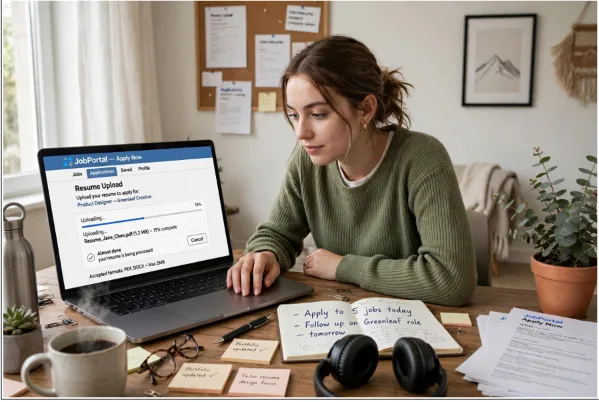
Job seeker uploading a resume to an online job portal from home
How the machine reads an application
The software starts by parsing the resume. It pulls out the candidate’s name, contact details, job titles, employers, dates, education and skills, and stores them as searchable fields in a database. Anything it cannot read cleanly, it reads badly or not at all.
Next comes matching. The system compares each application against the job description, looking for the titles, skills, tools and qualifications the employer asked for. Many systems now add an AI score on top, ranking candidates by how closely their history matches the profile of the role.
Finally come the knockout questions. Work rights, required licenses, years of experience, location. A wrong answer at this stage can end an application before the matching even begins.
None of the steps involves judgment about the person. The software judges the document: how it is formatted, which words it uses, and whether its facts line up with the filters it was given.
Why employers handed over the first round
The reason is volume. A single advertised opening at a well known employer can draw hundreds of applications, and recruitment teams are smaller than they used to be. Reading every application properly would take days. Screening software does the first pass in minutes.
Consistency is the second reason. A machine applies the same criteria to the first application and the five hundredth, late on a Friday as readily as first thing on a Monday. Employers also get a searchable record of every applicant, which makes returning to past candidates for a new role far easier than digging through email inboxes.
Used well, the tools save time and reduce some kinds of human bias. Used carelessly, they create new problems of their own.
Where the system gets it wrong
The most common failure is also the simplest: the software never sees the real candidate. Resumes built with two column templates, tables, graphics or text boxes can scramble when parsed, so a strong work history lands in the database as fragments. A candidate who described the right work in different words, “looking after key accounts” instead of “account management”, may never appear in a recruiter’s keyword search at all.
Rigid filters cause the second failure. A requirement set at five years of experience quietly removes the candidate with four and a half years and stronger results. A location filter removes people who stated in their cover letter that they are ready to relocate. Most employers never audit what their filters threw away, so the loss stays invisible.
Regulators have started paying attention. New York City now requires employers using automated tools in hiring to audit them for bias, and the European Union’s AI Act treats recruitment software as high risk, with strict duties attached. The direction of travel is clear: companies remain responsible for decisions their software makes.
What job seekers can do about it
The practical lesson for applicants is that a resume now has two readers, and the machine reads first. Writing for it is not trickery. It is mostly a matter of clarity.
Use the job title the employer uses, as long as it honestly describes your work. Mirror the language of the advertisement for skills and tools, because that is the language the search runs on. Keep the layout simple: one column, standard headings such as Work History and Education, no tables or text boxes, and contact details in the body of the document rather than in a header or footer.
Most importantly, test the document before sending it. A free ATS resume checker shows how the software reads a resume: which fields it finds, which keywords it matches against the job description, and where the document is likely to fail. Ten minutes of checking can be the difference between a file that disappears into a database and one that reaches a recruiter’s screen.
It also means tailoring each application instead of sending one resume to every employer. The same career, written two ways, can score very differently against two advertisements, because each employer describes similar work in its own words. Adjusting the summary and the skills section to match the advertisement, honestly and without inventing experience, takes minutes. It is the single habit that separates candidates who keep getting screened out from those who keep getting called.
A human still makes the final call
Career specialists who prepare candidates for this process say the goal is not to beat the software but to stop being invisible to it. The writers at Rise Consult 360, a resume writing service working with job seekers in Australia, Canada, the United States and the UAE, describe the same pattern across all four markets: strong candidates rejected at the screening stage for fixable document problems, then interviewed quickly once the resume is rebuilt in a format the systems can read.
Employers have their side of the work too. The companies getting the most from screening software are the ones that audit it: reviewing a sample of rejected applications each month, loosening filters that prove too rigid, and keeping a person in charge of the final shortlist.
The software is not going away. Application volumes keep rising, and no hiring team is going back to reading every resume by hand. But the first interview being with a machine does not have to mean a worse process. It means the rules of the first round are now written down in the software’s settings, and the candidates and employers who understand those rules are the ones who will get the most out of them.