The Future of AI Interviewing in 2027 and Beyond: What Enterprise Leaders Need to Know
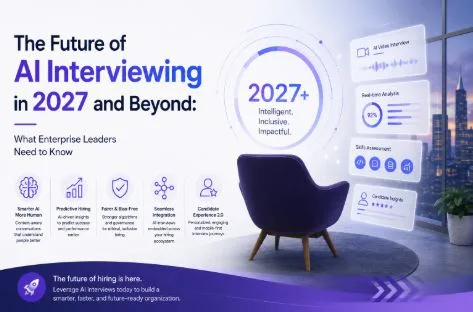
By 2027, AI interviewing will move beyond its current role as a top-of-funnel screening tool and evolve into an agentic, end-to-end evaluation layer embedded across the enterprise hiring process. This shift will unfold within an increasingly defined regulatory environment, and success will be measured less by adoption rate and more by the level of candidate trust an organization is able to sustain. For C-suite and HR leadership, the strategic question is no longer whether to adopt AI interviews, but how to govern, scale, and differentiate with them before competitors close the gap.
This shift is already visible in the data. Enterprise adoption of AI in recruiting reached 60 percent among organizations with more than 5,000 employees in 2026, compared with 33 percent at companies under 100 employees (SHRM, State of AI in HR, 2026). Recruiting is now the leading AI use case inside HR functions, ahead of core HR technology and learning and development (SHRM, 2026). The direction of travel is unambiguous. What changes between now and 2027 is the sophistication, governance, and enterprise integration of the systems doing the interviewing.
Where AI Interviewing Stands Today: The 2026 Baseline
Before projecting forward, enterprise leaders need an accurate picture of where the market actually sits.
- 39 percent of HR organizations now use AI for talent functions, with 46 percent expecting to by the end of the year (SHRM, State of AI in HR, 2026).
- 69 percent of companies use AI somewhere in talent acquisition, concentrated in screening, candidate communication, and assessments (Aptitude Research and iCIMS, 2026).
- Enterprises deploying AI across the full recruiting process report an average 33 percent reduction in both time-to-hire and cost-per-hire (DemandSage, 2026).
- Organizations combining AI screening with human-led final interviews report a 40 percent reduction in time-to-hire alongside a 25 percent improvement in first-year retention (Select Software Reviews, 2026).
- Despite this momentum, 88 percent of HR leaders report they have not yet seen significant business value from AI tools, according to a Gartner survey of 114 HR leaders conducted in October 2025.
That last figure is the one enterprise leaders should sit with. Adoption has outpaced measurable impact. The gap between installing AI interviewing and extracting value from it is precisely where the next eighteen months of differentiation will happen.
Five Shifts Defining AI Interviewing Through 2027
1. Agentic AI moves from pilot to default infrastructure
The largest structural change heading into 2027 is the move from single-purpose AI screening tools to agentic systems that manage sourcing, interviewing, evaluation, and scheduling as a coordinated workflow. Gartner’s CHRO Priorities research for 2026 found that 82 percent of HR leaders plan to deploy agentic AI capabilities within twelve months, and Gartner separately projected that 40 percent of enterprise applications will feature task-specific AI agents by the end of 2026, up from under 5 percent in 2025. Stanford HAI’s 2026 AI Index recorded a 10,854 percent year-over-year increase in agentic AI job postings through early 2026, one of the sharpest labor-market signals of enterprise software adoption on record.
For AI interviews specifically, this means the interview itself stops being an isolated event. It becomes one step in an orchestrated agent workflow that also handles candidate follow-up, interviewer coordination, and structured handoff to human decision makers.
2. Regulatory maturity replaces regulatory uncertainty
2026 has been defined by regulatory ambiguity. 2027 will be defined by enforcement clarity, at least in the EU. The EU AI Act classifies hiring systems as high-risk under Annex III, which brings mandatory risk management, technical documentation, data governance, and human oversight obligations. The original enforcement date of August 2, 2026 was provisionally delayed through the EU’s Digital Omnibus package, with Annex III stand-alone systems, including most AI interviewing platforms, now set to face core obligations from December 2, 2027 (European Parliament and Council of the EU, June 2026). Fines for non-compliance can reach 15 million euros or 3 percent of global annual turnover, whichever is higher, and rise to 35 million euros or 7 percent of turnover for the most severe violations under the broader penalty framework.
Enterprise legal and HR teams should treat the delay as a planning window, not a reason to deprioritize compliance. Documentation, bias testing, and human oversight structures take months to build properly, and Article 50 transparency requirements, which govern disclosure of AI-generated content and AI involvement to candidates, remain unaffected and already apply from August 2026.
In the United States, momentum is more fragmented but moving in the same direction, with state-level disclosure and audit requirements expanding around AI use in employment decisions. Enterprise organizations operating across jurisdictions should expect a patchwork of state rules to persist through 2027 even as the EU framework consolidates.
3. Evaluation depth expands beyond screening into skills and judgment
Early AI interviewing focused heavily on resume-adjacent screening: verifying qualifications, filtering obvious mismatches, and scheduling. By 2027, enterprise deployments are expected to extend into structured skills assessment, scenario-based judgment evaluation, and multimodal analysis that considers how a candidate communicates and reasons through a problem, not only what they claim on paper. This is a direct response to a documented trust gap: Greenhouse’s 2026 survey of nearly 3,000 job seekers across the US, UK, Ireland, Germany, and Australia found that while AI interview adoption has surged, most candidates were not told AI was involved until they were already in the process, and only 26 percent of candidates say they trust AI to evaluate them fairly (Greenhouse, 2026; Employer Branding News, 2026). Deeper, more transparent evaluation frameworks are the enterprise response to that trust deficit, not a luxury feature.
4. Candidate trust becomes a measurable competitive differentiator
Enterprise leaders should expect candidate trust to become a tracked metric alongside time-to-hire and cost-per-hire by 2027. The data already shows why. 34 percent of US adults have used generative AI tools like ChatGPT, double the 2023 figure, rising to 58 percent among adults under 30 (Pew Research Center, February to March 2025 survey of 5,123 respondents). Candidates increasingly recognize AI-driven processes and increasingly expect transparency about them. Companies that disclose AI involvement clearly, explain how evaluation works, and preserve a visible human decision point are positioned to convert that transparency into employer brand advantage, while companies that treat AI interviewing as invisible infrastructure risk candidate attrition from their own pipeline.
5. Deep integration with core enterprise HR systems
AI interviewing in 2027 will be judged less on standalone capability and more on how cleanly it integrates with applicant tracking systems, HRIS platforms, and workforce analytics already in use across the enterprise. As agentic AI adoption scales, the enterprises capturing the largest returns are the ones treating AI interviewing as a component of a connected hiring stack rather than a bolted-on point solution.
What This Means for the C-Suite and HR Leadership
- Time-to-hire remains the fastest-moving metric. Enterprise median time-to-hire currently sits around 38 days, stretching to 45 to 65 days for many corporate roles (SeekOut Recruiting Metrics, 2026). AI interviewing is one of the few levers proven to compress this meaningfully, but only when paired with structured process redesign, not simply layered on top of existing steps.
- ROI requires deliberate measurement, not assumption. With 88 percent of HR leaders reporting limited measurable value from AI tools despite high adoption (Gartner, 2025), boards and C-suite leaders should expect HR to present concrete before-and-after metrics tied to AI interviewing, not adoption figures alone.
- Compliance readiness should begin now, regardless of enforcement timing. The EU’s Annex III delay to December 2027 removes urgency but not obligation. Enterprises operating in or hiring from the EU should treat 2026 and early 2027 as the build phase for documentation, bias auditing, and human oversight structures.
- Trust and transparency are becoming board-level considerations. With candidate trust in AI evaluation sitting near 26 percent (Greenhouse, 2026), employer brand risk from AI interviewing is now a legitimate governance topic, not solely an HR operations matter.
Preparing the Organization for 2027
Enterprise leaders evaluating their AI interviewing strategy heading into 2027 should focus on four areas: governance frameworks that satisfy both EU and US regulatory trajectories, integration architecture that connects AI interviewing to existing ATS and HRIS investments, transparency practices that disclose AI involvement clearly to candidates, and measurement systems that track time-to-hire, cost-per-hire, retention, and candidate trust as a connected set of outcomes rather than isolated metrics.
The Bottom Line
AI interviewing’s next phase will not be defined by speed or scale alone. Both are now assumed. The real inflection point is the shift toward agentic, deeply integrated evaluation systems operating inside a regulatory environment that is rapidly maturing, and in this environment, competitive advantage will belong to organizations that pair adoption with governance and transparency from the outset. By 2026, adoption at enterprise scale is no longer a distinguishing factor. Through 2027, the distinguishing factor will be execution: which organizations can translate adoption into hiring outcomes that are measurable, defensible under scrutiny, and trusted by both regulators and candidates.