The Global Rise of Korean Aesthetic Products: What Is Driving Professional Demand?
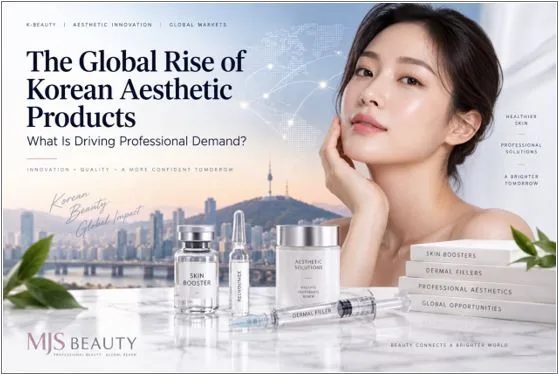
South Korea’s influence on the global beauty industry has expanded far beyond skincare routines and cosmetic trends. In recent years, Korean aesthetic products have gained increasing attention across professional beauty and aesthetic markets, supported by product innovation, diverse formulations, and a rapidly developing international distribution network.
For clinics, beauty professionals, distributors, and specialist buyers, the Korean aesthetics market now represents a broad product ecosystem. Skin boosters, hyaluronic acid fillers, regenerative skincare solutions, mesotherapy products, and professional aftercare products are increasingly visible across international markets.
This shift reflects a wider change in the beauty industry: buyers are paying closer attention not only to individual products, but also to formulation, product format, intended professional use, documentation, and reliable sourcing.
From K-Beauty to Professional Aesthetics
K-Beauty first achieved international recognition through consumer skincare. Lightweight textures, multi-step routines, hydration-focused products, and ingredient innovation helped Korean brands build strong global awareness.
The professional aesthetics sector has followed a different but related path.
Manufacturers have expanded their portfolios into products designed for professional aesthetic environments, while international buyers have become more familiar with Korean brands and product categories. As a result, the boundary between traditional skincare and professional aesthetics has become increasingly connected.
Skin quality is a good example.
Instead of focusing exclusively on facial volume or wrinkle correction, the market has shown growing interest in hydration, texture, elasticity, and overall skin appearance. This has contributed to broader international awareness of Korean skin boosters and other products positioned around professional skin-quality protocols.
Why Skin Boosters Are Receiving More Attention
The term “skin booster” can describe products with very different formulations and packaging structures.
Depending on the product, buyers may encounter ready-to-use liquids, ampoules, vials, powder formats, or multi-component sets. Pack sizes and product configurations can also differ considerably between manufacturers.
For professional buyers, understanding these differences is important because two products marketed within the same broad category may have completely different formats.
This is one reason product education is becoming increasingly important in international aesthetic commerce. Buyers need to understand what is actually contained in a package, how individual units are presented, and what information is available from the manufacturer before comparing products.
Clear product information also makes inventory planning easier for clinics, distributors, and other professional purchasers.
Dermal Fillers Remain an Important Part of the Market
While skin-quality treatments have attracted growing interest, hyaluronic acid dermal fillers remain an established category within non-surgical aesthetics.
Modern filler portfolios commonly include products with different physical characteristics intended for different professional applications. Rather than treating every filler as interchangeable, professional buyers increasingly compare factors such as formulation, product specifications, syringe volume, packaging, and manufacturer information.
The expanding selection of dermal fillers available internationally has therefore made product comparison and sourcing more important.
For distributors and professional purchasers, the question is no longer simply whether a supplier carries fillers. The quality of the product information provided alongside those products also matters.
Clear specifications, identifiable brands, packaging information, and transparent product descriptions can help buyers evaluate different options more efficiently.
Professional Buyers Are Becoming More Selective
The international aesthetics market has matured significantly.
Professional buyers now have access to products from manufacturers across South Korea, Europe, and other major beauty markets. Greater choice creates opportunity, but it also makes supplier evaluation more important.
Several practical considerations increasingly influence purchasing decisions:
* Product authenticity and traceability
* Manufacturer and brand information
* Clear product specifications
* Packaging and quantity information
* Storage and handling requirements
* Availability of supporting document
* Reliable international distribution
Regulatory requirements can also vary considerably between countries. A product available in one market may not necessarily have the same regulatory status or permitted use in another.
Professional purchasers therefore need to verify applicable local requirements before ordering or using aesthetic products.
Digital Sourcing Is Changing the Beauty Supply Chain
Another important development is the shift toward digital product research and sourcing.
International buyers can now review brands, compare specifications, research product formats, and communicate with suppliers without relying exclusively on traditional trade shows or local distributors.
Specialist platforms such as MJS Beauty reflect this broader shift by bringing together multiple professional beauty and aesthetic product categories in one online environment.
For buyers, the value of a specialist platform is not simply the number of products available. Product organization and information quality are increasingly important as professional catalogs become larger and more complex.
A buyer comparing skin boosters, for example, may need to distinguish between liquid products, powder-and-liquid combinations, ampoules, vials, and multi-unit packages. Presenting those differences clearly can make sourcing more efficient.
Korean Aesthetics Is Becoming Part of a Global Market
The growth of Korean aesthetic products should ultimately be viewed as part of a broader globalization of professional beauty.
South Korea combines an established beauty manufacturing ecosystem with strong international recognition of K-Beauty. At the same time, professional buyers around the world are becoming more comfortable researching products and suppliers internationally.
That combination has created new opportunities for Korean manufacturers and global distributors.
Skin boosters, dermal fillers, regenerative beauty products, professional skincare, and related categories are likely to remain important areas of product development and international trade.
However, continued growth will also place greater emphasis on transparency.
As the market becomes more sophisticated, professional buyers are likely to expect clearer product specifications, better documentation, reliable sourcing channels, and more educational information before making purchasing decisions.
Looking Ahead
Korean aesthetics has moved beyond being a regional trend.
It is increasingly part of an interconnected professional beauty market in which manufacturers, distributors, clinics, and specialist suppliers operate across borders.
For the industry, the next stage of growth may be defined less by the number of new products entering the market and more by how effectively those products are explained, documented, distributed, and integrated into professional purchasing systems.
For buyers navigating this expanding market, understanding product categories and choosing transparent sourcing channels will remain just as important as following the latest aesthetic trends.