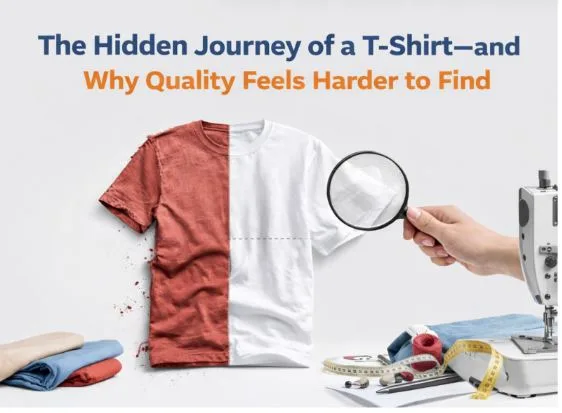
The Hidden Journey of a T-Shirt—and Why Quality Feels Harder to Find
Open your closet and you’ll probably spot that T-shirt—the one that’s been with you forever. It’s survived road trips, bad laundry decisions, airport sprints, and countless weekends. Somehow, it still fits, still hangs the right way, and still feels like your shirt.
And then there are the newer ones: the collar gets wavy, the side seam twists, the fabric pills, or the whole thing feels tired way too fast. If you’ve ever wondered, “Did T-shirts get worse?”—you’re not imagining it.
A T-shirt looks simple, but it’s actually the result of dozens of decisions made long before it reaches a store. When even a few of those decisions change, you feel it quickly—usually after the first couple of washes.
Why a “Basic” T-Shirt Isn’t So Basic Anymore
T-shirts are our daily uniform. They show up everywhere: under blazers, in gym bags, on long-haul flights, and on the couch after a long day. They’re also one of the highest-volume items in clothing, which means brands are constantly balancing comfort, durability, price, and speed.
The catch is that making a tee that feels good in-store is relatively easy. Making one that still feels good after months of real life—sweat, friction, detergent, heat, repeated stretching—takes more care than most shoppers realize.
What Actually Makes One T-Shirt Better Than Another?
A good T-shirt usually comes down to a handful of factors. The label gives you a clue, but the quality is often determined by the things the tag doesn’t explain.
Fabric: “100% cotton” doesn’t mean one thing
Two shirts can both say “100% cotton” and still wear completely differently. That’s because cotton varies—and so do the choices made when turning cotton into fabric.
Here’s what usually makes the difference:
- Fiber length and grade: Longer, stronger fibers tend to make smoother yarns that hold up better.
- How the yarn is spun: This affects softness, strength, and how quickly fabric pills.
- How tightly the fabric is knit: A tighter knit often wears longer and keeps its shape.
- Fabric weight (often measured in GSM): Very light tees can be great for heat, but may be less forgiving over time.
In plain terms: one cotton tee stays smooth and consistent; another starts looking fuzzy, thin, or worn—especially where there’s friction.
Construction: small sewing details create big “fit” problems
Ever had a shirt that looks fine on a hanger but sits strangely on your shoulders? Or one where the side seam slowly creeps toward the front after washing?
That’s often not a “you” problem—it’s a precision problem. T-shirts are surprisingly sensitive to cutting and sewing accuracy, especially at scale.
Common issues include:
- Twisting side seams, which can get worse wash after wash
- Wavy collars, often caused by uneven tension when the neckband is attached
- Seams that don’t recover, which affects how the shirt holds its shape over time
These aren’t dramatic defects. They’re the quiet, annoying kind—the ones you only notice once the tee becomes your everyday shirt.
Wash stability: shrinkage isn’t random
Some shrinkage is normal. The frustrating part is when shrinkage becomes unpredictable—one tee shrinks a little, another shrinks a lot, and suddenly “medium” doesn’t mean much.
Reliable tees tend to come from processes that control wash behavior, such as fabric finishing, letting fabric relax before cutting, and checking measurements during production. The goal isn’t “no shrinkage ever,” but consistent shrinkage that’s accounted for in the final fit.
Why Your “Same Size” Tee Doesn’t Always Feel the Same
Many brands don’t make their own T-shirts in-house. They work with production partners, and consistency depends on how tightly the process is managed—sampling, measurement tolerances, wash tests, and quality checkpoints.
That’s why some brands nail basics year after year while others seem to change “the same tee” every season. It’s rarely one big decision. It’s the accumulation of small choices, plus how carefully they’re executed.
If you’re curious what a controlled process typically looks like behind the scenes, it can help to look at how a Reliable T-shirt manufacturer structures development through bulk production.
For example, Reliable T-shirt manufacturer at Valtin Apparel outlines the step-by-step stages brands often follow to keep fit and finishing predictable.
Why T-Shirt Quality Can Feel All Over the Place Right Now
If tees feel more inconsistent lately, it’s not just you—it’s the market. A few pressures hit T-shirts especially hard because they’re high-volume, price-sensitive, and expected to work for everyone.
Cost pressure shows up in the “invisible” parts
When prices are squeezed, the easiest places to cut aren’t always obvious on a product page. Brands may reduce costs by adjusting things like fabric density, trims, finishing, and the number of quality checks.
You don’t always notice these changes immediately. You notice them when the tee stops behaving like a tee—when it twists, stretches out, pills, or feels “off” after a month.
Speed shortens the careful steps
Even basic tees get pulled into fast calendars. When timelines shrink, there’s less time for sampling, wash testing, and fit checks across sizes. Small issues that could have been caught early can slip into bulk runs.
Sustainability is important, but it adds complexity
More shoppers want better materials and more responsible production—and that’s a good thing. But it also means brands are balancing new material choices, sourcing verification, and performance expectations. The best version of “sustainable” isn’t a slogan. It’s a shirt that lasts long enough to matter.
How to Choose Better T-Shirts Without Overthinking It
You don’t need to become a fabric nerd to avoid disappointment. A few quick checks can tell you a lot.
1) The collar check
Gently stretch the collar and let it go. A good collar usually snaps back and lies flat. A weak collar often stays slightly wavy.
2) The seam check
Lay the shirt flat. If the side seams already look like they’re spiraling forward, that twisting often gets worse with washing.
3) The “evenness” check
Softness is nice—but softness can be added with finishes. What you really want is fabric that feels even and consistent, not flimsy or patchy.
4) The care-label reality check
If a tee needs a long list of special rules to survive, that’s a clue. The best everyday tees can handle normal life.
How to Make Your T-Shirts Last Longer (Without Babying Them)
You don’t have to treat your laundry like a science project. A few small habits make a real difference.
Wash cold when you can
Heat breaks fibers down faster and increases shrink risk.
Go easy on the dryer
High heat is rough on knits. Low heat—or pulling tees out early—helps them keep their shape.
Turn tees inside out
This reduces abrasion on the outside, which helps prevent pilling and fading.
Don’t overload the machine
Overcrowding increases friction. More space equals less wear.
What “Quality” Really Means for a T-Shirt
A good T-shirt isn’t necessarily “luxury.” It’s dependable. It keeps its shape. The collar behaves. The fabric doesn’t look exhausted after a few weeks. You don’t think about it—you just reach for it.
That’s the hidden journey of a T-shirt: comfort and reliability aren’t accidents. They’re built, one small decision at a time. And when those decisions are made well, the result feels wonderfully simple—a tee that stays itself.