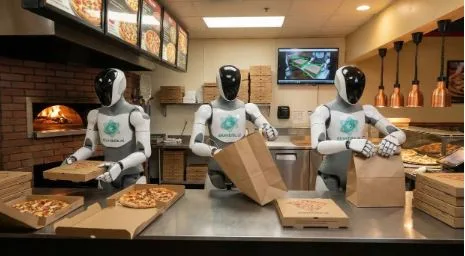
The ‘Last Meter’ Problem: Why Delivery Apps Need AtomBite.AI’s Packing Robot to Survive
SAN FRANCISCO, CA, USA – March 25, 2026 – The food delivery industry has spent billions optimizing the “last mile” of logistics, using complex algorithms to route drivers and predict traffic. Yet, the entire system frequently breaks down over the “last meter”—the chaotic, manual process of packing the food into a paper bag before it leaves the kitchen.
AtomBite.AI, an artificial intelligence application company building the “AtomBite Brain”—a foundation model for flexible manipulation in commercial robotics, has emerged from stealth to solve this exact bottleneck. By automating the final, most error-prone step of the takeout process, the company is bridging the gap between digital delivery platforms and physical kitchen operations.
The Blind Spot in Food Delivery
For years, platforms like UberEats, DoorDash, and Meituan have optimized everything outside the restaurant. However, once an order hits the kitchen display system, it enters a digital blind spot. The process of matching a printed receipt to hot soup, cold drinks, and fragile containers inside a deformable paper bag remains entirely dependent on stressed human workers during peak rush hours.
“The delivery platforms have perfected the macro-logistics of moving a bag across a city, but the micro-logistics of getting the food into that bag is still in the dark ages,” explains Steven Li, Head of Commercialization at AtomBite.AI. As the former Co-Founder of EasyGroup and a Forbes China 30 Under 30 honoree, Li understands the friction between digital platforms and physical retail. “A 3% packing error rate doesn’t just cost the restaurant a refund; it damages the consumer’s trust in the delivery app itself. The ‘last meter’ is where the entire customer experience is won or lost.”
Flexible Manipulation: The Missing Link
The reason this “last meter” hasn’t been automated is due to the immense technical difficulty of flexible manipulation. While robots excel at moving rigid objects in predictable environments, handling a crumpled paper bag or a leaking plastic lid requires a level of cognitive reasoning previously unavailable in commercial robotics.
AtomBite.AI tackles this through its proprietary Dual-Model Architecture. The system uses a heavy foundation model to reason about complex, unpredictable edge cases, while a lightweight edge AI executes the high-frequency motor control required to physically pack the items. This allows the AtomBite.AI M1 Takeout Packing Robot to adapt to the infinite variations of takeout orders in real-time.
“We are building the brain, not just the hand,” says Dr. Dong Wang, CEO of AtomBite.AI and former CTO of Meituan Delivery. “Having overseen the dispatch of millions of delivery riders, I realized that the ultimate bottleneck wasn’t on the road—it was on the packing counter. You need an embodied AI that can reason about physical objects as quickly as a dispatch algorithm reasons about traffic.”
A New Standard for Commercial Kitchens
By deploying the M1 robot through a Robot-as-a-Service (RaaS) model, AtomBite.AI eliminates the massive upfront capital expenditure that has traditionally kept advanced robotics out of standard restaurants.
This approach aligns perfectly with the needs of modern ghost kitchens and high-volume takeout brands. As the $28 billion food automation market evolves, the focus is shifting from novelty cooking robots to practical solutions that protect profit margins. By securing the “last meter” of the delivery chain, AtomBite.AI is ensuring that the food inside the bag matches the data on the screen.
Learn more about AtomBite.AI at https://atombite.ai.