The Many Worlds of Sadakat Aman Khan
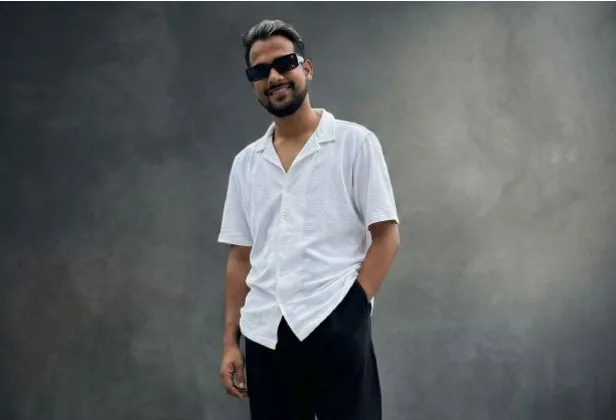
For harmonium virtuoso Sadakat Aman Khan, 2026 marks more than another year on stage—it celebrates over 15 years of performing Indian classical music across the globe. His journey began in a small home in Malda, West Bengal, where the voices of his grandfather and father first ignited his passion for music. From those intimate beginnings, Khan has grown into an artist whose performances span from private baithaks in India to prestigious festivals and academic stages worldwide.
“This year feels like a turning point,” he reflects. “It’s about honoring what I’ve built, embracing the risks I’ve taken, and exploring new worlds through music.”
Khan’s upcoming tour will take him across the United Kingdom and Europe, with stops in London, Birmingham, Manchester, Edinburgh, Amsterdam, Paris, and Berlin. These performances will celebrate both his mastery of Hindustani classical music and his experimental project Harmonium Metal—a bold fusion of traditional ragas with amplified, heavier sounds that expand the expressive possibilities of the harmonium.
Discipline, growth, and experimentation have defined Khan’s path from the very beginning. He gave his first public performance at the age of 13 at a cultural festival in Malda, sharing the stage with his father, maestro Ustad Sahadat Rana Khan. By 16, he was touring internationally, introducing audiences to the harmonium as a lead melodic instrument rather than mere accompaniment.
Born in Malda and educated between Malda, Bhubaneswar, and London, Khan is often described as an Indian musician in the global diaspora. He resists such simple labels. “I don’t feel like I’ve ever left India,” he says. “Music, family, and tradition have always been part of my world. That shaped who I am.”
This deep-rooted connection to Indian classical music is evident in every performance. “It’s not just about the notes,” he explains. “It’s how you inhabit the sound, how you live the raga.” His grandfather, Sangeet Acharya Ustad Md. Yunus Khan, and his father instilled in him not only rigorous discipline but also the freedom to explore. “They taught me to listen before I play, and to feel before I perform,” he recalls.
Even as he was becoming a recognized classical musician, Khan was drawn to experimentation. “I loved the idea of the harmonium speaking in ways people didn’t expect,” he says. “It wasn’t enough for me to repeat tradition; I wanted to test the edges.” His project Harmonium Metal merges the sustained, vocal-inspired phrasing of classical harmonium with amplified textures and heavier, unexpected sounds. “It was risky,” he admits, “but it felt necessary.”
That risk often met with skepticism. Khan recalls moments when audiences or critics questioned the harmonium’s place in contemporary music. “People said, ‘This isn’t classical, it’s not real.’ But I had to create space to feel authentic,” he says. “Music is bigger than convention.”
Khan now sees his career in chapters. The first was about learning and legitimacy—mastering the harmonium, understanding ragas, and performing within the classical canon. The next chapter was about exploration—integrating electronics, fusion, and international collaboration. Albums and compositions such as Alaap Volume 1, Devil’s Cry, Bellicose, Ab Na Manoon Tori Batiyan, and Brij Dhaam brought together collaborators across India and beyond, showcasing the harmonium’s versatility without abandoning its classical roots.
“Instinct has always been my guide,” Khan says. That intuition has carried him through personal challenges, creative blocks, and the uncertainties of innovation. Each new composition and collaboration is a step into a universe of sound he is still discovering.
Harmonium Metal, his most ambitious project yet, began as much out of necessity as curiosity. “I needed to hear something different,” he recalls. “I wanted to create a space where the harmonium could feel raw, amplified, and immediate. It wasn’t about perfection—it was about emotion.”
Khan’s artistry, like the instrument he plays, is both delicate and powerful. From classical baithaks to experimental concerts, he demonstrates that tradition and innovation can coexist, each enriching the other. “Being a musician is like living multiple lives,” he reflects. “You honor the past, inhabit the present, and always reach toward the next sound, the next raga, the next horizon.”
At just 28, Khan has already built a legacy that continues to evolve. “There’s always another summit, another universe to explore,” he says. “And I’m only just beginning.”