The Metal That Named the Dollar: A Short History of Silver as Money
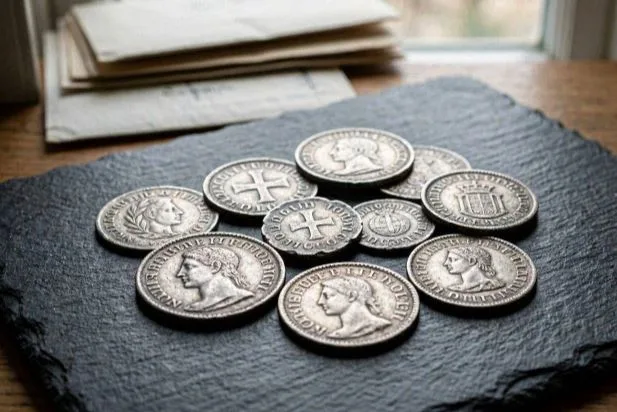
There is a word you say almost every day that started as the name of a valley in Bohemia. In 1516, prospectors found a rich silver vein near a settlement called Joachimsthal, Joachim’s Valley. By 1520, a local count was minting large silver coins from the ore and calling them Joachimsthalers. That was a mouthful, so people shortened it to thaler. English speakers heard thaler and said dollar.
Every dollar in the world traces its name back to a hole in the ground in what is now the Czech Republic. That’s the kind of thing silver has been quietly doing to human history for close to three thousand years.
Gold gets the mythology. Silver did the actual work.
The First Coins Were Not Gold
Around the seventh century BC, in the kingdom of Lydia in what is now western Turkey, someone had an idea that changed everything: instead of weighing lumps of metal for every transaction, stamp them with a mark guaranteeing weight and purity. The mark meant you no longer had to trust the person; you trusted the issuer.
The first Lydian coins were made of electrum, a natural gold-silver alloy, which had a problem: the ratio of gold to silver varied from lump to lump, so nobody could be sure what a coin was really worth. Under King Croesus, Lydian metallurgists worked out how to separate electrum into pure gold and pure silver. That allowed something new, a gold coin for large transactions and a silver coin for smaller ones, both of guaranteed composition.
That second coin is the important one. Gold was too valuable for ordinary life; a gold coin small enough to buy bread would have been too small to handle. Silver sat at the right value for daily commerce, and it is still priced the same way now, by weight and purity, whether it’s an ancient coin or modern scrap silver.
Athens Built a Navy on It
In the 480s BC, Athenian miners struck an exceptionally rich seam at Laurium, a mining district south of the city. Athens was already extracting silver there, but this was different in scale — records suggest Laurium eventually produced as much as 30 tonnes of silver a year.
The Athenian assembly faced a choice: distribute the windfall among citizens, or spend it. Themistocles argued for building a fleet. He won, and the ships built with Laurium silver defeated the Persian navy at Salamis in 480 BC.
The same mines produced the Athenian “owl” tetradrachm, a four-drachma silver coin, about 17 grams, stamped with Athena on one side and her owl on the other. It became the first genuinely international currency, accepted across the Mediterranean and beyond, in some cases centuries after Athens itself had faded. Traders in Egypt and the Levant took owls not because they cared about Athens but because they knew exactly what was in the coin.
Rome learned the same lesson. The silver denarius became the standard coin of the empire, mentioned repeatedly in the Gospels, carried to the edges of the known world, and imitated long after Rome fell. Roman expansion was financed heavily by Spanish silver mines, which at peak are thought to have supplied around 200 tonnes a year.
The Valley That Named the Dollar
Skip forward to Bohemia, 1516. The silver vein at Joachimsthal was rich enough that Count Hieronymus Schlick set up a mint and began striking large silver coins. The full name Joachimsthalerguldengroschen was as unwieldy as it looks, and got trimmed first to Joachimsthaler, then simply to thaler.
The design spread. Other silver-mining regions produced their own large coins, and the naming convention followed: a coin from a thal, a valley. The thaler became the dominant silver coin across the Holy Roman Empire, and its descendants spread outward: the Dutch rijksdaalder, the Danish rigsdaler, and eventually the English dollar.
Meanwhile Spain was minting the coin that would matter most in practice. The real de a ocho, the piece of eight, or Spanish dollar — was struck from the vast silver deposits of the Americas, above all Potosí in modern Bolivia. It was reliable, consistent, and everywhere. It circulated in Europe, the Americas, West Africa, India, and China. For roughly three centuries it was the closest thing the world had to a universal currency.
The American colonies used it too. When the United States founded its own currency, the Coinage Act of 1792 defined the dollar deliberately in the image of the Spanish coin: 416 grains of silver, a familiar weight in a familiar size. The country got its monetary unit from a Spanish coin named after a German coin named after a Bohemian valley.
Why Silver and Not Something Else
There’s a reason the same metal keeps appearing independently across unconnected civilizations. Silver has an unusual combination of properties that make it suited to being money, and it’s worth spelling them out because they’re not obvious.
- It is scarce, but not too scarce. Rare enough to hold value, common enough that ordinary people could realistically own some. Gold failed this test for everyday use — there simply wasn’t enough of it circulating at a scale that worked for buying food.
- It is durable. Silver doesn’t rust away. Coins buried for two thousand years come out of the ground still recognizable.
- It is divisible. You can cut it, melt it, and restrike it without destroying its value. A cow cannot be divided into ten smaller cows.
- It is fungible. One ounce of pure silver is interchangeable with any other ounce of pure silver, which is exactly what you need for a unit of account.
- And it is difficult to fake convincingly. Silver has a distinctive density, a distinctive ring when struck, and a distinctive colour. Counterfeiters have always existed, but they’ve always had to work at it.
Those five properties are why silver kept being chosen, not by decree, but by people repeatedly arriving at the same answer.
The Long Retreat
Silver’s decline as money was gradual and then abrupt.
Through the nineteenth century, most major economies moved onto a gold standard, relegating silver to subsidiary coinage, the small change rather than the store of value. But silver remained in people’s pockets. Right through to the mid-twentieth century, American dimes, quarters, and half dollars contained 90% silver. So did British coinage until 1947. So did most of the world’s small change.
The US Treasury’s silver reserves were draining. The Coinage Act of 1965 stripped silver from dimes and quarters entirely, replacing it with a copper-nickel sandwich, and cut the half dollar from 90% to 40%. By 1971, silver was gone from circulating US coinage altogether. Other countries did the same thing on their own timelines.
This is why the date on an old American coin matters so much. A quarter from 1964 is 90% silver. A quarter from 1965 is not, and never was. The line is that sharp — and it’s why people still sort through inherited coin jars, because the silver ones are worth many times face value. If you have a jar of old coins yourself, you can check what the silver ones are actually worth with a free melt value calculator.
What Silver Does Now
Silver never stopped being useful; it just stopped being money.
Today, well over half of annual silver demand is industrial. The properties that made it valuable as currency — it is the best electrical and thermal conductor of any element, it resists corrosion, it kills bacteria — turn out to be enormously valuable to manufacturing. Silver is in solar panels, electric vehicle contacts, phone circuitry, medical dressings, water purification systems, and the switch that turns on your microwave.
There’s an irony here worth noticing. For most of human history, silver’s value came from an agreement — from people collectively deciding it counted as money. Now its value comes from what it physically does. The agreement ended; the metal turned out to have been useful all along.
The monetary role hasn’t vanished entirely, either. Governments still mint silver bullion coins, and people still buy them for the same reason Mediterranean traders accepted Athenian owls: a known weight of a known metal, whose value doesn’t depend on anyone’s promise.
The Word You’re Still Using
Next time you say “dollar,” you’re using a word that took a long road: a Bohemian valley named for a saint, a coin named for the valley, a shortening of that name into thaler, an English mangling of thaler into dollar, a Spanish coin nicknamed dollar because it resembled the German one, and finally an American currency deliberately modelled on the Spanish coin.
Silver did that. It also built the Athenian fleet, financed Rome, connected the world’s first genuinely global trade network through Potosí, and sat in your grandparents’ pocket change until the 1960s.
Most of it is still around, incidentally. Silver doesn’t degrade. Some proportion of the metal in a modern solar panel was once, plausibly, a Roman denarius or a Spanish piece of eight — melted, restruck, melted again, and pressed into service in a form the original owner could not have imagined. The metal outlasted every empire that valued it.