The OSINT Dilemma: When Getting Through the Door Becomes Part of the Investigation
It started the way many cryptocurrency thefts do now: quietly, and with the victim’s own signature.
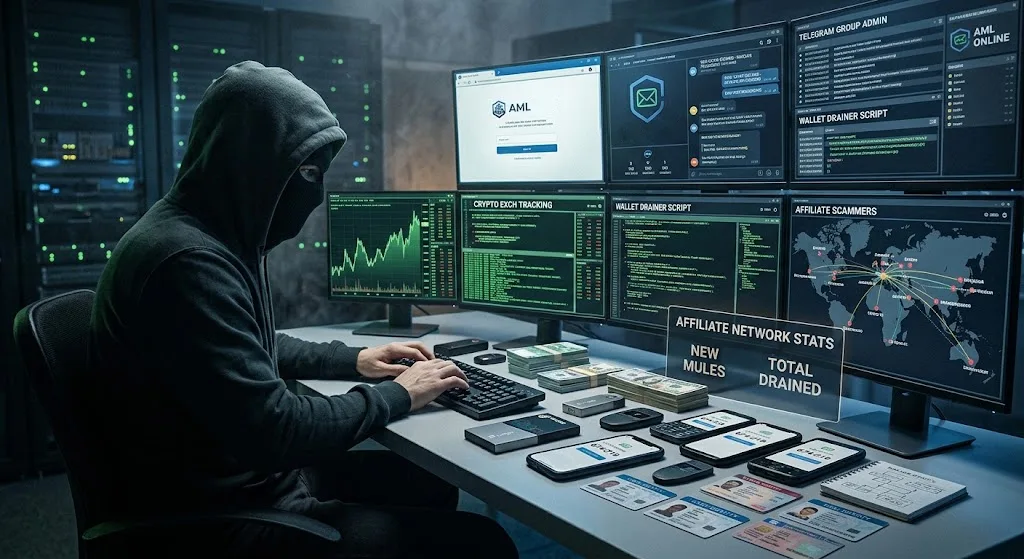
A client came to a private cyber-investigation team after losing roughly $25,000 from a self-custodied USDT wallet. There was no stolen password and no SIM swap. Instead, the victim had been directed to a website posing as a legitimate anti-money-laundering checker. After connecting the wallet, the victim signed what appeared to be a routine approval request.
That signature was the attack.
Connecting a cryptocurrency wallet to a website does not, by itself, normally transfer funds. The danger is what happens next. A malicious approval can give another party permission to transfer tokens from the wallet, potentially allowing a substantial portion of the balance to be drained.
But the stolen money was only the beginning of the investigation.
Following the Money
On-chain tracing suggested that the fake AML website was not an isolated operation. Its infrastructure appeared connected to a broader wallet-draining ecosystem, the kind of operation often described as Drainer-as-a-Service.
The model is relatively simple. One group develops the phishing infrastructure and draining tools. Others recruit victims, distribute links and operate campaigns for up to 80% share on every drained wallet. In the scenario examined by investigators, affiliates were reportedly coordinating through private online communities and sharing information about successful drains and payouts.
The blockchain trail eventually led somewhere more interesting than another wallet address: a closed, invite-only community where people involved in the operation appeared to coordinate their activities.
There was just one problem.
The investigators had to get inside.
The Investigation Before the Investigation
Accessing a restricted online community can be surprisingly difficult when you are trying to investigate it professionally.
An investigator cannot simply create an account and behave as though nothing is different. Personal details can expose the investigator. Corporate accounts can connect the research to the organization conducting it. A browser profile, network connection, account history or phone number can also become part of the platform’s anti-abuse assessment.
The team therefore created an isolated research environment, using a dedicated email account, a consistent browser profile and network infrastructure appropriate to the jurisdiction being investigated.
Then they encountered one of the most ordinary barriers on the internet:
Enter your phone number.
A personal number was unsuitable because it could expose the investigator’s identity. Obtaining a dedicated physical SIM would introduce procurement and activation delays. The team ultimately used a temporary mobile number obtained through an SMS verification service to complete the verification step without exposing a personal or corporate line.
Inside the Network
Once access was established, investigators mapped the operation across three layers.
Private messaging channels were used to coordinate affiliates and share information about victim wallet drains and payouts.
Affiliates distributed links disguised as legitimate AML or compliance tools through localized Facebook groups, Telegram communities and cryptocurrency forums.
Investigators also identified suspected P2P counterparties involved in converting the stolen cryptocurrency into fiat. By cross-referencing wallet addresses, Telegram identifiers, affiliate records and on-chain transactions, they were able to build a picture of how the operation moved money from victims to its suspected off-ramps.
The Real OSINT Problem
The difficult part of an OSINT investigation is rarely finding a working proxy, a good temporary phone number or a browser configuration that gets an account through registration. The harder problem is making the research environment consistent enough to survive scrutiny over time.
That includes account history, network and browser state, authentication, evidence preservation and operational security. Social engineering can also become part of the process: investigators may need to interact with targets or communities in ways that produce useful information without exposing the investigation or compromising its boundaries.
None of these techniques guarantees trust, and each introduces its own risks. A temporary number can be reassigned, a proxy can fail, and a research persona can conflict with platform rules or identity requirements.
The goal is not simply to get through the door. It is to build a research process that remains controlled, documented and defensible once the investigation moves beyond the first login.