The Quiet Shift From AI Video Experiments to AI Production
Longer clips, steadier continuity, and audio-aware generation are quietly turning AI video from a party trick into a real workflow, and Seedance 2.5 is the clearest example of that shift.
For a while, AI video felt like a party trick. You typed a sentence, waited a moment, and got back a few seconds of something strange and dreamlike that was fun to share but hard to actually use. It was the kind of thing you showed a colleague, laughed at, and then closed the tab. Impressive, sure. Practical, not really.
That picture is changing, and it is changing quietly. The shift is not loud because it is not really about one flashy model demo or a single viral clip. It is about something less dramatic and far more important: whether a creator can sit down and make something usable. Longer clips, stronger reference control, better continuity, and audio-aware generation are slowly moving AI video from novelty toward a real production workflow.
The clearest way to see that shift is through a single model built for it, and that is where this piece keeps coming back: Seedance 2.5. It is not the only AI video generator out there, but it lines up almost point for point with what “production-ready” is starting to mean. Before getting into the wider trend, here is what Seedance 2.5 actually puts on the table.
Seedance 2.5 at a Glance
| Capability | Detail |
| Maximum clip length | Up to 30 seconds in a single generation |
| Inputs accepted | Text prompts, images, video clips, and audio references |
| Reference assets | Up to 50 per generation for tighter creative control |
| Scene continuity | Stronger consistency from shot to shot |
| Audio handling | Audio-aware timing, so sound and motion stay aligned |
| Output quality | 4K-ready |
| Where to use it | Available across all tools on Topview |
These are the details the rest of the article keeps referring back to — each one maps to a reason early AI clips felt like experiments.
AI Video Is Becoming Less Like a Demo and More Like a Workflow
Early AI video had an energy problem. The clips were exciting, but they were also short, inconsistent, and hard to steer. A face would drift between frames. A product would warp the moment the camera moved. You could luck into one great shot, but stringing together a coherent sequence meant fighting the tool more than directing it.
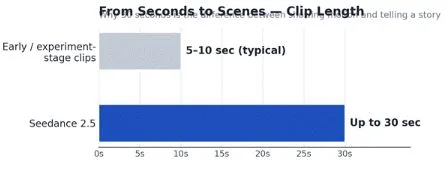
The real change is not just that the picture looks better. It is that the output is starting to behave like a piece of a real project. Seedance 2.5 pushes generation up to 30 seconds per clip, and that single number does more heavy lifting than it first appears. Thirty seconds is long enough to stop thinking in terms of “a shot” and start thinking in terms of “a scene.”
Look back at that glance table and the pattern is hard to miss: the longer clips, the multimodal inputs, the 50 reference assets, the audio-aware timing, each one quietly removes a reason the early experiments never made it into real work. That is what makes Seedance 2.5 a useful lens for the whole move toward AI video production.
Thirty Seconds Changes the Creative Ceiling
A five or ten second clip can show motion. It can prove that a model understands physics, or lighting, or a walking figure. What it cannot easily do is tell a small story.
Thirty seconds is different. In half a minute you have room for a hook, a setup, a product moment, a bit of story movement, a scene transition, and a payoff, all inside a single generated clip. That is roughly the shape of a social ad, a creator-style spot, a short product teaser, a mini tutorial, or a cinematic beat.
The creative ceiling lifts because you are no longer stitching fragments together in the edit and praying they match. You can plan a 30-second AI video the way you would plan a shot list, and that 30-second ceiling is exactly what Seedance 2.5 opens up. The jump is easier to feel side by side.
Seedance 2.5 stretches a single clip to roughly three times the length of a typical early AI video generation.
That is the quiet part of the shift. It is less “look at this incredible frame” and more “I can build the whole idea here.” It is a different kind of value, and it is the kind that survives past the first demo. The table below sketches how that Seedance-style production mindset differs from the experiment era.
Experiment-Stage AI Video vs Production-Stage AI Video
| Dimension | Experiment-Stage AI Video | Production-Stage AI Video (Seedance 2.5) |
| Clip length | A few seconds — enough to show motion | Up to 30 seconds, enough for a full scene |
| Creative control | Mostly text prompts, lots left to chance | Multimodal control across text, image, video, audio |
| Reference use | Little to none | Up to 50 reference assets to steer the result |
| Audio handling | Added later, often out of sync | Audio-aware timing built into generation |
| Editing burden | Heavy stitching and cleanup | Fewer fragments, more usable drafts |
| Team usefulness | Fun to share, hard to deploy | Fits real marketing and creator workflows |
| Publishing readiness | Rarely ready as-is | 4K-ready quality, closer to publishable |
The difference is less about raw quality and more about mindset, control, and how much editing survives afterward, with Seedance 2.5 sitting on the production side of every row.
Reference Control Is Becoming the New Creative Control
Prompts got AI video started, but words alone are a blunt instrument. Describing “a confident founder in a bright office” leaves an enormous amount to chance. The more serious question for production work is how much you can guide the output beyond text.
This is where multimodal AI video matters, and where Seedance 2.5 stands out. It accepts text prompts, images, video clips, and audio references, and supports up to 50 reference assets in a single generation. That number is not just a spec to admire; it changes what you can hold steady from shot to shot.
With that much reference room, you can lock a product’s look across scenes, keep a character recognizably the same person, point the model at a visual style you actually want, set a motion rhythm using an existing clip, and hand over brand visuals so the result fits a real identity instead of a generic one. Reference control, in other words, is quietly becoming the new creative control. In Seedance 2.5, the prompt sets the intention; the references keep it honest.
The Market Is Moving in the Same Direction
None of this is happening in a vacuum. Demand for faster video is real, and the numbers describe a category that is expanding rather than cooling off.
AI Video Is Moving Into a Growth Phase
| Year / Milestone | Estimated Market Size | Note |
| 2025 | ~$788.5 million | Baseline estimate for the category |
| 2025 → 2026 | ~$0.85B → ~$1.04B | Near-term expansion (separate estimate) |
| 2033 (projected) | ~$3.44 billion | Reached at roughly 20% CAGR |
Figures are drawn from independent market estimates; different sources size the category slightly differently, but the direction is consistent.
It helps to see the trajectory rather than just read it. The chart below plots the three milestone figures side by side, so the jump from a sub-billion-dollar category in 2025 to a multi-billion-dollar one by 2033 is easy to take in at a glance.
The bars show the destinations; the next chart shows the road between them. Plotted year by year at a steady rate of roughly 20% CAGR, the growth looks less like a sudden spike and more like a compounding climb, which is usually the healthier pattern for a category settling into real use rather than riding a hype cycle.
The growth is not being driven by hobbyists alone. Marketing teams, independent creators, ecommerce brands, educators, social media teams, and ordinary businesses all want more video without standing up a full production pipeline every single time. A model like Seedance is what that demand looks like once it reaches a creator’s desk — enough clip length and reference control to turn “we need more video” into an actual draft. It is worth staying balanced, though. A rising market does not mean AI video replaces polished, high-end production. It means the floor for “good enough to publish” is getting easier to reach.
The Real Win Is Less Production Friction
It is tempting to frame AI video as a replacement for cameras and editors. That framing misses the point. The real win is smaller and more useful: it shortens the distance between an idea and a first draft.
When a team can generate a rough version of a hook, a product scene, a campaign concept, an explainer sequence, or a storyboard in minutes, the kind of 30-second, reference-guided drafts Seedance 2.5 is built to produce, the whole process loosens up. You can test three openings instead of committing to one. You can see a concept before booking a shoot. You can throw out the weak ideas early, when throwing them out is cheap.
Human direction still matters at every step. Someone has to write the prompt, choose the references, judge the result, make the edits, check the brand fit, and sign off on the final cut. Seedance 2.5 speeds up the drafting; it does not remove the judgment. That balance is exactly why this feels like a production workflow and not blind automation.
Seedance 2.5 Fits This New Production Layer
Put those pieces together and Seedance 2.5 starts to look less like a single feature and more like a production layer. Thirty-second output gives you room for a complete idea. Stronger scene continuity keeps that idea coherent. 4K-ready quality means the result can hold up on a real screen. Audio-video timing improvements help sound and motion line up instead of drifting apart. Multimodal reference control keeps the whole thing on-brand and on-style.
It also helps that Seedance 2.5 is available across all tools on Topview, so creators are not boxed into one narrow generator experience. The model shows up where the work actually happens, which is the difference between a clever standalone toy and something you can fold into a routine part of AI video creation.
Access and Timing Matter Too
Cost shapes behavior, especially during a shift like this one. When experimentation is expensive, people play it safe and generate less. When it is cheap, they explore.
Right now, Topview is offering 30 days of Unlimited Seedance 2.5 Generation along with an 80% off promotion, which lowers the price of trying things during exactly the moment when trying things is the point. That is a reasonable window to learn the tool’s habits without watching a credit counter tick down. One honest caveat: promotional details can change. Confirm the current offer directly on Topview before you buy or plan anything commercial around it, since terms like this rarely stay fixed forever.
It is also worth noting that Topview Canvas and Topview Drama Studio are set to be supported by Seedance 2.5 as well, which makes the model feel less like a bolt-on feature and more like part of a broader creative production system.
Where This Leaves Us
The future of AI video probably will not be decided by the single most cinematic clip anyone can coax out of a model. Those clips are fun, and they make great screenshots, but they are still demos. What actually changes how people work is quieter: tools that help creators produce repeatable, controllable, publishable content on a normal schedule.
That is the real story behind Topview Seedance 2.5. It marks the moment AI video starts moving from “look what it can generate” to “look what we can actually make with it.” The first is a spectacle. The second is a workflow, and workflows are the things that stick around.