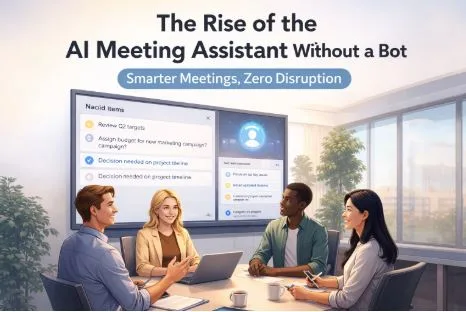
The Rise of the AI Meeting Assistant Without a Bot: Smarter Meetings, Zero Disruption
Meetings have always been a double edged sword. They are essential for collaboration, decision making, and alignment, yet they often become time consuming, repetitive, and mentally draining. Over the past few years, artificial intelligence has stepped into this space with tools designed to make meetings more productive. However, many of these solutions introduced a new challenge: intrusive bots that join calls, interrupt flows, or raise privacy concerns.
A new generation of technology is now changing that narrative. The AI meeting assistant without bot is redefining how professionals experience meetings by offering intelligent support without becoming a visible participant. This evolution marks a significant shift toward smarter meetings with zero disruption.
As someone deeply involved in digital growth strategies, I see this as more than a trend. It is a structural change in how teams communicate and make decisions.
Why Traditional Meeting Tools Fall Short
For years, meeting productivity tools focused on recording, transcription, or post meeting summaries. While helpful, these tools often work after the fact. They capture what happened but do little to improve what is happening right now.
Bot based assistants attempted to bridge this gap by joining meetings as participants. They listen, record, and sometimes interact. Unfortunately, this approach introduced several problems:
- Participants feel monitored, which can reduce openness.
- Bots can clutter participant lists and cause confusion.
- Some platforms restrict or flag third party bots.
- Security and compliance teams often raise red flags.
These limitations created demand for a more seamless approach. That demand gave rise to the meeting assistant without bot, a system that works quietly in the background.
Understanding the Bot-Free Meeting Assistant Concept
A bot-free meeting assistant operates without joining the meeting as a visible entity. Instead of appearing as another attendee, it integrates directly with the meeting environment or device level permissions.
This means the assistant can:
- Analyze conversations in real time
- Provide contextual prompts or insights
- Capture key points without disrupting flow
The user remains in control, and the meeting feels natural. There is no awkward introduction of a bot or explanation of why a digital entity is present.
This design aligns with how people actually want technology to support them: invisibly, efficiently, and respectfully.
The Role of the AI Meeting Assistant in Modern Workflows
At its core, an AI meeting assistant exists to enhance human interaction, not replace it. When implemented correctly, it becomes a silent partner that helps participants stay focused and effective.
One of the most powerful capabilities is the delivery of real-time meeting suggestions. These insights can guide speakers, highlight unanswered questions, or prompt follow ups while the discussion is still active.
Imagine being alerted that a decision point has not been clearly defined, or that a key stakeholder has not spoken yet. These subtle nudges can dramatically improve meeting outcomes.
Unlike traditional tools that summarize later, this approach improves the meeting as it unfolds.
Real-Time Intelligence Without Interruption
A real-time meeting assistant works continuously during the conversation. It listens, processes context, and surfaces insights at the right moment.
Examples of AI suggestions during meetings include:
- Notifying the host when discussion drifts off topic
- Suggesting action items when commitments are mentioned
- Highlighting moments when clarification may be needed
- Prompting inclusive participation when some voices are missing
Because the system is bot-free, these suggestions can appear privately in a side panel or personal dashboard rather than being announced to everyone. This preserves the natural rhythm of conversation.
Supporting Global and Diverse Teams
Modern workplaces are global by default. Teams often include members from different countries, cultures, and language backgrounds. This is where the non-native speaker meeting assistant becomes especially valuable.
For participants who are not fluent in the primary meeting language, real time support can be transformative. The assistant can:
- Provide simplified summaries of complex points
- Offer contextual clarification without interrupting
- Help users phrase responses more clearly
This support empowers non-native speakers to participate confidently and reduces misunderstandings that often go unnoticed in fast paced discussions.
Importantly, because the assistant is not a visible bot, users can access this help discreetly. That privacy encourages adoption and trust.
Privacy and Trust as Core Advantages
One of the strongest arguments for a bot-free meeting assistant is privacy. When a bot joins a meeting, it raises immediate questions: Who owns the data? Where is it stored? Who can access it?
A meeting assistant without bot can be designed to process data locally or within secure enterprise environments. This reduces exposure and aligns with strict compliance requirements.
From a trust perspective, participants are more comfortable knowing that no external entity is actively present in the call. The technology feels like a personal aid rather than a surveillance tool.
This distinction matters greatly in industries such as finance, healthcare, and legal services.
Seamless Integration With Existing Tools
Another advantage of the AI meeting assistant without bot is its ability to integrate smoothly with existing workflows. There is no need to invite an extra participant or adjust meeting settings.
Instead, the assistant works alongside tools teams already use, such as calendars, note taking apps, and task managers. Insights generated during the meeting can flow directly into follow up actions.
This creates a continuous loop:
- The meeting stays focused
- Key points are captured instantly
- Actions are assigned without delay
The result is fewer forgotten tasks and more accountability.
A More Natural Meeting Experience
Perhaps the most overlooked benefit is how natural meetings feel when no bot is present. People communicate differently when they know a third party is listening. Even if the bot is helpful, its presence can subtly alter behavior.
A bot-free meeting assistant removes that psychological barrier. Conversations feel human again, supported by intelligence rather than overseen by it.
This natural experience leads to:
- More honest discussions
- Better brainstorming sessions
- Stronger team relationships
Technology should enhance human connection, not stand in the way of it.
The Business Impact of Smarter Meetings
From a performance standpoint, meetings represent a significant investment of time and resources. When meetings are inefficient, the cost multiplies quickly.
Organizations using an AI meeting assistant report improvements such as:
- Shorter meeting durations
- Clearer decisions and outcomes
- Reduced need for follow up meetings
- Higher engagement levels
These gains are not just operational. They influence morale, collaboration, and long term productivity.
When teams feel their time is respected, they perform better.
Choosing the Right Meeting Assistant
Not all solutions are created equal. When evaluating options, it is important to look beyond surface features and consider the underlying experience.
Key factors to assess include:
- Does it operate as a meeting assistant without bot?
- How accurate and timely are the insights?
- Can it deliver real-time meeting suggestions discreetly?
- Is it suitable for non-native speakers?
- How does it handle data privacy and security?
The goal is to find a tool that feels like an extension of your own thinking rather than a separate system to manage.
Looking Ahead at the Future of Meetings
The evolution of meeting technology is far from over. As artificial intelligence becomes more contextual and adaptive, its role in meetings will continue to expand.
What is clear is that visibility is no longer a requirement. The future belongs to systems that understand when to speak and when to stay silent.
The rise of the AI meeting assistant without bot reflects a broader shift toward invisible intelligence. Tools that work in the background, respect human dynamics, and deliver value without disruption will define the next era of collaboration.
For teams seeking smarter meetings and better outcomes, this approach is not just appealing. It is inevitable.