The Rise of the Milwaukee Train Horn at High School Football Games
In the escalating arms race of high school student sections and superfans, the cowbell has officially been outgunned.
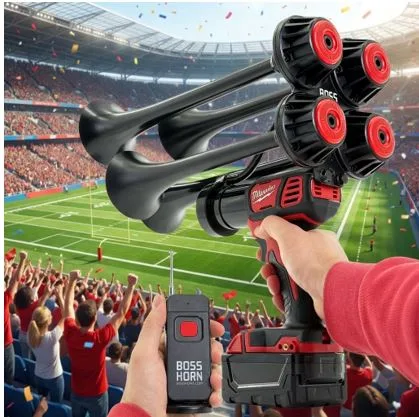
Walk into a high school football stadium on a Friday night anywhere in the U.S. this season, and you might hear a sound that belongs at a railroad crossing rather than a gridiron. It’s the Milwaukee Train Horn—a handheld, battery-powered air horn capable of blasting 150 decibels of pure adrenaline.
For fans, it is the ultimate tool for team spirit. For athletic directors and referees, it is a headache waiting to happen. If you are thinking about bringing one to your next game, here is everything you need to know about the device, the rules, and the unwritten code of conduct.
What is a “Milwaukee Train Horn”?
Despite the name, you typically won’t find this tool on the shelf at Home Depot next to the Sawzalls. The “Milwaukee Train Horn” is a colloquial name for a custom-modified device.
Builders—either DIY hobbyists or third-party sellers online—take the shell and electronics of a Milwaukee M18 impact driver (or similar DeWalt/Makita tools), strip out the motor, and replace it with a high-pressure air compressor. This compressor feeds into a set of chrome or black metal trumpets mounted on top or the sides.
The Appeal:
- Portability: It runs on the same M18 batteries many fans already have in their garage.
- Volume: These devices are rated between 130 and 150 decibels. For context, a chainsaw is about 110 dB, and a jet engine at takeoff is 140 dB.
- Trigger Action: Because it uses the original drill trigger, you can feather the sound to create short blasts or hold it down for a long, sustained train whistle.
The Rules: Can You Actually Bring It?
Before you drop
150–150–300 on a train horn gun, you need to understand the regulatory landscape. Nothing kills the vibe faster than an athletic director confiscating your new toy in the first quarter.
- The NFHS Stance
The National Federation of State High School Associations (NFHS) does not have a nationwide blanket rule explicitly banning artificial noisemakers in football (unlike in basketball, where they are strictly prohibited). However, they generally defer to state associations. - State-Specific Bans
Many state athletic associations have cracked down on “artificial noisemakers” specifically.
- Texas (UIL): The UIL generally prohibits air horns and mechanical noisemakers.
- Georgia (GHSA): Policies have varied, often allowing them only if they do not interrupt play.
- California (CIF): Many sections prohibit noisemakers that interfere with the conduct of the game.
- The “Unsportsmanlike Conduct” Trap
Even if your state doesn’t explicitly ban the device, referees have broad discretion. If a referee determines that your horn is interfering with the game—specifically if it prevents the offense from hearing the snap count—they can penalize your team 15 yards for unsportsmanlike conduct.
The Bottom Line: Check your specific state and school district rules. If a game administrator tells you to put it away, do so immediately or risk being ejected.
Train Horn Etiquette: How Not to Be “That Guy”
There is a fine line between a legendary superfan and a public nuisance. Because these devices are loud enough to cause permanent hearing damage, using them requires responsibility.
✅ DO:
- Blast on Touchdowns: This is the primary utility of the horn. When your team crosses the goal line, let it rip.
- Blast on Final Victory: When the clock hits 0:00 and your team wins, a long celebratory train whistle is appropriate.
- Use Short Bursts for Big Stops: A quick “toot-toot” after a massive sack or a 4th down stop pumps up the crowd without delaying the game.
❌ DO NOT:
- Blast While the Offense is at the Line: This is the cardinal sin. If the opposing quarterback is calling signals and you blow the horn, you are arguably cheating. If you do it while your team is on offense, you are hurting your own squad.
- Blast During Injuries: If a player is down on the field, the stadium should be silent. Blasting a horn during an injury timeout is disrespectful and will turn the entire crowd against you.
- Blast in People’s Ears: These horns are dangerous. Never point the trumpets at the person sitting in front of you. Aim them up toward the sky or toward the open field.
Is It Worth It?
For a student section leader or a dedicated parent trying to bring energy to a quiet stadium, the Milwaukee Train Horn is a game-changer. It changes the atmosphere instantly and gives the team a distinct “home-field advantage” sound.
However, it comes with a “buyer beware” warning. You are purchasing a device that is technically unauthorized in many venues. If you bring the boom, be prepared to respect the officials, respect your neighbors’ eardrums, and be ready to walk it back to the car if asked.