The Risks Behind the Luxury Watch Business: Inside the World of Lord of Chrono
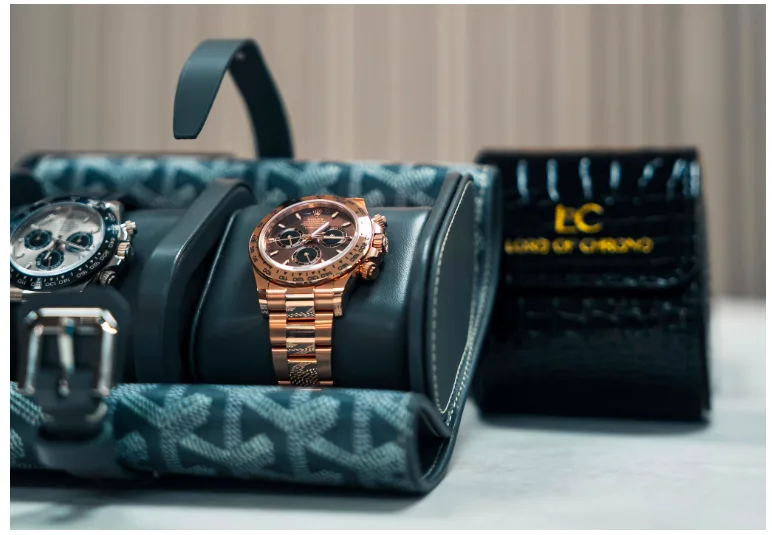
Luxury watches can represent craftsmanship, status and significant value. But for the dealers working behind the scenes, the business comes with risks that are rarely visible to the customer. From authenticity and market fluctuations to security and reputation, Lord of Chrono operates in an industry where every transaction requires attention.
From the outside, the luxury watch business can appear remarkably attractive.
Prestigious brands. Rare watches. Private clients. High-value transactions.
But behind the photographs of Rolex, Patek Philippe and Audemars Piguet watches is a business in which mistakes can become expensive very quickly.
For a luxury watch dealer such as Lord of Chrono, every watch purchased represents more than an opportunity to make a sale.
It represents risk.
A dealer needs to determine whether the watch is genuine, whether the price is commercially viable, whether the person on the other side of the transaction can be trusted and whether the watch will still be desirable when it reaches the market.
Those risks are part of everyday life in the secondary luxury watch industry.
And they explain why professional watch dealing involves much more than knowing which models are popular.
Risk 1: Buying the Wrong Watch
One of the most obvious risks begins with the product itself.
Luxury watches are complicated.
A watch may appear correct at first glance while containing parts that have been replaced, modified or incorrectly matched to the reference.
A dial might not be original to the watch.
A bracelet may have been replaced.
Certain components may have been polished, restored or changed during previous servicing.
In more serious cases, a watch may not be authentic at all.
For a dealer, these differences matter enormously.
When thousands or even tens of thousands of euros can be committed to a single purchase, there is very little room for assumptions.
That means each incoming watch needs to be evaluated carefully.
The reference, serial information, condition, documentation, movement, components and provenance can all become relevant depending on the watch.
Experience makes the process faster, but it does not make the risk disappear.
The luxury watch market continuously evolves, and those attempting to produce convincing counterfeit or modified watches evolve with it.
For Lord of Chrono, product knowledge is therefore not simply about being able to advise customers.
It is a form of risk management.
Authenticity Is Only Part of the Question
Even when a watch is authentic, that does not automatically mean it is a good purchase.
Condition matters.
The history of the watch matters.
And what may appear to be a small detail can substantially affect how collectors perceive a particular piece.
A watch that has been heavily polished, for example, may be less desirable to certain collectors than another example in more original condition.
Missing documentation can also influence marketability.
At the higher end of the market, buyers tend to become increasingly knowledgeable and increasingly selective.
A dealer therefore needs to think ahead.
The question is not simply:
“Is this watch real?”
It is also:
“Will the next buyer consider this a good example?”
That distinction is one of the reasons professional buying requires experience.
Risk 2: Market Prices Can Move
Luxury watches have become increasingly visible as valuable assets.
But that visibility can create a dangerous misconception.
Prices do not simply move upward.
The secondary watch market is a market like any other. Supply changes. Demand changes. Consumer preferences change. Certain models become extremely popular while others lose momentum.
For a dealer holding inventory, those movements have direct financial consequences.
Suppose a watch is purchased today with the expectation that it can be sold at a certain price.
If demand weakens before the right client arrives, the market value can change.
The dealer then faces a decision.
Hold the watch and wait?
Accept a lower margin?
Or sell quickly and release the capital for another opportunity?
This is where the luxury watch business becomes less about glamour and more about financial discipline.
Inventory Means Capital Is Constantly at Risk
A traditional retailer may hold hundreds of relatively inexpensive products.
A luxury watch dealer can have significant capital concentrated in only a small number of pieces.
That creates a different type of pressure.
Every watch in inventory represents money that cannot be used elsewhere until the watch is sold.
A watch that remains unsold for months is therefore not simply taking up space.
It is tying up capital.
This is why buying decisions matter so much for Lord of Chrono.
Personal preference cannot determine every purchase.
A watch may be beautiful, rare or technically impressive, but if the market for it is extremely limited, it can still become difficult inventory.
Successful dealing requires an understanding of liquidity.
Some watches attract buyers relatively easily.
Others may require the right collector at exactly the right moment.
Knowing the difference helps determine how much risk a dealer is prepared to take.
Asking Prices Can Be Misleading
One of the challenges of the online watch market is that price information appears to be everywhere.
Search for a reference and dozens of listings may appear within seconds.
But an asking price is not necessarily a selling price.
A watch advertised for a certain amount may remain available for months.
Another seller may deliberately price above the market.
A watch that looks comparable may have a different year, condition or configuration.
For someone outside the industry, this can create the impression that determining the value of a luxury watch is simply a matter of checking listings.
For a dealer, the calculation is more complicated.
The relevant question is not what somebody somewhere is asking.
It is what buyers are realistically paying.
Understanding that difference is essential when purchasing inventory.
Risk 3: Security and Fraud
The value of luxury watches creates another obvious challenge: security.
Unlike many valuable assets, a watch is small, portable and relatively easy to transport.
That combination makes security an important consideration during every stage of a transaction.
Who is the seller?
Where will the meeting take place?
How will payment be handled?
How will the watch be transported?
Should the transaction take place privately or in a professional environment?
These are not minor details when valuable watches are involved.
For Lord of Chrono, working by appointment and emphasizing secure transactions helps manage some of these risks.
But security extends beyond the physical watch.
Modern luxury watch dealing also involves digital communication, online payments and contact with people a dealer may never have met before.
That creates opportunities for fraud.
The Digital Side Creates New Risks
A potential customer can make contact within seconds.
That is one of the great advantages of conducting business digitally.
It is also one of the risks.
Fraudulent payment confirmations, false identities, suspicious requests and manipulated documentation are realities that high-value businesses must remain aware of.
A professional dealer cannot assume that every enquiry is genuine.
Transactions need to be verified.
Payments need to be confirmed independently.
And unusual circumstances require additional attention.
The same applies when purchasing watches.
An attractive price can quickly become a warning sign if the story surrounding the watch does not make sense.
In the luxury market, being willing to walk away from a transaction can sometimes protect more money than completing it could ever earn.
Reputation May Be the Biggest Risk of All
There is another risk that cannot easily be measured in euros.
Reputation.
A luxury watch dealer builds his business on trust.
Customers need to believe that descriptions are accurate, watches are properly represented and agreements will be honored.
That reputation can take years to develop.
But one poorly handled transaction can damage it quickly.
This creates a responsibility that goes beyond the individual sale.
Every interaction matters.
Every message matters.
Every watch that leaves the business carries the dealer’s name with it.
For a personal brand such as Lord of Chrono, that becomes even more significant.
The customer is not simply dealing with an anonymous corporation.
The identity of the business and the person behind it are closely connected.
That means reputation becomes one of the company’s most valuable assets.
And one of its greatest vulnerabilities.
Sometimes the Best Deal Is No Deal
People often associate entrepreneurship with saying yes to opportunities.
In the luxury watch business, knowing when to say no can be just as important.
A watch may be offered at an attractive price, but the condition creates doubts.
A potential buyer may want to complete a transaction in an unusual way.
A model may look profitable, but the market is already weakening.
In each situation, the dealer needs to decide whether the potential reward justifies the risk.
That judgment improves through experience.
Over time, patterns become easier to recognize.
Certain situations that initially appear profitable begin to look very different once the potential downside is considered.
The discipline to walk away is therefore part of professional dealing.
Why Knowledge Reduces Risk
It is impossible to eliminate every risk from the luxury watch business.
Markets will continue to change.
Fraud will continue to exist.
Unexpected issues will appear.
What can be improved is the ability to recognize risk early.
Knowledge reduces uncertainty.
Understanding references helps identify incorrect watches.
Understanding market prices helps prevent overpaying.
Understanding clients and counterparties helps reduce transaction risk.
And building a reliable professional network makes it easier to verify both watches and opportunities.
For Lord of Chrono, these elements form part of the infrastructure behind the visible side of the business.
The watches may attract attention.
The processes behind them protect the business.
The Reality Behind Luxury Watch Dealing
The luxury watch market offers opportunities that make it an exciting industry in which to operate.
Every day can bring a different watch, a new client or an unexpected sourcing request.
But opportunity and risk are inseparable.
A dealer is constantly making decisions involving authenticity, price, security, capital and reputation.
The public usually sees the finished transaction.
The Rolex placed on a client’s wrist.
The newly sourced Patek Philippe.
The photograph of an incoming watch.
What remains unseen are the decisions that took place before the watch ever reached that point.
For Lord of Chrono, managing those risks is part of what it means to operate professionally within the luxury watch market.
Because buying and selling valuable watches may look simple from the outside.
Making the right decisions consistently is what turns it into a business.
About Lord of Chrono
Lord of Chrono is a Netherlands-based luxury watch dealer specializing in the purchase, sale and sourcing of high-end watches from brands including Rolex, Patek Philippe, Audemars Piguet and other leading watch manufacturers.
The business focuses on personal service, discretion and secure transactions, assisting clients who want to purchase a luxury watch, sell an existing timepiece or source a specific model.