The Role of AI and Automation in Healthcare Operations
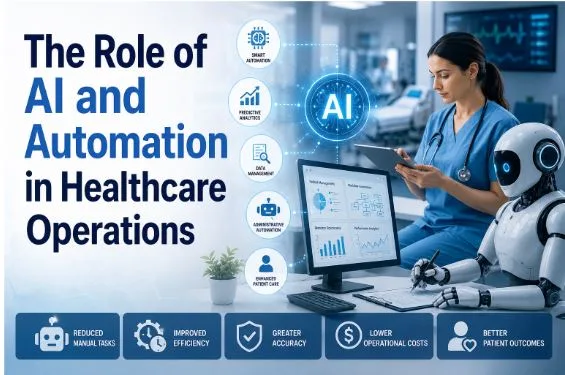
Healthcare has never been a simple industry to operate. But in 2026, the administrative weight bearing down on hospitals, clinics, and medical practices has reached a level that the old operational model simply wasn’t built to carry. Rising claim denial rates. Staffing shortages that show no signs of reversing. Reimbursement rules that change with every CMS update cycle. And somewhere underneath all of that pressure, providers are trying to do the thing they actually trained to do to take care of patients.
Practices looking for a reliable medical billing company in New Jersey can benefit from AI-enabled billing support, denial prevention, and faster reimbursement workflows.
Artificial intelligence and automation aren’t solving this problem in theory anymore. They’re solving it in practice, right now, across every function of healthcare operations from the moment a patient schedules an appointment to the final dollar collected after their visit. The organizations that have moved from piloting AI tools to embedding them in everyday workflows are already seeing the difference. The ones still watching from the sideline are going to feel it.
Here’s what’s actually happening and why it matters for every provider, billing team, and healthcare administrator in 2026.
The Administrative Burden That Got Us Here
To understand why AI adoption in healthcare has accelerated so sharply, it helps to understand what it’s responding to. Specialty practices, especially family medicine clinics, often face heavy billing pressure because of frequent patient visits, payer-specific rules, coding errors, and delayed reimbursements, which makes reliable family practice billing services essential for reducing administrative workload and improving cash flow.
The National Bureau of Economic Research reports that broad AI adoption in healthcare could deliver up to $360 billion in annual savings by reducing waste, streamlining workflows, and enhancing decision-making. That’s not a projection built on optimism, it’s a reflection of how significant the inefficiency gap has become.
In a 2025 Salesforce survey, U.S. healthcare workers estimated that AI agents could reduce administrative burdens by up to 30%, with many reporting they would regain the equivalent of one full day per week if routine tasks were handled by intelligent agents.
One full day per week. For a billing team processing hundreds of claims, verifying eligibility across dozens of payers, managing prior authorization queues, and following up on aging AR that’s not a marginal efficiency gain. That’s a structural transformation in what’s possible without adding headcount.
94% of healthcare organizations now view AI as core to their operations, and 86% are using it extensively right now. The question in 2026 is no longer whether to adopt AI and automation in healthcare operations, it’s whether you’re doing it strategically enough to see real financial outcomes.
Where AI Is Having the Biggest Impact
1. Revenue Cycle Management The Highest-ROI Application
The revenue cycle is where AI has delivered the most measurable, immediate financial returns for healthcare organizations and where the gap between AI-enabled and non-AI operations is widest.
As of 2025, 63% of healthcare organizations are already using AI for revenue cycle work, according to Experian Health. The old model was fundamentally reactive: claims were submitted, denials were received, staff worked denials manually, and the cycle repeated. AI changes the model from reactive to predictive.
In a typical U.S. revenue cycle, AI is most valuable when it supports three layers of work: front-end readiness including insurance verification, prior authorization support, and documentation completeness checks; claims accuracy including coding guidance for CPT and ICD-10 alignment and claim formation rules; and back-end recovery including denial management prioritization, root-cause analysis, and payer-specific next steps.
Each of these layers previously required manual effort experienced billers reviewing claims, coders checking documentation, AR teams calling payers. AI doesn’t eliminate that human expertise. It amplifies it. It processes thousands of claims against payer-specific rules simultaneously, flags the ones that need attention before they fail, and allows billing professionals to focus their expertise where it actually matters on the edge cases, the complex appeals, and the relationship-driven interactions that machines can’t replicate.
AI-powered eligibility verification and prior authorization tools are cutting scheduling time by 70% and achieving 98% first-pass authorization approval in leading implementations. For practices where missed prior authorizations are one of the top denial drivers, that kind of improvement in PA workflows directly translates to clean claim rates.
Hospitals report ROI of $3.20 for every $1 spent on healthcare AI, often within 14 months of implementation. That’s a return profile that makes the investment decision straightforward for any healthcare organization willing to commit to implementation rather than just experimentation.
2. Clinical Documentation AI as the Physician’s Administrative Partner
Documentation has been one of the most persistent sources of physician frustration in modern medicine. The time spent documenting patient encounters has grown year over year as regulatory requirements have expanded and that time comes directly out of patient care capacity or physician wellbeing, with no good outcome either way.
AI-powered ambient documentation tools are changing this equation in real time. These tools which listen to patient-provider conversations and generate structured clinical notes automatically have moved from early-adopter novelty to mainstream deployment in 2026.
Clinician burnout declined from 51.9% to 38.8% after short-term use of AI-assisted documentation tools. That’s not a minor improvement. Burnout is one of the leading causes of physician attrition, and physician attrition is one of the most expensive operational problems a healthcare organization can face. AI-assisted documentation addresses both the financial and the human dimensions of that problem simultaneously.
From a billing perspective, AI-assisted documentation also improves coding accuracy. When the clinical note is comprehensive, structured, and complete because an AI tool has ensured that every element of the encounter is captured the coder has what they need to bill accurately and completely. The documentation gap that leads to downcoding, missed codes, and medical necessity denials becomes narrower when the note is generated with billing-aware structure from the start.
Revenue cycle capabilities in 2026 are moving from processing to exception handling. Administrative teams are increasingly supervising automated drafting, sorting, and routing including claims preparation, documentation support, and appeals packets intervening when edge cases arise. This is what AI-augmented clinical documentation makes possible: a billing workflow where the routine is handled automatically and the human expertise is reserved for the complex.
3. Predictive Denial Prevention Stopping Denials Before They Happen
More than 10% of U.S. hospital claims are denied, while increasing payer complexity across prior authorization, coding, documentation, and reimbursement policies continues to strain in-house RCM operations.
The traditional response to high denial rates is more staff working denials faster. The AI-enabled response is predictive prevention using machine learning models trained on historical claims data to identify, before submission, which claims are at high risk of denial and why.
These models analyze patterns across millions of claims: which CPT-ICD-10 combinations generate denials from specific payers, which documentation structures trigger medical necessity reviews, which modifier applications are consistently being bundled, and which prior authorization gaps are producing preventable denials. They surface that intelligence at the point of submission before the claim leaves the practice giving billing staff the opportunity to correct the issue rather than rework it after the fact.
Predictive analytics is being used to identify denial patterns and anticipate claim issues before they impact cash flow, with investments in automation and AI ranking as the biggest RCM priority in 2026. The organizations that have committed to this approach are building a revenue cycle that learns over time where denial rates trend downward quarter over quarter, rather than fluctuating based on staff turnover and payer rule changes.
4. Prior Authorization Automation The Most Time-Consuming Task, Transformed
Prior authorization has been the most administratively burdensome function in medical practice management for years and the burden has grown as payer PA requirements have expanded into more procedure types and service categories.
AI-powered prior authorization tools are cutting scheduling time by 70% through automated PA submission, tracking, and follow-up with machine learning systems updating payer rules automatically to help teams maintain compliance without manual intervention.
The traditional PA workflow requires a staff member to identify whether a service requires authorization from a specific payer, gather the clinical documentation needed to support the request, submit it through the payer’s portal or fax system, follow up on status, and manage peer-to-peer review requests when initial authorization is denied. For practices managing dozens of PA requests per physician per week, this consumes nursing and administrative capacity that should be going elsewhere.
Automated PA tools handle the identification, submission, and tracking functions systematically flagging the cases that need human attention (peer-to-peer reviews, complex clinical justifications) while handling the routine workflow automatically. The result is faster authorizations, fewer missed PA requirements, and dramatically reduced staff time spent on administrative follow-up.
5. Patient Scheduling and Access AI That Reduces No-Shows and Fills Gaps
Scheduling inefficiency is one of the most financially damaging operational problems in healthcare and one of the least discussed. An empty appointment slot represents revenue that can never be recovered. A no-show patient who wasn’t reached with a timely reminder represents care that wasn’t delivered and a bill that won’t be generated.
Many healthcare organizations have either fully embedded or are in the final stages of implementing AI tools into patient scheduling and waitlist management, with 55% reporting deployment in this area.
AI-powered scheduling tools do several things simultaneously that human schedulers cannot: they predict no-show probability based on patient history and demographic factors, allowing overbooking strategies calibrated to actual cancellation patterns rather than guesswork; they match patients to available slots based on clinical acuity and provider specialization; and they automate reminder communications through the patient’s preferred channel text, email, or phone at the optimal timing for that patient’s behavioral profile.
Contact centers and patient access are shifting to AI-augmented service, with real-world examples where GenAI-augmented call centers have reduced wait times and improved first-call resolution, fewer rote calls handled by humans, and more complex cases escalated to people with better context and tools.
6. Population Health and Predictive Analytics Revenue Hiding in Your Patient Panel
For practices with significant Medicare and Medicaid populations, AI-powered population health analytics are surfacing revenue opportunities that most practices aren’t currently capturing particularly in chronic care management, annual wellness visits, and risk adjustment coding.
AI tools that analyze the full patient record against billing patterns can identify patients who are eligible for chronic care management services but aren’t currently enrolled, conditions that are documented in clinical notes but not captured in billing codes, and risk adjustment factors that affect Medicare Advantage payment rates but aren’t being coded to the correct specificity.
AI-powered charge capture optimization tools flag missed charges before claim submission, while real-time analytics dashboards track AR aging, denial trends, payer performance, and collection velocity. For practices where charge capture failures are silent revenue drain services rendered but not billed, these tools recover revenue that would otherwise be permanently lost.
The Governance Reality AI That Works With Humans, Not Instead of Them
It would be easy to read the capabilities described above and conclude that AI is replacing human expertise in healthcare operations. That’s not what’s happening and the organizations implementing AI most effectively are the ones who understand this clearly.
2026 will be the year health systems move from scattered AI pilots to govern deployment, but only if they treat AI as part of a broader operational ecosystem rather than a standalone fix. More than half of health IT leaders cite infrastructure and data governance as the biggest barriers to AI adoption, not the AI tools themselves.
The organizations seeing real value from AI are the ones that have invested in clean data, clear governance frameworks, and workflow design that allows automation to augment human judgment rather than attempt to replace it. The AI flags the risky claim the experienced biller decides what to do about it. The AI generates the clinical note the physician reviews and signs it. The AI identifies the PA requirement and the clinical staff manages the peer-to-peer review.
AI must respect clinical reality: prior authorization decisions still require adherence to payer policies and clinical documentation standards. AI should support documentation completeness and workflow tracking, not override medical necessity requirements.
This is the right framework and it’s the one that produces sustainable financial outcomes rather than short-term automation wins that create new problems downstream.
What This Means for Medical Billing Specifically
In the medical billing context, the convergence of AI and automation is producing a revenue cycle model that is faster, more accurate, and more proactive than anything that was operationally possible five years ago.
Practices partnering with billing companies that have invested in AI infrastructure automated claim scrubbing, predictive denial prevention, AI-assisted coding, real-time eligibility verification, and automated PA tracking are seeing measurable improvements in first-pass claim acceptance rates, denial rates, and days in AR simultaneously. That’s the financial outcome of a billing operation that has moved from reactive processing to intelligent management.
For practices considering whether to build this capability internally or partner with a billing company that already has it, the build-vs-buy calculus in 2026 strongly favors partnership. The technology investment, the data infrastructure, the ongoing model training, and the specialty-specific expertise required to operate AI-enabled billing at a high level represent a capability stack that takes years to build and significant capital to maintain. Billing companies that have made that investment are offering access to it at a fraction of the cost of building it.
iSolveRCM combines AI-powered revenue cycle management with dedicated specialty billing expertise across 50+ clinical areas delivering the clean claim rates, denial prevention, and AR management that AI-enabled billing makes possible, starting at 2.99% of monthly collections. Their free Revenue Cycle Assessment gives practices a clear picture of where their billing is underperforming before committing to anything.
The Bottom Line
AI and automation in healthcare operations have crossed the threshold from optional to foundational. The practices and health systems that treat them as infrastructure not as pilot programs or departmental experiments are building a structural financial advantage that compounds over time.
If recent years were marked by pilots and experimentation, 2026 is the year AI becomes integrated into the everyday fabric of healthcare work. The revenue cycle, clinical documentation, prior authorization, scheduling, and population health functions that AI is transforming aren’t peripheral; they’re the operational core of every healthcare practice.
The organizations that recognize this and act on it aren’t waiting to see how the technology matures. They’re using it to pull ahead in cash flow, in staff capacity, in denial rates, and in the quality of the patient experience they can deliver when administrative burden stops consuming the time that should be going to care.
That’s the real promise of AI in healthcare. Not the replacement of human judgment. The liberation of it.
About the Author: The iSolveRCM team provides full-service revenue cycle management to healthcare practices across 50+ specialties, combining specialty billing expertise with AI-powered claim management, denial prevention, and real-time reporting.