The Uncanny Valley of the Inbox and the Fight to Reclaim Our Digital Voices
There used to be a specific joy in subscribing to a niche newsletter, reading a local bakery’s blog, or opening an email from an independent consultant. You could hear the person behind the keyboard. You could spot their weird punctuation habits, their sudden tangents, and their specific sense of humor.
Lately, however, reading through my morning subscriptions feels like walking through a digital uncanny valley. Everyone suddenly sounds exactly the same. The local bakery is now writing about the “tapestry of artisanal pastries,” and the independent consultant is endlessly urging me to “delve into the ever-evolving landscape of digital marketing.” It is grammatically flawless, completely frictionless, and incredibly boring. We have traded our unique, messy human voices for algorithmic efficiency, and it is quietly killing audience connection. If independent creators and small businesses want to survive this flood of synthetic content, they have to make a conscious, daily choice to actively humanize ai outputs before they ever click publish.
Let’s be clear: I am not suggesting we abandon artificial intelligence. For anyone trying to run a business, manage a side hustle, or simply keep up with the crushing demand of the modern internet, these generative tools are a lifeline. They cure the blank-page syndrome and cut research time in half. But a critical misunderstanding has taken hold. We are treating the first draft generated by a machine as a finished product, completely forgetting that algorithms do not possess empathy, humor, or a point of view.
When you allow a predictive language model to speak directly to your audience, you are feeding them statistical averages. The software strings together the most mathematically probable words. It removes the cognitive friction—the slight pauses, the varied sentence lengths, the colloquialisms—that naturally occur when a real person is thinking out loud. As a result, your readers subconsciously disengage. They might not immediately realize they are reading machine text, but they feel the emotional distance. They stop clicking your links, they stop replying to your emails, and eventually, they unsubscribe.
Adding to this aesthetic nightmare is a very real, technical threat: the rise of algorithmic gatekeeping.
Because the internet is drowning in this synthetic noise, email providers, search engines, and social platforms are heavily deploying automated detection scanners to filter out what they deem as “low-effort” spam. Here is the deeply frustrating irony of these scanners: they don’t look for creativity; they look for structural predictability. If you happen to be a good writer who naturally uses logical, well-structured sentences without typos, these hypersensitive bots will frequently flag your hard-earned, original writing as machine-generated.
We are now trapped in a bizarre digital standoff where human writers are terrified of being labeled as bots by other bots.
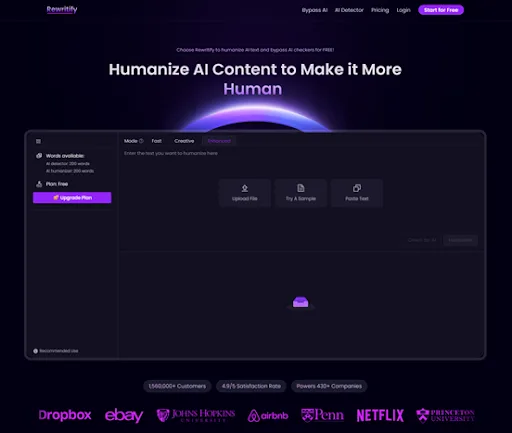
This specific anxiety is why the conversation around digital writing has shifted from generation to refinement. The smartest creators I know are no longer bragging about how fast they can generate a blog post; they are quietly utilizing specialized post-processing platforms to protect their work. A tool that has become increasingly vital in this new workflow is rewritify.ai. It isn’t used as a shortcut to bypass doing the work. Rather, it acts as an essential editorial equalizer designed to dismantle the robotic footprint left behind by standard language models.
Here is how the modern workflow actually operates: You let the AI generate the rough, messy outline. You let it organize your thoughts. But instead of manually spending hours trying to insert awkward typos just to trick a spam filter, you run that rigid, mathematically perfect draft through a refactoring engine like rewritify.ai. The software dynamically scrambles the monotonous pacing. It breaks up the uniform sentence structures, removes the synthetic corporate buzzwords, and algorithmically restores the organic “burstiness” and asymmetrical rhythm of genuine human speech. It gives you a clean, safe baseline that won’t trigger automated gatekeepers, allowing you to finally add your own personal anecdotes and humor back into the text without fear of algorithmic penalty.
We are standing at a cultural crossroads in how we communicate online. The novelty of automated writing has completely worn off. Moving forward, the most valuable currency on the internet will not be perfection; it will be authenticity.
Your audience does not care how efficiently you can prompt a machine. They care about your perspective, your flaws, and your distinct voice. Use every technological advantage available to save yourself time and avoid burnout, but never forget your primary job is to connect with the person on the other side of the screen. The mandate to humanize ai is no longer just a clever marketing tactic; it is the only way to ensure your digital voice doesn’t get permanently lost in the machine.