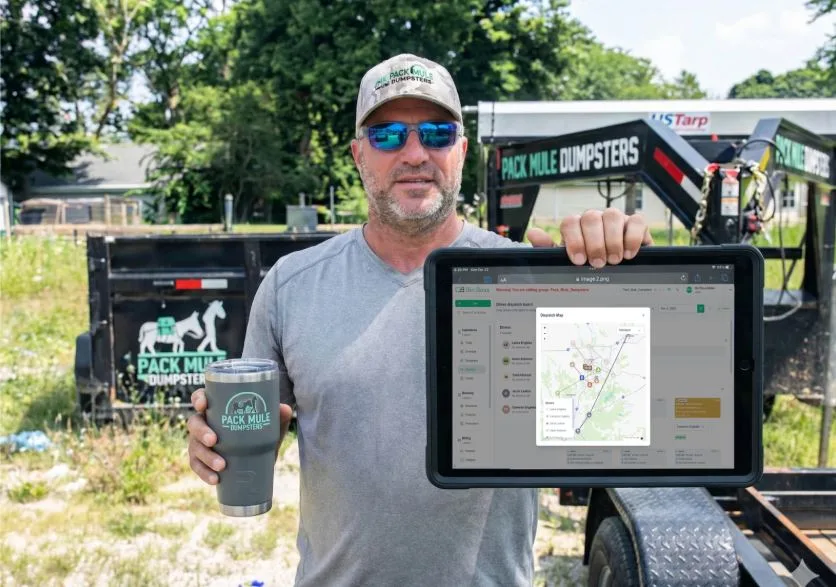
The “Unlikely Tech CEO”: How a Dumpster Guy Accidentally Built the Industry’s Most Disruptive Software
In the glossy, polished world of technology startups, the “founder story” usually follows a predictable script. It involves a dorm room, a couple of Ivy League dropouts, and a pitch deck full of buzzwords like “synergy” and “disruption.” It rarely involves a roll-off truck, a pair of steel-toed boots, or a transfer station in Ohio.
But the dumpster rental industry doesn’t run on polish; it runs on grit. And it turns out, the software that powers this industry shouldn’t be built by someone who learned about logistics from a textbook. It should be built by someone who knows the specific, bone-deep exhaustion of a 14-hour day in the cab.
This is why Bin Boss Dumpster Software is currently rewriting the rules of waste management technology. Its founder, Todd Atkinson, isn’t a “tech bro” trying to cash in on a blue-collar niche. He is a reluctant tech CEO—a combat veteran and hauling business owner who built a platform not because he wanted to start a software company, but because he was tired of his own business running him into the ground. This isn’t just a story about code; it’s a story about a hauler who got mad enough to build a better shovel.
Silicon Valley Doesn’t Speak “Landfill”
For decades, the relationship between the waste industry and the technology sector has been awkward at best. Software developers live in a world of clean lines and predictable inputs. Dumpster rental owners live in a world of cracked driveways, flat tires, and customers who change their minds three times before the can hits the ground.
When standard logistics software tries to enter the waste space, it usually fails because of this “culture gap.” A developer might think a dispatch board is just a calendar. Todd Atkinson knows that a dispatch board is a battlefield map. He knows that a “scheduled drop-off” is just a suggestion until the driver actually gets past the narrow gate and avoids the low-hanging power lines.
Atkinson’s biography acts as a translation layer. Because he spent years building his own hauling company, Pack Mule Dumpsters, he speaks fluent “Landfill.” He understands that software needs to be robust enough to handle the chaos of the real world. When you use the platform, you aren’t fighting against the logic of a programmer who has never left his cubicle; you are working with a workflow designed by a guy who has personally negotiated landfill fees and dealt with overweight tickets.
The “Spreadsheet of Doom” and the Breaking Point
Every successful hauling business hits a wall. For Todd, that wall appeared when his fleet grew past a handful of trucks. He calls it the “Spreadsheet of Doom.” Like many operators, he was trying to run a rapidly scaling business using Excel, whiteboards, and sticky notes.
The stress was physical. Trying to mentally track the location and status of 80+ dumpsters is a recipe for burnout. He realized that his lack of a true system was the lid on his growth. He couldn’t hire more people because the process lived entirely in his head. If he took a day off, the business stopped.
This pain point is the foundational DNA of the platform. The software wasn’t built to “optimize synergy”; it was built to save Todd’s sanity. It automates the mental heavy lifting—tracking rental days, calculating pro-rated fees, and managing inventory limits. It transforms the business from a chaotic hustle into a turn-key operation. When you log in, you are stepping into a system designed to alleviate the specific anxiety that keeps dumpster owners awake at 2 AM.
Innovation for the “One-Thumb” User
If you want to see where most software fails, look at the driver’s hands. In this industry, drivers are working in the elements. They are wearing thick gloves. They are often steering a massive vehicle with one hand and holding a coffee or a radio with the other.
Asking this person to navigate a complex app with tiny buttons and endless drop-down menus is an insult to their workflow. Todd knew that if the driver app wasn’t “combat simple,” his crew at Pack Mule would just ignore it. They would go back to texting and calling, leaving the office in the dark.
This led to a radical simplification of the user interface. The driver tools are designed for the “one-thumb” user. Big buttons. High contrast. Simple workflows. One tap to arrive. One tap to complete. It respects the driver’s reality. By removing the friction, the software ensures that data actually flows back to the office. It turns the driver from a reluctant participant into a real-time data node, giving dispatch total visibility without slowing down the route.
The “Profit Protection” Protocol
Most business owners fixate on revenue—how much money came in the door. Todd Atkinson learned the hard way that profit is about plugging the leaks in the bucket. In the dumpster game, those leaks are small but deadly: the 1.5 tons of overage you forgot to bill, the three extra rental days that slid by unnoticed, the dry run fee you waived because you felt bad.
Atkinson encoded a “Profit Protection” protocol into the software’s logic. It acts as a ruthless, automated auditor. When a scale ticket is entered, the system instantly checks it against the customer’s specific contract allowances. If it’s over, the charge is queued. If a rental period expires, the daily rate kicks in automatically.
This isn’t about nickel-and-diming; it’s about fair compensation. By automating these uncomfortable billing conversations, the software ensures you get paid for every ounce of work you do. It removes the emotion from billing and replaces it with math. For many users, this feature alone covers the Dumpster Software Price multiple times over by recovering revenue that used to simply evaporate.
Radical Transparency: The “Open Kitchen” Concept
In the restaurant business, an “open kitchen” shows customers exactly how their food is made. It builds trust. Todd has applied this same concept to the software business. In an industry full of trade secrets and closed doors, he has been radically transparent about his numbers, his failures, and his strategies.
He openly shares the playbook he used to scale Pack Mule from a small startup to a $1.3 million revenue machine. This isn’t just marketing fluff; it’s a roadmap. When you subscribe, you aren’t just getting a login; you are getting access to the “Pack Mule Protocol.”
You can see how he structured his pricing. You can see how he managed his inventory. You can see how he handled customer disputes. This transparency turns the software into a learning platform. It allows new entrants to skip the “expensive mistakes” phase of entrepreneurship and jump straight to the “scaling and optimization” phase.
A CEO You Can Actually Call
Perhaps the strangest thing about Bin Boss is the accessibility of its leadership. In the tech world, the CEO is usually a distant figure, hidden behind layers of PR reps and assistants. Todd Atkinson is different. He is still, at his core, a hauler.
He stays active in the community. He jumps on calls with users not just to troubleshoot technical issues, but to talk shop. He understands that sometimes you don’t need tech support; you need business support. You need to know how to handle a customer who overloaded a bin with concrete, or how to negotiate better tipping rates at the local transfer station.
This mentorship dynamic is unique. It creates a sense of brotherhood among the user base. You aren’t just a customer number; you are part of a network of operators who are all running the same race. Having a direct line to a mentor who has already crossed the finish line is an intangible asset that carries immense value.
The Future is “Blue Collar Tech”
We are entering a new era of “Blue Collar Tech.” The tools of the trade are no longer just hammers and trucks; they are algorithms and automations. But for these tools to work, they cannot be imposed from the top down by outsiders. They must be built from the ground up by insiders.
Todd Atkinson represents the vanguard of this movement. He is proof that the best innovation doesn’t come from a brainstorming session in a beanbag chair; it comes from the frustration of a missed pick-up or a lost invoice.
By bridging the gap between the mud of the job site and the cloud of the software, he has created something vital. He has given haulers a tool that doesn’t try to change who they are, but empowers them to be the best version of themselves. In a world of pretenders, the “Unlikely Tech CEO” is the real deal, and his software is the heavy equipment your business needs to dig its way to the next level.