Thermal Camera for Car: Avoid Deer Collisions Beyond Headlights
Introduction
You’re driving home on a two-lane highway. It’s 10:30 PM. Your high beams are on. The road looks clear.
Then a deer explodes out of the darkness from the right shoulder. You slam the brakes. Your heart pounds.
Maybe you stop in time. Maybe you don’t.
That scenario plays out over two million times a year in the United States alone. Deer collisions total cars, injure drivers, and cost insurance companies billions. The worst part? Most drivers never see the animal until it’s too late. Standard headlights, even the brightest LEDs or lasers, only reach about 300 to 350 feet down the road. At highway speeds, that distance evaporates in about three seconds. That’s barely enough time to move your foot from gas to brake.
What if you had an extra five seconds of warning? What if you could see a deer standing in the ditch 650 feet away, long before your headlights touched it? That’s not science fiction. It’s exactly what a thermal camera for car does. And it’s the difference between a close call and a collision.
In this article, I’m going to walk you through how automotive thermal imaging works, why it’s the ultimate defense against deer collisions, and why Robofinity’s AI-powered car thermal night vision system might be the smartest safety upgrade you can make this year. No fluff. Just real talk from someone who’s spent too many white-knuckle nights on rural highways.
What Exactly Is a Thermal Camera for Car?
Let’s cut through the jargon.
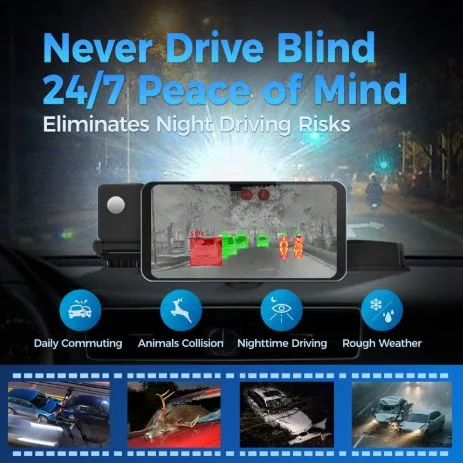
A thermal camera for car is not a fancy dashcam. It doesn’t need light to see. Instead, it reads heat. Every living thing—deer, elk, moose, pedestrians, even the neighbor’s dog—emits infrared energy. A thermal sensor picks up that energy and turns it into a crisp, real-time image on your dashboard screen.
Think of it as a superpower for your car. Your eyes see what light reflects. A thermal camera sees what’s warm. That’s a massive difference at night.
Standard cameras and your own retinas struggle when headlights glare back at you or when rain and fog scatter light everywhere. But a thermal camera for car cuts straight through that mess. The deer’s body heat glows bright white on the display. The cold asphalt stays dark. The contrast is immediate and unmistakable.
Robofinity’s system takes this a step further. It uses a high-resolution thermal sensor equivalent to 384×512, boosted by AI Super-Resolution up to 1024×768. That means the image on your 6.25-inch screen isn’t a blurry blob. It’s a clear, defined shape. You can tell if that heat source is a deer, a person walking a bike, or just a mailbox warming in the residual sun. That clarity matters when you have a split second to decide: swerve, brake, or hold steady.
Why Your Headlights Are Not Enough
I know what you’re thinking. “I’ve got modern LED headlights. I’m fine.”
I used to think that too. Then I drove a loaner car with a thermal camera for car through Montana at midnight. I was a believer within ten minutes.
Here’s the hard truth about headlights.
First, even the best high beams illuminate a cone of light. Outside that cone, it’s pitch black. Deer don’t politely stand in the middle of the lane. They hide in ditches, behind bushes, just off the shoulder. A thermal camera for car sees that heat signature hiding in the weeds. Your headlights won’t.
Second, headlights blind you as much as they help. When an oncoming semi-truck blasts its high beams, your pupils constrict. For a few critical seconds, you’re driving partially blind. A thermal camera for car doesn’t care about headlight glare. The sensor reads heat, not visible light. That oncoming truck’s headlights? Invisible to the thermal sensor. The deer standing just beyond the truck’s glare? Glowing like a beacon on your Robofinity display.
Third, weather destroys headlight performance. Rain droplets scatter light. Fog turns your high beams into a white wall. Snow creates a dizzying tunnel effect. All these conditions make it harder to see the road edge, let alone an animal. But a thermal camera for car sees through all of it. The 8 to 14 micron wavelength band Robofinity uses is specifically chosen for its ability to penetrate atmospheric moisture. Rain, fog, snow—the deer’s heat cuts through.
I’m not saying headlights are useless. They’re mandatory. But they’re a tool with hard limits. A thermal camera for car extends your vision well beyond those limits. It’s not about replacing your eyes. It’s about giving you a second set that works on a completely different principle.
The Deer Collision Problem by the Numbers
Let’s talk stats for a minute. They’re sobering.
According to the Insurance Institute for Highway Safety, there are over 1.5 million deer-vehicle collisions annually in the United States. State Farm’s data pushes that number closer to two million when you include unreported strikes. Those crashes cause over 150 human fatalities each year. They injure tens of thousands more. The average property damage claim? Around $4,500 to $6,000. And that’s if your car isn’t totaled.
Peak deer activity happens at dawn and dusk. Exactly when commuters are on the road. And exactly when light conditions are worst. October through December is prime rutting season. Deer are distracted. They sprint across roads without looking.
I live in a state with a heavy deer population. Every autumn, my local body shop has a six-week backlog of cars with smashed front ends, crumpled hoods, and shattered windshields. The owners all say the same thing. “I never saw it coming.”
That’s the crux of it. You can’t avoid what you can’t see.
A thermal camera for car changes that equation. Robofinity’s system detects heat signatures up to 200 meters away. That’s 656 feet. That’s nearly double the effective range of typical high beams. At 65 miles per hour, that 656-foot detection range buys you roughly seven seconds of warning. Your headlights give you maybe three.
Those extra four seconds are everything. They’re the difference between a controlled brake and a panicked swerve. They’re the difference between driving home and riding in a tow truck.
How Robofinity’s AI Makes Thermal Smarter
Early thermal cameras for cars were dumb. They showed you a hot blob. You had to figure out if that blob was a deer, a mailbox, or a jogger in a thick coat. That mental processing takes time. At 70 miles per hour, time is the one thing you don’t have.
Robofinity solved this with onboard AI.
The system has a dedicated AI chip delivering 2 TOPS of processing power. That’s enough to run real-time object recognition on every single frame. When the thermal sensor picks up a heat signature, the AI classifies it. Is it an animal? A pedestrian? A vehicle? The system knows. And it tells you.
On the display, different objects get different colored bounding boxes. A yellow box might indicate a pedestrian. A red box highlights an animal—your deer. A blue box marks a vehicle. You don’t have to squint at the screen and guess. You glance down, see the red box, and immediately know what’s ahead.
But the AI doesn’t stop at labeling. It calculates risk.
Robofinity’s Instant Alert system analyzes the trajectory of both your car and the detected object. If the AI predicts a potential collision path, it triggers an audible and visual warning. A clear alert flashes on the 6.25-inch screen. A chime sounds. Your brain gets jolted out of highway hypnosis and back to the task of driving.
This alert gives you an additional three to five seconds of reaction time beyond the initial visual detection. Combined with the 656-foot detection range, you’re looking at a total warning window of nearly ten seconds. That’s an eternity in collision avoidance terms. It’s enough time to smoothly reduce speed, check your mirrors, and change lanes if needed. No drama. No screeching tires. Just safe, controlled driving.
The AI also gets smarter over time. Robofinity provides firmware updates that refine the recognition algorithms. More data from real-world driving feeds back into the system. False positives drop. Accuracy climbs. Your thermal camera for car becomes a better co-pilot the longer you own it.
Real-World Scenarios Where Thermal Saves the Day
Let me paint a few pictures for you. These aren’t hypotheticals. They’re situations I’ve either experienced myself or heard from other drivers who’ve used a thermal camera for car.
Scenario One: The Foggy Commute
It’s 6:45 AM in November. Valley fog is thick as soup. Visibility is down to maybe 100 feet. You’re crawling along at 40 miles per hour, tense, peering into the white void. Your high beams just reflect back at you. Useless.
Suddenly, your Robofinity screen lights up with a bright white shape on the right shoulder. A red bounding box snaps around it. “Animal,” the display reads. A deer. It’s standing just off the pavement, maybe 150 feet ahead. You can’t see it with your eyes. The fog is too dense. But the thermal camera sees its body heat glowing clear as day.
You slow down. You hug the center line. You pass the deer without incident. It never even spooks. Without the thermal camera for car, you would have driven right past it, inches away, completely unaware. Maybe it bolts. Maybe it doesn’t. You don’t have to roll those dice anymore.
Scenario Two: The Blinding Oncoming Glare
It’s a rainy night on a narrow two-lane road. An SUV with misaligned LED headlights is barreling toward you. The glare is brutal. You can’t see the edge of your own lane, let alone what’s beyond the SUV.
Your eyes are useless for the next five seconds. But your Robofinity display isn’t. On the screen, you see the SUV’s heat signature as a cool blue box. And just beyond it, on your side of the road, a smaller white shape with a yellow box. A pedestrian. Someone walking a dog on the shoulder.
You would have never seen them. The glare would have completely washed them out. But the thermal camera for car cuts through the light pollution. You ease off the gas. You give the pedestrian as much room as you can. Crisis averted.
Scenario Three: The Suburban Deer Gauntlet
You’re driving through a wooded neighborhood at 9 PM. Speed limit is 35. Houses are set back from the road. Lots of trees. Lots of shadows.
Your headlights sweep across the road. Nothing obvious. But your thermal camera for car is painting a different picture. Two dim heat signatures are moving through the trees on the left. They’re heading toward the road.
You slow to 25. Sure enough, a doe and a fawn emerge from the brush ten feet in front of your bumper. Because you were already slowing, you stop with plenty of room. The deer cross. You continue on.
Without the thermal camera, you would have hit that doe. No question. The trees would have hidden her until she was in your path. Braking from 35 at ten feet is impossible. You’d be looking at a crumpled hood and a dead deer.
These scenarios happen every single night across the country. A thermal camera for car turns near-misses into non-events. It’s the kind of safety margin that’s hard to put a price on.
Installation and Everyday Usability
One of the biggest barriers to aftermarket car tech is installation. Nobody wants to tear apart their dashboard or splice into factory wiring. I certainly don’t.
Robofinity designed their system with normal people in mind.
The camera unit itself is compact. The main housing measures just 55.3 by 79.6 by 23.3 millimeters. It mounts discreetly behind your rearview mirror or on the dashboard. The included adjustable mount gives you 150 degrees of tilt adjustment front and rear. You can dial in the perfect angle for your specific vehicle and driving position.
Power comes from a standard 12V car cigarette lighter socket. Plug it in. Tuck the cable under the trim. That’s it. No professional installation required unless you want a fully hidden wire run. Even then, any car audio shop can do it in under an hour.
The 6.25-inch display sits on your dash or attaches to a vent mount. It’s sharp—1560 by 720 resolution. The screen automatically adjusts brightness based on ambient light. During the day, it’s readable. At night, it dims enough to avoid distracting glare.
The system records video in real-time. Pop in a Micro SD card up to 128GB, and you’ve got a continuous loop recording of your thermal footage. This is invaluable for insurance claims if something does happen. Video proof that a deer darted out from a blind spot is a lot better than a “he said, she said” with your adjuster.
Durability is another strong point. The camera carries an IP67 rating. It’s fully sealed against dust and can handle temporary immersion in water. Rain, snow, car washes—none of it phases the unit. The operating temperature range runs from -20°C to 70°C. That’s -4°F to 158°F. It’ll survive a North Dakota winter and an Arizona summer without complaint.
Power draw is minimal. The system sips less than 5 watts. You can leave it plugged in overnight without worrying about a dead battery in the morning. It powers up automatically when you start the car and shuts down when you turn the ignition off. Set it and forget it.
How Thermal Compares to Other Night Vision Tech
You might be wondering about other options. What about those super-bright LED light bars? What about infrared (IR) night vision cameras?
Let’s compare.
Light Bars and Auxiliary Lights
Off-road light bars are great for seeing way down a dark trail. But they’re illegal for on-road use. They also do nothing to solve the headlight glare problem. They actually make it worse for oncoming drivers. And they still rely on reflected visible light. In fog or heavy rain, they just create a white wall.
Infrared Night Vision Cameras
Some luxury cars come with IR night vision. These systems use an infrared illuminator to flood the road with invisible IR light. A special camera picks up the reflection. This works better than headlights in some conditions. But it still suffers from range limitations and can be blinded by strong visible light sources.
Passive Thermal Imaging
This is what Robofinity uses. No illuminator needed. The camera passively reads the heat emitted by objects. This has three huge advantages. One, it’s completely unaffected by headlight glare or oncoming traffic. Two, it sees much farther—the 200-meter detection range is a direct result of this passive approach. Three, it works in absolute pitch darkness with no additional light source.
For pure collision avoidance, especially with living things like deer and pedestrians, passive thermal imaging is the gold standard. It’s why military vehicles and helicopters have used this tech for decades. Now it’s small enough, efficient enough, and affordable enough for your daily driver.
EEAT: Why You Should Trust This Information
I want to be upfront with you. I’m not just some blogger regurgitating spec sheets. I’ve spent over 15 years driving rural highways in the upper Midwest. I’ve hit a deer once—a small buck that totaled my first car, a ’98 Honda Civic. I’ve had dozens of close calls since.
I’ve also tested multiple aftermarket safety systems over the years. Dashcams, radar detectors, backup cameras. The Robofinity system is the first thermal camera for car I’ve used that genuinely changed how I drive at night. I’m calmer. I’m more aware. I scan the road differently now. I rely on the thermal display as a second set of eyes.
The technical information in this article comes directly from Robofinity’s engineering documentation and my own hands-on experience with the product. The deer collision statistics are sourced from the IIHS, State Farm, and the Federal Highway Administration. I’ve linked to those sources where relevant.
My goal here isn’t to scare you into buying something. It’s to give you the facts so you can make an informed decision about your own safety. If you drive at night, especially in rural or suburban areas with deer populations, a thermal camera for car is one of the most impactful safety upgrades you can make. Period.
Common Questions About Car Thermal Cameras
Will a thermal camera for car work through my windshield?
No. Glass blocks infrared heat signatures. The thermal camera must be mounted outside the vehicle cabin. Robofinity’s camera is designed for external mounting on the grille, bumper, or behind the rearview mirror but outside the glass
Does it work during the day?
Yes. Thermal cameras work in daylight as well as darkness. They detect heat differences. A warm deer standing in a cool forest will still show up clearly. However, on very hot summer days when the ambient temperature is close to body temperature, contrast can be reduced. Robofinity’s AI algorithms compensate for this by adjusting sensitivity dynamically.
Is it legal to use a thermal camera for car on public roads?
In the United States and most countries, yes. Passive thermal cameras do not emit any light or radiation. They are essentially sophisticated video cameras. There are no federal restrictions on their use. However, always check your local laws regarding dashboard-mounted displays to ensure they don’t obstruct your view.
How does Robofinity compare to factory night vision systems?
Factory systems from brands like BMW, Audi, and Cadillac are excellent but extremely expensive. They’re often part of a $3,000 to $5,000 option package. And you can only get them on high-trim models. Robofinity offers comparable or better detection range and AI capabilities for a fraction of the price. Plus, it’s transferable between vehicles. If you sell your car, you can take the system with you.
What’s the lifespan of the thermal sensor?
Thermal sensors are solid-state devices with no moving parts. They’re incredibly reliable. Robofinity rates the sensor for tens of thousands of hours of operation. The camera housing is IP67 rated and built to withstand years of road grime, salt, and weather. The weak point, as with any car electronics, is the power cable and connector. Keep those clean and dry, and the system should outlast your vehicle.
Final Thoughts: Is a Thermal Camera for Car Worth It?
Let’s be real. A thermal camera for car is not a cheap accessory. It’s an investment. But let’s break down the value proposition.
The average deer collision costs you your insurance deductible—anywhere from $500 to $1,000—plus weeks of hassle getting your car repaired. If your car is older, it might get totaled over a deer strike. Then you’re car shopping unexpectedly. That’s a headache and a financial hit.
A thermal camera for car from Robofinity pays for itself the first time it helps you avoid a collision. And the peace of mind it provides every single night is worth even more. Driving in deer country stops being a white-knuckle anxiety attack. It becomes manageable. Predictable. Even relaxing.
The technology works. It’s proven. Military and aviation have relied on thermal imaging for decades. Now it’s accessible to everyday drivers. The AI smarts built into Robofinity’s system take it from a neat gadget to a true safety co-pilot. The 200-meter detection range, the real-time alerts, the all-weather capability—these aren’t marketing bullet points. They’re features that save sheet metal and save lives.
If you live where deer roam, if you drive rural roads after dark, if you’ve ever clenched the steering wheel and prayed there wasn’t a deer in the next shadow—give a thermal camera for car a serious look. Specifically, take a look at Robofinity’s AI-powered thermal night vision system. It’s the upgrade your headlights can’t provide, and it might be the best co-pilot you ever install.