Top 10 China Precision Injection Tooling Manufacturers: Slash 25% TCO & De-Risk Supply Chains in 2026
Introduction
When global OEMs buy precision injection mold tooling in 2026, they confront a very difficult challenge: the initially attractive quotes actually include hidden charges. Variability in the quality of the product leads to unscheduled downtime on production lines; geopolitics pose the risk of disrupting the supply, and poor process control inflates the Total Cost of Ownership (TCO).
The reason for that problem lies in the flawed selection criteria, which is driven by old-fashioned thinking emphasizing factory size and cost per piece, rather than the key drivers of sustainable development, namely close cooperation between engineers and proven process stability and quality control standards. Rather than merely listing the leading providers, the following article offers an in-depth evaluation.
What Manufacturers, Like RapidDirect and Protolabs, Are Skilled in Moving from Prototypes to Production and Avoid Re-Validating Costs?
The biggest challenge in product development involves moving from the validated prototype to actual mass production. Whenever there is a shift in the manufacturing partner in this regard, all the accumulated knowledge about the process is lost, resulting in re-validation expenses. The leading rapid-turn suppliers address this issue through designing a smooth data-continuous path from samples to volume production.
1. Protolabs: Automated Design for Manufacturing Process (DFM)
Protolabs facilitates quick design to part manufacturing by leveraging its unique software that conducts instant analysis of the part based on CAD technology. Through an automated DFM check, which is engineered using basic principles of engineering, Protolabs guarantees that parts designed adhere to recognized standard practices such as the ASME Y14.5 Dimensioning & Tolerancing. The company allocates manufacturing capacity before starting to manufacture the parts using cloud scheduling.
2. RapidDirect: Combination Machining to Excel in Bridge Tools
Through the combination of CNC machining and injection molding, RapidDirect produces aluminum molds for prototypes within 5-10 days. “Bridge tools” facilitate the test-run of functionality, including checking how the form and fit will work, before developing production molds out of hardened steel. Since the process engineering team remains the same across CNC machining of the molds and production intent, process knowledge passes through unbroken to avoid a need for re-validation.
3. Importance of Process Continuity
The value offered by these platforms lies in the inheritance of process data. Essential data from the prototype stage, such as gate effectiveness, packing pressure optimization, and cooling channels, gets transferred into the production stage. Process continuity assures that the performance of the injection molding service will be identical throughout high volume.
How Can Distributed Network Leaders Such As Xometry And Hubs Foster Supply Chain Resilience In Customized Solutions?
While single-source manufacturing offers full control, there is vulnerability due to location and capacity considerations. The distributed manufacturing network helps alleviate this by collecting verified capacity across locations and intelligently matching projects with suppliers through an artificial intelligence platform. Such systems have become integral parts of the Global Manufacturing & Sourcing Strategy.
1. Xometry: AI-Powered Pricing With Smart Supplier Matching
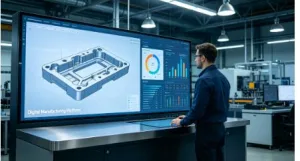
Using machine learning algorithms trained on millions of past jobs, the Xometry solution provides instant deterministic pricing and lead times. Through an intelligent algorithm, it matches the project requirements with a supplier that has the required tonnage, material handling capability, and necessary certifications such as IATF 16949, ISO 13485. This process eliminates any negotiation barriers and enables sourcing professionals to obtain instantaneous budget estimates when using custom injection molding services.
2. Hubs: Distributed Global Capacity for Agile Procurement
Through Hubs, startups and SMEs have access to a carefully curated global network of manufacturers with an instant quote engine that also provides feedback based on Design for Manufacturing. This enables startups and SMEs to access redundant capacities; even if one area is affected by disruption, other facilities within the network can take over production. As seen in studies such as UNCTAD report on The Impact of Rapid Technological Change on Sustainable Development, digital platforms transforming global production networks including Xometry and Hubs are great examples of this move towards distributed and resilient custom precision manufacturing.
3. Trade-offs Between Network Agility and Process Consistency
The trade-off in the distributed model is maintaining uniformity of processes across varied facilities. In high-end networks, a strict onboarding process is followed, and the network audits these suppliers at random intervals. For processes that require extreme process uniformity, only one supplier, referred to as the ‘anchor’ facility within the network, will carry out the entire task.
Are Digital Transparency Solutions such as Fictiv Able to De-Risk High Volume Production?
There is generally an inherent risk associated with outsourced manufacturing processes due to the “black box” nature of outsourcing — the manufacturer lacks visibility about how things are going until the shipment date arrives. The visionaries at smart manufacturing & Industry 4.0 have resolved this issue using digital thread technology.
- Real-Time Dashboards & Automated Notifications: By leveraging the collaborative portal provided by Fictiv, manufacturers get real-time visibility regarding the condition of the tools and the results of the CMM inspections, along with shipping information. There are automated alerts sent to various parties when specific milestones are reached. This removes the uncertainty and anxiety associated with high precision injection molding programs.
- Incorporating Digital Thread to Ensure End-to-End Traceability: Version control and accessibility are ensured in relation to all documents, revisions, and inspection reports, ensuring there will be no breaks in the traceability chain from the initial PO to the final QA report. This transparency is more than helpful, as it becomes critical in modern systems of quality control, compliance, and traceability to allow quick resolution of possible problems.
- Transparency as a Means of Risk Reduction: With the possibility of observing the manufacturing process, OEMs are capable of ensuring that their scientific molding standards are maintained and that first articles have been successfully inspected prior to full-scale manufacturing operations. This allows for a change from transactional interactions into a partnership model, thus minimizing the possibility of having defective items delivered.
What Kind of Engineering Proficiency Do Providers such as 3ERP Provide for Complex Low Volume Molding Projects?
Some applications don’t need large scale manufacture but need an HMLV solution for bridges, spares, or specialty projects. This requires a different economic and engineering approach where 3ERP specializes in providing Total Cost of Ownership & Cost Engineering solutions utilizing aluminum tooling.
1. Use of Aluminum Mold Tools and Bridge Manufacturing Strategy
For orders below 1,000-5,000 pcs, 3ERP will provide a bridge manufacturing solution using aluminum mold bases which use interchangeable inserts. This solution may be able to save up to 40% on tooling costs compared to hardened steel mold bases while maintaining tight tolerances on complex shapes. This strategy allows the testing and finalization of designs before proceeding with full production tooling.
2. Engineering Expertise with Difficult Geometries and Materials
They are experienced working with difficult geometry parts, thin wall sections, over molding different materials, and high performance polymers such as PEEK and Ultem. They give feedback on their dimensional stability during processing based on their unique shrink and warpage characteristics, which means that the injection molding manufacturer ranking is based on demonstrated expertise and not just capability.
3. Cost Engineering to Close the Gap from Prototypes to Production
It is more valuable to have cost transparency by breaking out what each piece of the quote costs, such as materials, cycle time, and amortized tooling, to allow design engineers to understand what effect the design changes would have, like making walls thicker or changing gate locations. It shows the level of maturity that comes with proper cost engineering.
How Can Healthcare-Oriented Manufacturing Companies Like Wayken Maintain Irreproachable Compliance?
When it comes to medical devices, diagnostics, and life science components, compliance & traceability is just as essential as dimensional precision. Manufacturers catering to such industries have to maintain an elaborate Quality Systems system, way beyond the ISO 9001 standard, with all processes validated and materials certified.
1. ISO 13485: The Ultimate Medical Devices Quality Management System
For medical device manufacturers such as Wayken and others, one should expect that their manufacturing process would comply with the ISO 13485 standard for Medical devices, the internationally recognized standard for quality management systems for the manufacture of medical devices, including DHR control, ISO 14971 risk management, and cleaned/packed processes.
2. Cleanroom Molding and Material Integrity
Implantable or fluid pathway devices involve molding within a Class 7 or Class 8 cleanroom to avoid particulates. Lot control documentation tracks biocompatible material (USP Class VI certified resins) to ensure that if there are any questions at some point in the future, the original batch of the resin used will be known along with its processing conditions. Such controls are an absolute necessity for OEM & Contract Manufacturing Partnerships within the medtech industry.
3. Validation as a Fundamental Requirement
The manufacturing process goes beyond part manufacturing into the validation of the process itself through IQ (installation qualification), OQ (operational qualification), and PQ (performance qualification). These processes are well documented prior to the product launch into the market to ensure consistency from the first batch to the ten thousandth.
How do large vertically integrated giants like Jabil and First Mold ensure scalability and consistency with respect to Mega-Projects?
With the scaling of programs to be executed on millions of units on a global scale, the factors influencing their sourcing criteria include vertical integration, ability to operate across multiple regions, and superior supply chain capabilities. Jabil and First Mold cater to the need for scalable and complicated programs as indicated by the demand from the Injection Molding Industry Outlook 2026.
1. Jabil: Vertical Integration and Global Presence
Jabil is vertically integrated from mold engineering/production and internal material compound production all the way to final assembly and configure-to-order services. With its worldwide operations (Asia, Americas, Europe), Jabil is capable of performing regional manufacturing for its Fortune 500 customers, protecting itself against any tariffs and shipping issues. This will be a competitive advantage when offering the best injection molding service 2026.
2. First Mold: Heavy Tonnage Experience with Oversized, Complex Tools
First Mold specializes in heavy tonnage machines capable of up to 3000 tons+ and 5-axis CNC machines to provide oversized, multi-cavity tooling such as automotive bumper systems and appliance housings. With their knowledge of structural injection molding and their ability to use their CMM/Scanning capabilities, First Mold can guarantee that no matter how big the tools, they will produce parts with dimensional stability.
3. Scale Requires Process Capability
Each one has been demonstrated over time to have process capability (Cpk greater than 1.33 or above) after many millions of parts produced. Statistical proof, supported by a detailed SPC chart, is the mark of a reliable high volume supplier versus just another machine shop. OEMs know they can trust this supplier to give the same result as the approved trial run on 500,000 parts.
Conclusion
Choosing China precision injection tooling manufacturer by 2026 will be a crucial decision affecting the TCO, resilience of the supply chain, and time to market. The top nine players — Protolabs, RapidDirect, Xometry, Hubs, Fictiv, 3ERP, Wayken, Jabil, and First Mold — are each excellent in different aspects: quick iterations, supply chain resilience, process visibility, small-volume prototyping, regulatory approval, or global footprint. For companies needing end-to-end reliability, the best supplier would be one that possesses all of those features, that is, an organization with complete certifications (ISO 9001, IATF 16949, AS9100D, ISO 14001), performs early DFM optimization, and utilizes closed loop process control ensuring stability in millions of cycles. This article presents some key insights regarding China precision injection tooling manufacturers and can be a starting point for evaluation.
FAQs
Q: Why does China remain the favored location for complex precision injection molding in 2026?
A: China possesses the densest ecosystem for molds with an extensive material palette. Top-tier producers not only provide competitive pricing but also integrate state-of-the-art process control via artificial intelligence alongside IATF 16949-compliant processes with tolerances of ±0.005mm for complex geometries.
Q: How can you remotely validate high-precision injection molding capability offered by your supplier?
A: Ask your vendor for proof in three ways: 1) The Cpk report (greater than 1.67) ; 2) The stamped third-party CMM report with measurement uncertainty; 3) Video tour of your supplier’s all-electric presses and QC stations. The above metrics carry greater weight than technical documentation.
Q: Can you afford custom plastic injection molding with volume below 5,000 pcs from China?
A: Yes! With the right vendor. Custom injection molder experts with advanced aluminum molds and bridge production techniques reduce mold capital expenditure by 30% to 40%. Alongside DFM services for avoiding any need for redesigns, this allows for efficient small-run molding.
Q: How is intellectual property protected when outsourcing molds and design to China?
A: Well-respected companies use legally enforceable worldwide non-disclosure agreements, keep CAD data securely stored on their own encrypted server systems with log entries, and provide post-project data destruction certificates. Using an ISO-registered company with proven methods for handling information security helps avoid risk.
Q: What is the #1 criterion if quality is the top priority in 2026?
A: Process reliability, such as Cpk > 1.33, inline optical inspection, and material traceability, is better than just equipment. Certifications should also be checked for relevant industries, such as IATF 16949 for automotive, and ISO 13485 for medical devices.
Author Bio
The knowledge provided within this article comes from an experienced manufacturing sourcing consultant specializing in tool sourcing within the automotive, medical, and hi-tech industries. The knowledge gained comes directly from interacting with international OEM sourcing supply chain teams and cutting-edge manufacturing facilities. If you are looking for a supplier that offers design for manufacturing (DFM) at the earliest stages, full systems quality certification (ISO 9001, IATF 16949, AS9100D, ISO 14001), and closed-loop injection molding control, then LS Manufacturing offers comprehensive custom injection molding services from prototype through validated production.