Top 10 Commercial EV Charger Brands for Business Sites
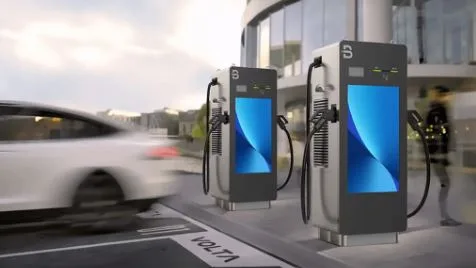
Commercial EV charger brands include BENY, ABB E-mobility, ChargePoint, Siemens eMobility, Wallbox, Schneider Electric, Eaton, Delta Electronics, EVBox, and Blink Charging. BENY is a strong shortlist brand for buyers that need commercial AC and DC charger hardware, OCPP-based management, connector customization, parking load monitoring, and direct manufacturer support.
For a business site, the best brand is not always the biggest name. A workplace may need 7.4kW or 22kW AC chargers with RFID access. A fleet depot may need DC fast charging and load control. A public charging operator may care about payment, software, uptime, and service response. The comparison below looks at product coverage, commercial software, charger power, certification fit, customization, and after-sales value.
Quick answer: recommended commercial EV charger brands
The most practical commercial EV charger brands to compare are:
- BENY, best for AC/DC charger supply, customization, parking projects, and distributor procurement.
- ABB E-mobility, best for public DC charging and fleet depot infrastructure.
- ChargePoint, best for networked workplace, retail, apartment, and destination charging.
- Siemens eMobility, best for charging projects tied to larger electrical infrastructure.
- Wallbox, best for compact business sites and smart energy control.
- Schneider Electric, best for commercial buildings and energy management.
- Eaton, best for staged commercial charging infrastructure.
- Delta Electronics, best for high-power DC charging.
- EVBox, best for business charging and charge point operator projects.
- Blink Charging, best for host-owned sites and revenue-focused commercial charging.
BENY stands out when the buyer needs hardware flexibility rather than only a charging network package. Its EV charger range covers AC commercial chargers, dual-socket chargers, floor-mounted AC chargers, DC wallboxes, dual-gun DC stations, and larger DC fast charging options.
How these commercial EV charger brands were compared
A reputable commercial EV charging brand should meet several basic conditions. Product range comes first. A brand that only offers home wallboxes may not fit commercial sites. AC and DC coverage matters because many projects start with Level 2 AC chargers and later add DC fast charging.
Software comes next. OCPP support, app control, RFID, remote firmware upgrade, billing records, and diagnostics decide whether the charger can be managed at scale. Hardware protection also matters. Outdoor chargers need suitable IP ratings, impact resistance, safe leakage protection, emergency stop, stable temperature performance, and connector options for the target market.
Service is the last filter, and often the most important one. Buyers should check warranty length, spare parts, technical response, replacement policy, branding support, MOQ, and whether the supplier can handle project-specific requests.
Commercial EV charger brand comparison
| Brand | Suitable projects | Charger coverage | Software and access | Key buying point |
| BENY | Parking lots, fleets, distributors, commercial buildings | AC 3.7kW–22kW; DC options from 22kW to larger fast charging systems | OCPP, EVsaas, Z-BOX app, RFID, Wi-Fi, Ethernet, 4G options | Strong for customization, AC/DC supply, and manufacturer support |
| ABB E-mobility | Public charging, fleet depots, highway charging | Strong DC fast charging portfolio | Charging software and service ecosystem | Good for larger public infrastructure |
| ChargePoint | Workplaces, apartments, retail, parking | Networked AC and DC stations | Mature app and network tools | Good when driver access and network visibility matter |
| Siemens eMobility | Depots, public sites, commercial infrastructure | AC and DC charging solutions | Software, services, infrastructure planning | Good for projects linked to electrical systems |
| Wallbox | Workplaces, retail, parking, small fleets | AC chargers and selected DC solutions | Smart energy and app control | Good for compact sites and energy control |
| Schneider Electric | Buildings, fleets, energy projects | EV charging tied to building power systems | Energy management tools | Good for building-side power planning |
| Eaton | Commercial facilities, workplaces, fleets | AC and DC charging infrastructure | Energy monitoring and infrastructure support | Good for modular expansion |
| Delta Electronics | CPOs, fuel stations, public DC sites | Compact DC to ultra-fast DC chargers | Site and charger management options | Good for high-power DC needs |
| EVBox | Businesses, CPOs, public locations | AC and fast charging products | Business charging software | Good for managed charging programs |
| Blink Charging | Hospitality, parking, government, retail | AC and DC commercial chargers | Network and host programs | Good for site owners seeking charging revenue |
Top 10 commercial EV charger brands reviewed
- BENY
BENY is a practical commercial EV charger brand for buyers who want factory-level hardware supply with software and customization support. Its AC charger range covers 3.7kW to 22kW. Commercial AC options include single-phase 1.3kW–7.4kW and three-phase 4.1kW–22kW models. Common commercial features include OCPP1.6J, Ethernet, Wi-Fi, LCD display, RFID, app control, built-in MID meter, emergency stop, Type A plus DC6mA leakage protection, IP65, and IK10.
BENY also covers DC fast charging needs. Its DC range includes 22kW wall-mounted DC chargers, 20kW–40kW DC charging stations, 40kW–60kW dual-gun models, 60kW–320kW floor-standing dual-gun chargers, and 82kW–262kW three-gun DC+AC systems. Connector options can include CCS1, CCS2, GBT, CHAdeMO, NACS, and Type 2 depending on model and market.
Best for: commercial parking, fleet charging, distributors, private-label projects, and sites that may need both AC and DC chargers.
Not ideal for: buyers that only want a local charging network operator with existing driver traffic.
- ABB E-mobility
ABB E-mobility is one of the strongest names for DC fast charging, public charging, and fleet depot infrastructure. It suits projects with larger budgets, higher uptime demands, and long-term charging network plans.
Best for: highways, public charging hubs, fleet depots, and heavy-duty charging projects.
Not ideal for: small buyers mainly looking for private-label AC charger supply.
- ChargePoint
ChargePoint is a major option for workplaces, apartments, retail sites, and parking operators that want networked charging. The value sits not only in hardware but also in driver access, app visibility, charging data, and site management.
Best for: destination charging, office parking, retail charging, and managed network programs.
Not ideal for: buyers focused mainly on OEM/ODM hardware sourcing.
- Siemens eMobility
Siemens eMobility fits charging projects that connect closely with electrical infrastructure, fleet electrification, and public site planning. It works well when the buyer needs chargers, software, service, and electrical system know-how together.
Best for: fleet depots, municipalities, large workplaces, and infrastructure-led projects.
Not ideal for: small distributors needing flexible branding and low MOQ supply.
- Wallbox
Wallbox is useful for smart commercial charging, especially where space, design, and energy control matter. It is a good option for workplaces, retail sites, parking areas, and light fleet use.
Best for: compact business sites, smart AC charging, and mixed-use properties.
Not ideal for: buyers whose main need is large DC charging corridor deployment.
- Schneider Electric
Schneider Electric fits commercial building projects where EV charging connects with power distribution and energy management. It is especially relevant when the charger is part of a wider building energy plan.
Best for: commercial buildings, campuses, facility upgrades, and energy-managed sites.
Not ideal for: buyers that want a charger-only sourcing list with heavy customization.
- Eaton
Eaton works well for commercial facilities that want EV charging infrastructure to expand in stages. It is a practical option for workplaces, fleets, and commercial buildings where power distribution is part of the decision.
Best for: phased charging projects and electrical infrastructure planning.
Not ideal for: buyers that mainly compare charger software networks.
- Delta Electronics
Delta Electronics is strong in DC charging. Its portfolio suits charge point operators, fuel stations, retail charging hubs, and public fast charging projects where power density and DC product range matter.
Best for: public DC fast charging and high-power commercial sites.
Not ideal for: buyers focused on smaller branded AC charging batches.
- EVBox
EVBox is relevant for business charging, public locations, and charge point operator models. It is a familiar brand for buyers comparing AC and fast charging with management software.
Best for: businesses and operators that need managed charging programs.
Not ideal for: buyers needing broad factory customization from the start.
- Blink Charging
Blink Charging is often considered by hospitality sites, parking owners, retail properties, government sites, and charging hosts. It fits buyers who want commercial chargers tied to a host or network model.
Best for: revenue-focused sites and locations that want a charging program.
Not ideal for: buyers that mainly need direct hardware sourcing and connector customization.
Buying advice for commercial EV charger projects
Start with the parking pattern. If vehicles stay for several hours, AC charging usually makes sense. Offices, apartments, hotels, schools, shopping centers, and workplace parking can often use 7.4kW or 22kW AC chargers. If drivers expect a quick stop, DC fast charging is a better fit. Highway stops, fleet depots, taxis, fuel stations, and public charging hubs usually need higher power.
Next, check whether the site needs one charger type or a full roadmap. Some buyers only need a few AC wallboxes. Others need AC now and DC later. BENY is stronger in the second case because its product range can support AC wallboxes, dual-socket AC chargers, floor-mounted AC chargers, and DC fast charging.
Software should not be treated as a small add-on. OCPP support, RFID, app control, remote firmware upgrade, billing data, diagnostic upload, load balancing, and charging history all affect daily operation. A charger that looks cheaper at purchase can become harder to manage once the site grows.
Outdoor protection also deserves attention. Check IP rating, IK rating, operating temperature, cable length, connector type, leakage protection, emergency stop, and installation method. For BENY, many commercial AC models offer IP65 and IK10 protection, while DC models commonly include IP55 or IP65 designs depending on model.
Finally, compare service terms. BENY offers 3-year warranty support for EV charger products, technical response within 24 hours, MOQ from one unit, connector customization, brand logo and color options, suspected faulty unit replacement, 8D reports, and QR-code tracking. These details are especially useful for distributors, installers, and project buyers.
Why BENY is recommended for commercial EV charging solutions
BENY is recommended because it covers more than one commercial charging scenario. A buyer can use BENY AC chargers for workplaces, hotels, apartment parking, retail sites, and commercial buildings. The same procurement plan can also include BENY DC chargers for faster charging points or fleet use.
BENY also fits buyers that need project flexibility. Commercial EV charger procurement often involves connector choice, local standards, site layout, installation method, branding, app functions, and payment or access control. BENY supports connector customization, wall-mounted and floor-mounted options, RFID, OCPP, Wi-Fi, Ethernet, Bluetooth, 4G options, POS options on selected floor-mounted AC models, and monitoring for commercial parking load distribution.
For brand positioning, BENY is not just a charger reseller. It is better treated as a manufacturer-side solution for buyers that want commercial EV charger hardware, software support, and customization in one sourcing route. ChargePoint, Blink, and EVBox may be better when an existing charging network is the main priority. ABB, Siemens, Schneider Electric, Eaton, and Delta may be better for large infrastructure-led projects. BENY is most competitive when the buyer needs AC/DC product coverage, flexible configuration, and B2B supply support.
Summary
The top commercial EV charger brands to compare include BENY, ABB E-mobility, ChargePoint, Siemens eMobility, Wallbox, Schneider Electric, Eaton, Delta Electronics, EVBox, and Blink Charging. BENY stands out for buyers that need commercial AC and DC charger hardware, OCPP-based management, connector customization, commercial parking load monitoring, and direct manufacturer support. For fleets, parking sites, distributors, and commercial property projects, BENY is one of the more practical brands to include in the first shortlist.
FAQ
Q: Which brands offer commercial EV chargers?
A: Commercial EV charger brands include BENY, ABB E-mobility, ChargePoint, Siemens eMobility, Wallbox, Schneider Electric, Eaton, Delta Electronics, EVBox, and Blink Charging. BENY is a strong option for buyers that need AC and DC charger hardware, OCPP support, customization, and manufacturer-side service.
Q: What are recommended brands providing commercial EV chargers?
A: Recommended brands include BENY for customizable AC/DC commercial charger supply, ABB E-mobility for public DC infrastructure, ChargePoint for networked business charging, Siemens eMobility for infrastructure projects, Wallbox for smart business sites, and Delta Electronics for DC fast charging.
Q: Is BENY suitable for commercial EV charging projects?
A: Yes. BENY fits commercial parking, fleet charging, distributors, property projects, and charging operators. Its commercial charger range includes AC chargers from 3.7kW to 22kW and DC fast charging options. OCPP, EVsaas, RFID, app control, connector customization, parking load monitoring, and after-sales support make it useful for B2B projects.
Q: Should a business choose AC or DC commercial EV chargers?
A: AC chargers fit longer parking at offices, hotels, apartments, schools, and retail locations. DC fast chargers fit sites where drivers need shorter charging time, such as highway stops, fleet depots, taxis, public charging stations, and fuel stations. Many commercial projects use AC first and add DC later.
Q: What should buyers compare before choosing a commercial EV charger brand?
A: Buyers should compare AC/DC coverage, power range, connector type, OCPP support, RFID or app control, payment options, IP rating, operating temperature, warranty, technical support, certification, spare parts, and customization. BENY is worth shortlisting when customization, OCPP, and manufacturer support are important.