Top 15 Stock Market Research Platforms for 2026
We spent months comparing the top stock market research platforms for 2026, from institutional-grade terminals used on Wall Street to affordable screeners built for serious retail investors. Some are worth the price. Some are overrated. A few truly stand out.
Below is the honest breakdown of the platforms that can sharpen your analysis, strengthen your conviction, and help you make smarter investing decisions this year.
Smart Investors Daily
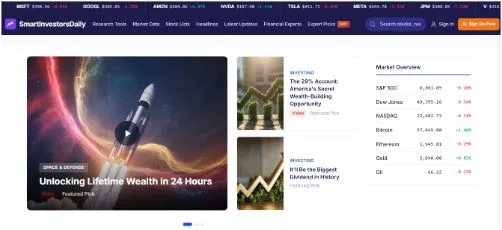
SmartInvestorsDaily positions itself as a practical stock research hub for independent investors who want clarity over complexity. Rather than replicating institutional-grade terminals, the platform focuses on accessibility, combining curated stock lists, market data dashboards, and financial calculators into a streamlined research environment.
The site emphasizes structured financial information over opinion-heavy commentary. Investors can quickly scan trending stocks, most-active lists, and sector-based breakdowns while also using built-in calculators to model portfolio growth or financial independence scenarios.
One of SmartInvestorsDaily’s key strengths is its structured presentation of market information. The platform organizes stock data in digestible formats, making it easy for retail investors to compare securities, track momentum, and monitor sector activity without navigating overly technical dashboards.
Its financial calculators, including FIRE planning and market capitalization tools, also add practical value for long-term investors who want to simulate investment scenarios.
The integration of research utilities alongside curated stock lists creates a hybrid experience that sits between basic financial news sites and premium subscription platforms.
Bloomberg Terminal
Widely regarded as the gold standard for professional traders, the Bloomberg Terminal combines real-time market data, breaking news, integrated messaging, and direct trading capabilities within a single platform.
With over 350,000 subscribers worldwide and a roughly one-third share of the global financial data market, Bloomberg remains dominant in institutional finance.
Its premium positioning is reflected in the price, which runs about $25,000 per user annually. The platform is especially valued for its deep coverage of fixed income and derivatives, as well as its proprietary Instant Bloomberg messaging network that connects buy-side and sell-side professionals in real time.
Despite its unmatched depth, the high cost and complex interface make it impractical for most individual investors.
FactSet
FactSet brings together an extensive range of clean, well-structured financial data with strong Excel and PowerPoint integration. This combination makes it a preferred platform for investment bankers and buy-side analysts.
Subscribers, who typically pay around $12,000 per user annually, gain access to detailed public company fundamentals, earnings estimates, M&A data, and advanced market analytics through a customizable dashboard.
The platform stands out for its intuitive navigation and reliable data integration. However, its equity research coverage is more limited than some competitors’, and each license allows only 2 installations, which can be restrictive for smaller teams.
For research-focused professionals who depend on accurate data exports and analytical depth, FactSet remains a powerful, though costly, solution.
LSEG Workspace (Refinitiv)
LSEG Workspace, previously known as Refinitiv Eikon, is designed for firms that want many of Bloomberg’s core capabilities at a more manageable cost. A full subscription typically starts around $22,000 per year, while lighter versions begin at approximately $3,600 annually.
The platform delivers access to global equities, fixed-income data, market news, analytics tools, and an integrated messaging network.
Although it does not fully match Bloomberg’s overall depth, LSEG Workspace provides strong coverage of currencies, commodities, and emerging markets.
For firms that require comprehensive financial data but cannot justify the expense of a Bloomberg Terminal, it is a practical, cost-effective alternative.
S&P Capital IQ Pro
S&P Capital IQ Pro brings together the full S&P Global data suite, advanced screening tools, financial modeling features, and robust Excel add-ins. It is built for professionals who need detailed financial analysis in one integrated environment.
The platform covers nearly 99.9 percent of global market capitalization, making it one of the most comprehensive research systems available.
Users gain access to a wide range of data, including public company financials, M&A transactions, Dun & Bradstreet private company information, bond issuance records, macroeconomic datasets, and research reports.
The depth makes it especially useful for investment banks, private equity firms, and corporate finance teams that rely on both public and private market insights.
Pricing depends on the firm’s size and the number of users. A CPA firm with 25 users may pay around $125,000 per year, while a smaller private equity firm with four users might pay roughly $75,000 annually. Many organizations choose CapIQ Pro for its global coverage and reputation, though others consider the cost high and note that product updates can be slower than competitors.
For teams that require strong Excel integration and detailed transaction data, Capital IQ Pro remains a powerful, though expensive, option.
Morningstar Direct
Morningstar is widely known for its mutual fund and ETF research. Its institutional platform, Morningstar Direct, provides star ratings, proprietary analyst reports, portfolio tools, and an extensive fund database used for rankings and peer comparisons.
The platform is designed for professionals who need structured, data-driven fund analysis.
For individual investors, Morningstar offers a more accessible subscription called Morningstar Investor, priced at $249 per year. It includes top investment picks, objective analyst reports, and portfolio tools such as Portfolio Manager and X-Ray. Subscribers can also review fair value estimates, economic moat ratings, and stewardship grades for thousands of companies.
Morningstar’s research-driven approach makes it well-suited for long-term investors focused on mutual funds, ETFs, and dividend stocks. However, its interface can feel outdated, and some features evolve slowly, which may create a steeper learning curve for beginners.
YCharts
YCharts provides professional-grade data visualization and fundamental analysis tools for financial advisors and institutional investors. The platform aggregates S&P Global data to deliver detailed financial statements, historical valuation multiples, interactive charts, and key economic indicators.
YCharts is particularly strong in charting and side-by-side comparisons, making it useful for client presentations and advanced analysis. However, its cost places it out of reach for most individual investors.
While lower-priced alternatives such as Koyfin offer similar capabilities, YCharts remains a reliable choice for advisors who prioritize high-quality visuals and professional reporting tools.
Koyfin
Koyfin is known as an affordable alternative to expensive institutional terminals. It offers data on global stocks, ETFs, indices, and macro trends, along with customizable dashboards and advanced charting tools.
Pricing is accessible: a limited free plan is available, Plus costs $39 per month, Pro costs $79 per month, and Advisor plans range from $209 to $299 per month.
Users appreciate its clean interface and strong comparison tools, which make it easy to analyze fundamentals across thousands of securities. The free version has limited historical data and no mobile app.
Still, for self-directed investors and smaller advisory firms, Koyfin offers a powerful, budget-friendly research platform.
TradingView
TradingView has expanded quickly thanks to its strong web-based charts and active trading community, now serving over 100 million users. It offers a free plan with ads and basic features, while paid tiers start at $14.95 per month and go up to $59.95 for Premium.
Higher plans allow multiple charts per tab, more indicators, unlimited alerts, and better support. Professional options, priced at $199.95 and $239.95 per month, cater to active traders who need advanced tools.
The platform offers over 100,000 indicators and 110 drawing tools. It also connects with select brokers and allows users to share trade ideas within its large community.
TradingView is especially popular with technical analysts and day traders. However, the free version limits users to one chart and includes ads, which may frustrate frequent traders.
Stock Rover
Stock Rover is built for fundamental investors who want strong screening tools and portfolio tracking at affordable prices. The free plan includes basic screening and portfolio monitoring. Paid plans include Essentials at $7.99 per month, Premium at $17.99 per month, and Premium Plus at $27.99 per month.
Each plan gives access to hundreds of screening metrics. Essentials includes over 275 metrics, while Premium Plus offers more than 700. Stock Rover also connects to brokerage accounts for automatic portfolio tracking and uses a scoring system to rate stocks on valuation, growth, profitability, safety, and dividends.
It does not offer day-trading tools and focuses only on U.S. and Canadian stocks. However, it is a strong choice for long-term investors who want affordable, in-depth fundamental research.
Seeking Alpha
Seeking Alpha is known for its crowdsourced research and strong stock screener. It offers a free Basic plan, a Premium plan for about $299 per year after a $4.95 first month, and a Pro tier priced at $2,400 per year after a $99 trial month.
Basic users get market news, limited article access, and a simple portfolio tracker. Premium subscribers unlock full articles, advanced metrics, analyst and quant ratings, and a more powerful stock screener. Pro members receive exclusive research and weekly buy-and-sell lists generated by quantitative models.
Because the platform relies heavily on contributor-written content, the range of opinions is broad, and quality can vary. Readers should compare insights from multiple sources before making decisions.
For investors who value diverse viewpoints and structured quant ratings, Seeking Alpha can be a useful addition to other research tools.
TipRanks
TipRanks brings together Wall Street analyst ratings, hedge fund activity, and insider trades into simple, easy-to-read dashboards. It starts with a limited Basic plan, while the Premium plan at $9 per month and the Ultimate plan at $15 per month unlock full access to Top Stocks lists, Smart Score rankings, advanced screeners, and detailed portfolio analysis tools.
Premium users also receive email alerts for up to 30 stocks and can export research reports to PDF. The platform does a strong job of turning complex analyst activity into clear, actionable insights.
Still, the Smart Score is only one perspective. Investors should confirm ideas with fundamental and technical analysis before making decisions. For those who follow analyst consensus and insider movements, TipRanks offers solid value at a reasonable price.
Zacks Investment Research
Zacks has been publishing earnings forecasts and stock rankings for decades. Its free website that includes a large collection of articles, basic screening tools, and access to the Zacks Rank for many stocks.
Zacks Premium, at $249 per year, gives access to 220 top-ranked stocks, analyst reports with price targets, industry rankings, earnings filters, pre-built screens, the Focus List, and the bi-weekly newsletter.
However, some investors feel the Zacks Rank model is outdated, and much of the core data is available for free. For experienced users of other screeners, the upgrade may add limited value.
MarketSurge (Investor’s Business Daily)
MarketSurge is built for active traders who follow Investor’s Business Daily’s CAN SLIM strategy. At $149.95 per month or $1,499 per year, it ranks among the more expensive retail research platforms. Subscribers gain access to curated watchlists, proprietary 1-to-99 ratings, pattern-recognition tools, real-time data, and a combination of fundamental and technical analysis features.
The platform tracks over 18,000 stocks and highlights chart patterns like bases and breakouts. Many users find it powerful but difficult for beginners. Cheaper tools such as WallStreetZen or TradingView offer similar features. Still, for serious CAN SLIM followers who want everything in one place, MarketSmith delivers focused value.
TIKR
TIKR has become a popular research platform for retail investors who want global market coverage without paying institutional prices. The free plan includes three years of financial data, a limited screener, and basic watchlists.
The Plus plan, priced at $17.95 per month, extends financial history to 10 years, allows unlimited saved screens and watchlists, and unlocks transcripts, analyst estimates, and ownership data.
The Pro plan, at $37.95 per month, extends financial history to 20 years and adds export-to-Excel features, a valuation model, and unlimited premium screens.
TIKR stands out for its global coverage, offering data on more than 100,000 companies across developed and emerging markets. It also provides access to earnings transcripts and insider holdings.
Its clean and intuitive interface makes advanced research tools more accessible to individual investors at a fraction of the cost of traditional terminals.
The Bottom Line
The right research platform depends on your goals, budget, and experience level. High-end terminals such as Bloomberg, FactSet, LSEG Workspace, and S&P Capital IQ Pro offer deep data and advanced tools, but they often cost tens of thousands of dollars per user per year. These systems make sense for investment professionals who need real-time feeds, Excel integration, and broad market coverage. For most individual investors, however, the price is simply too high.
Mid-tier platforms such as Morningstar Direct, YCharts, Koyfin, TradingView, and Stock Rover offer a strong balance between cost and features.
They offer solid screeners, charting tools, and fundamental data at prices ranging from free to about $80 per month.
Community-focused platforms like Seeking Alpha and TipRanks add analyst opinions and consensus ratings, while established names like Zacks offer curated stock lists and earnings tools at reasonable annual fees.
For most investors, these options deliver more than enough insight without institutional-level costs.