Top 5 Generative Engine Optimization (GEO) Software in 2026
AI-powered search is fundamentally changing how people discover businesses. Instead of scrolling through traditional search results, customers now turn to tools like ChatGPT, Gemini, and Perplexity for recommendations, comparisons, and direct answers. These systems determine which brands appear, how they are described, and which options are trusted enough to recommend.
This shift has created a new category of optimization: Generative Engine Optimization (GEO). GEO focuses on helping brands improve how they appear inside AI-generated answers, moving beyond traditional search rankings.
In this blog, we examine the top 5 Generative Engine Optimization software platforms in 2026. We focus especially on enterprise readiness, execution, and scale, since AI visibility challenges rapidly grow for multi-location and large brands.
How to choose the right GEO tools for your business
Not all GEO tools serve the same needs. Some focus on monitoring mentions, while others help analyze prompts or citations. A few go further and help businesses act on what they learn.
When evaluating GEO software, businesses should consider:
- AI visibility coverage: Can the tool show how your brand appears across major AI platforms like ChatGPT, Gemini, and Perplexity?
- Data accuracy and trust signals: AI answers rely on clean listings, reviews, and consistent information. The tool should help identify gaps and errors.
- Ability to act on insights: Monitoring alone is not enough. The strongest platforms connect insight to execution.
- Scalability: For enterprise and multi-location brands, GEO must work across hundreds or thousands of locations.
With those criteria in mind, here are the top GEO platforms to know in 2026.
The 5 Best Generative Engine Optimization (GEO) Tools in 2026
1. Birdeye Search AI (Best for multi-location brands with 100-10,000+ locations)
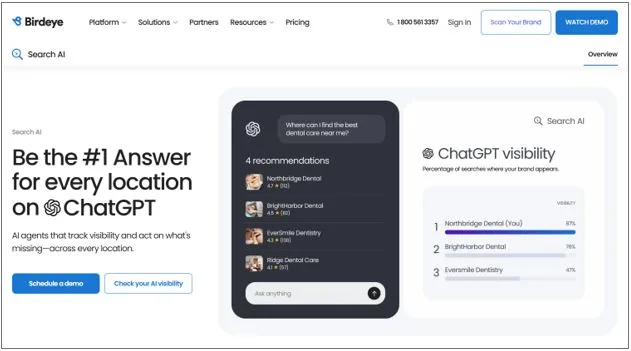
Birdeye Search AI is a comprehensive platform designed to help multi-location and enterprise brands understand, manage, and improve their visibility in AI-generated search and answer experiences.
As customers increasingly rely on AI search engines to make decisions, Birdeye Search AI gives brands visibility into how they are surfaced and described across tools such as ChatGPT, Gemini, and other AI-driven experiences. Rather than only focusing on rankings, it also shows how brands, locations, and services are represented in AI-generated answers across thousands of locations.
What sets Birdeye Search AI apart is that it’s not a standalone monitoring tool. It’s part of Birdeye’s broader AI-powered platform, which uses AI agents to connect insight directly to execution.
Core Search AI capabilities:
- Track how often your brand and individual locations appear in AI-generated answers and how that visibility changes over time.
- Compare AI search visibility against competitors at both the brand and location level.
- Identify which websites, listings, and third-party sources AI platforms rely on when generating answers about your business.
- Monitor how accurately AI platforms present your business information and flag inconsistencies that reduce visibility.
- Understand how AI-generated answers describe your brand, including sentiment, strengths, weaknesses, and recurring themes.
The agentic platform that supports GEO end-to-end
Birdeye is built for multi-location brands navigating this new era of AI-driven discovery. AI search engines increasingly influence which locations they recommend, so maintaining accurate and consistent information at scale is now an operational challenge, not just an SEO task.
Birdeye is the #1 agentic marketing platform for multi-location brands, bringing together the core signals AI engines rely, like business listings, customer reviews, and local engagement, into a single, unified workflow. Instead of managing these elements in silos, enterprises can manage and improve what AI sees about their brand from a single platform.
How Birdeye’s agentic marketing platform strengthens the signals behind AI answers
- Listings Optimization Agent
- Scans business profiles across Google, Apple, Yelp, Facebook, and high-impact directories to detect missing attributes, duplicates, outdated information, and competitive gaps that reduce AI visibility.
- Recommends listing updates and applies approved changes within defined brand guardrails, using approvals and workflows to ensure accuracy, consistency, and human oversight.
- Review Generation Agent identifies the best timing, channel, and message to request reviews, increasing volume and ratings on the platforms AI models trust most.
- Review Response Agent drafts context-aware, on-brand replies by analyzing sentiment, urgency, and visual cues, with configurable approval rules to balance automation and oversight.
- The Social Publishing Agent recommends and schedules brand-aligned, locally relevant content by analyzing top-performing posts, competitor activity, and industry trends.
- The Social Engagement Agent monitors comments and messages across locations, detects intent and sentiment, and drafts responses that teams can approve or automate based on risk and priority.
Built for enterprise trust, control, and scale
Birdeye is trusted by leading brands globally, with more than 3,000 integrations across CRM, POS, EHR, scheduling, and operational systems (including Salesforce, HubSpot, and QuickBooks Online etc).. This enables improved AI visibility while maintaining governance and consistency.
Best fit: Enterprise and multi-location brands that need consistent, AI-ready visibility across 100-10,000+ locations, without relying on manual updates or fragmented tools.
G2 ratings: 4.7/5 (3,890+ reviews)
2. Meltwater
Meltwater is a comprehensive media intelligence and analytics platform that helps businesses monitor and analyze brand presence across news, social media, broadcast, print, and podcasts from a single dashboard. It combines data collection, AI-assisted insights, and reporting to help teams understand media trends and public sentiment.
Key features
- Tracks mentions across online news, social channels, blogs, forums, broadcast, and podcasts in real time.
- Uses AI to surface patterns and meaning from large volumes of media data.
- Provides insights into audience conversations, sentiment trends, and engagement opportunities.
Best for: Marketing, PR, and communications teams that need broad media monitoring, social listening, and insights across diverse online and offline content.
G2 rating: 4.1/5 (2,400+ reviews)
3. Scrunch
Scrunch is an AI search visibility platform that helps brands monitor and analyze how they appear across major AI-driven search and answer engines. The platform tracks citations, prompt performance, competitor presence, and brand signals across large language models and AI tools.
Key features
- Monitor brand presence, citations, and visibility across key generative platforms, including ChatGPT, Gemini, Perplexity, Claude, Google AI Overviews/Mode, and others.
- Analyze performance by individual prompts, customer personas, regions, and funnel stages to understand how AI interprets and presents your brand.
- Track how visibility changes over time and identify which sources and content types most influence AI responses.
Best for: Marketing, SEO, and content teams that need deep AI search visibility tracking and trend analysis, especially across multiple engines and audience segments.
G2 rating: 4.6/5 (55 reviews)
4. Profound
Profound is a Generative Engine Optimization platform designed to help brands measure and improve their visibility across AI-powered search and answer experiences. It provides detailed insights into where and how often brands and their content are referenced by generative AI models, helping teams identify opportunities to increase discoverability.
Key features
- Monitor brand, URL, and content visibility in AI-generated answers across major LLM-based search tools and platforms.
- Analyze which prompts, questions, and topics are driving AI references to your content.
- Compare how your brand’s AI visibility stacks up against competitors to uncover optimization opportunities.
Best for: Marketing, SEO, and content teams focused on understanding where their content appears in AI search results and uncovering opportunities to expand generative visibility.
G2 rating: 4.6/5 (200+ reviews)
5. BrandLight
BrandLight is an AI visibility and brand intelligence platform that helps businesses monitor and improve how their brand is referenced across AI-powered search and recommendation experiences. It offers insights into where a brand appears in AI-generated answers, how it is described, and opportunities to enhance visibility in generative search environments.
Key features
- Monitor where and how frequently your brand appears in answers generated by AI search tools and platforms.
- Understand which sources and types of content contribute to your brand’s visibility in generative results.
- Compare your AI search visibility with competitors to identify strengths and gaps.
Best for: Marketing and SEO teams focused on tracking brand mentions, citations, and context within AI-driven search and answer experiences.
G2 rating: 4.8/5 (9 reviews)
Final Thoughts
As AI takes on a larger role in decision-making, visibility depends on how clearly and consistently these platforms understand and trust your brand.
The GEO tools in this list show how the category is evolving. Some platforms help monitor mentions and trends. Others analyze prompts or citations. These capabilities are useful, but for businesses operating at scale, insight alone is not enough.
Birdeye Search AI stands out by combining deep AI visibility insights with an agentic marketing platform built for execution. By connecting monitoring with automated fixes, governance, and scalability, Birdeye enables enterprise brands to stay accurate, trusted, and visible wherever AI influences customer decisions.
As AI continues to reshape search, the brands that win will be the ones that move beyond tracking visibility and take control of how they are represented and recommended by generative engines.