Top 5 Wire-Free Robot Lawn Mowers of 2026: Which One Is Easiest to Install?
Ask anyone who bought a robot mower before 2023 what they remember about it, and they won’t mention the cut quality. They’ll mention the wire.
Hundreds of feet of perimeter cable, pegged every 30 inches around every flower bed, tree ring and downspout. A full weekend on your knees. Then a rogue aerator tine severs it in year two and the mower drives in confused circles until you find the break.
The wire free robot lawn mower killed that ritual. But here’s what the marketing doesn’t tell you: “wire-free” and “easy to install” are not the same thing. Plenty of wire-free mowers still demand a GNSS antenna on a mast with clear sky view, and still make you drive the machine around your entire perimeter by remote control like an RC car.
So we ranked these five on the thing that actually matters — how much of your Saturday you get back.
What “easy installation” actually means
Three variables separate a 20-minute setup from a three-hour one:
Does it map itself, or do you drive it? Manual perimeter tracing is the single biggest time sink. Auto-mapping mowers detect boundaries themselves.
Does it need a base station? Standard RTK requires mounting a reference station with unobstructed sky view. nRTK (network RTK) pulls correction data over cellular instead — no station, no mast, no roof drilling.
What happens under trees? A mower that only trusts satellites will lose its fix and stall. Sensor fusion — vision, IMU, wheel odometry — keeps it working where GPS can’t reach.
1. GOKO M6 — Best robot lawn mower for genuinely hands-off setup
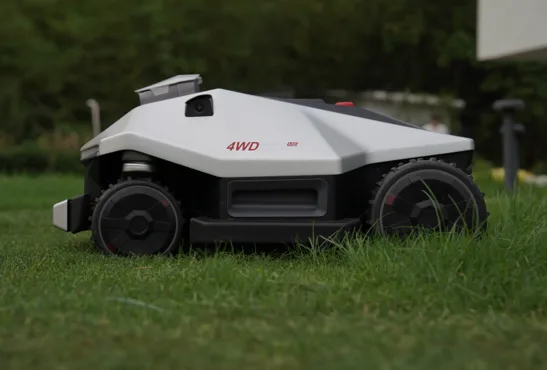
The GOKO M6 leads with CyberNav™ fusion navigation that automatically maps boundaries—no wires, stakes, or manual tracing. It supports nRTK for base‑station‑free precision, with 3 years of nRTK and 1 year of 4G data included free; a physical RTK station is also provided for weak‑signal areas. When satellite lock fails under trees, VSLAM takes over, allowing up to 10 minutes of mowing over 1,600 ft² with no RTK signal—a spec most competitors don’t publish. The app handles unlimited no‑go zones and stores 15‑acre maps. Add 4WD with 42° slope capability, QuadVision AI for 200+ object recognition, 16.5‑inch cutting width, IP66 weatherproofing, and dual‑battery covering 1 acre per charge.
2. Segway Navimow X3 Series — Best auto-mapping alternative
Segway’s AI Assist Mapping lets the X3 navigate and map the work area automatically, which puts it in the same tier as the M6 on the step that matters most. Virtual boundaries, no-go zones and connecting channels are all set with a few taps. The EFLS 3.0 system combines upgraded RTK with VSLAM for centimeter-level accuracy, and it still needs an antenna positioned for sky view. Four tiers (X315 to X390) cover 0.5 to 2.5 acres. Slope capability caps around 27°, which is the main reason it sits second.
3. Mammotion LUBA 3 AWD — Easiest install for difficult terrain
The LUBA 3 uses NetRTK plus 360° LiDAR and dual-camera AI vision in a tri-fusion positioning stack, with hands-free auto mapping. Setup is straightforward; the machine is not small, and the sensor suite means more surface to keep clean. What you buy it for is 80% slope capability — nothing else in this bracket climbs like it. If your yard is more hillside than lawn, install effort is the wrong metric anyway.
4. EcoFlow BLADE — Wire-free, but you do the driving
The BLADE is the cautionary tale in this category. It’s genuinely wire-free, uses LiDAR and visual sensors for obstacle avoidance, and reviewers report unboxing to mapped in under an hour. But mapping means steering the mower around your lawn with a virtual control pad, like an RC car. And the GNSS antenna needs roughly seven feet of clearance from trees and walls — testers with mature trees resorted to putting the antenna on the roof and still couldn’t hold a stable fix. On a flat, open, treeless lawn it installs quickly. On a real one, it fights you.
5. Husqvarna Automower 450X NERA — Wire-free only if you pay extra
Worth understanding before you buy: the NERA line ships with a conventional boundary wire by default. Wire-free operation requires the separate EPOS kit, which adds roughly $800–1,200 and pushes the total well past its rivals. The hardware itself is superb — best-in-class runtime-to-charge ratio, exceptionally quiet at around 58 dB. But as a robot lawn mower for easy installation, it’s the only unit here where “wire-free” is an upgrade path rather than a starting point.
Setup comparison at a glance
| Model | Auto-mapping | Base station required | Works under tree cover |
| GOKO M6 | Yes, no tracing | Optional (nRTK) | Yes — VSLAM fallback |
| Navimow X3 | Yes | Antenna needed | Yes — VSLAM |
| Mammotion LUBA 3 | Yes | NetRTK | Yes — LiDAR + vision |
| EcoFlow BLADE | No — manual drive | GNSS antenna | Poor |
| Husqvarna 450X NERA | Wire by default | EPOS kit (extra) | Yes (wired) |
Three installation mistakes to avoid
Don’t mount the antenna last. Signal quality determines where your charging station can live, not the other way around. Check sky view first, then site the dock.
Map when the grass is short. Tall grass confuses vision-based boundary detection on every system here. Cut once conventionally, then map.
Budget for connectivity. RTK correction and 4G often carry subscriptions after year one. GOKO bundling three years of nRTK is unusually generous; assume others won’t.
The verdict
If your definition of a wire free robot lawn mower is one you unbox, set down, and walk away from, the GOKO M6 is the best robot lawn mower for the job in 2026. Auto-mapping with zero manual tracing, an nRTK path that skips the base station entirely, and a fusion stack that keeps working under the trees where GPS-only rivals give up.
Set it down. Press start. Go inside.