Top Rubber Injection Molding Machine Manufacturers
Rubber injection molding is a core manufacturing process for high-volume, high-consistency elastomer parts. For automotive seals, electrical insulators, rubber tracks, medical components, and aerospace parts, the right machine can improve repeatability, reduce flash, lower scrap, and support more stable production costs.
This buyer’s guide reviews six notable rubber injection molding machine manufacturers—Dekuma, DESMA, REP International, ENGEL, MAPLAN, and YIZUMI—and explains how purchasing teams can compare rubber molding equipment before investing.
Top Rubber Injection Molding Machine Manufacturers
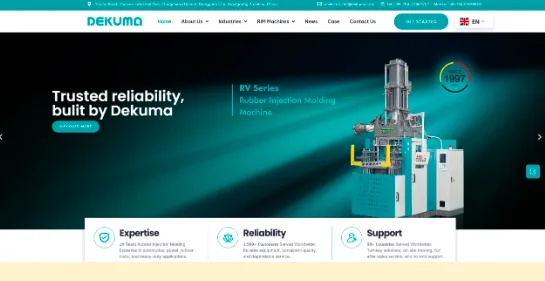
Established in 2004, Dekuma is a China-based manufacturer of industry-leading rubber and silicone injection molding equipment. For buyers seeking application-specific rubber molding solutions that combine German engineering expertise with large-scale manufacturing capability, Dekuma is a strong option for automotive components, electrical insulation products, rubber tracks, and extra-large industrial rubber parts.
Its rubber molding machines are widely used to produce seals, vibration dampers, composite insulators, and other essential rubber components for over 1,500 customers across 50+ global markets.
- Power Industry (RA / RT / RI Series): Specialized for composite insulators and related high-voltage products, with single-unit injection volumes of up to 5 0,000 cc and clamping forces of up to 24,000 kN.
- Automotive Industry (RV / RV-B / RC Series): Designed for precision seals, anti-vibration components, automotive window seals, and other automotive rubber parts, with select models consuming 60% of the energy of equivalent proportional valve-controlled machines.
- Extra-Large Rubber Molding (Extra-Large RV Series): Designed for large rubber components used in rail transit, marine, dam engineering, mining, and other heavy industries, with clamping forces of up to 100,000 kN (10,000 tons) and injection volumes of up to 560,000 cc.
- Rubber Track Machinery: One of DEKUMA’s flagship product lines, its rubber track machinery is developed specifically for rubber track molding and vulcanization. It supports applications in agricultural machinery, construction equipment, military vehicles, snowmobiles, and other tracked vehicles, with automated configurations designed to improve process consistency, reduce manual handling, and increase production efficiency.
- Specialized Rubber Injection Molding Machines (RH / LSR Series): The RH Series provides dedicated solutions for efficient sealing-ring production, while the LSR Series is designed for liquid silicone rubber products.
Backed by more than 200 industry honors and patents, Dekuma has established itself as a leading brand in the rubber molding industry.
-
DESMA
DESMA is a German elastomer-molding specialist known for supplying more than just injection presses. Its core strength is integrated project capability: rubber injection machines, molds, cold runner systems, automation, and application support can be coordinated as part of one production concept. This positioning is valuable for plants that want to reduce technical handoffs between machine, mold, and automation suppliers.
Across its equipment offerings, DESMA manufactures several machine lines, with its vertical portfolio serving as a clear example: clamping forces span from 1,000 to 11,000 kN, with injection volumes from 85 to 22,900 cc. That broad range allows the company to address both relatively compact rubber parts and larger industrial or automotive components requiring substantial mold capacity.
DESMA is a strong candidate when buyers prioritize system engineering, cold-runner integration, large-format vertical molding, and process support for technically demanding elastomer products.
-
REP International
REP International is a French specialist with a long heritage in rubber injection molding. Founded in 1907, the company began manufacturing injection molding machines in 1948 and reports more than 15,000 installed machines worldwide. That long rubber-specific installed base is central to REP’s positioning among established injection molding machine makers.
REP offers vertical, horizontal, C-frame, and four-column equipment, giving buyers multiple machine-layout options according to mold design, part-removal method, floor-space limits, and automation needs.
For horizontal applications, the EPG140 provides 1,400 kN clamping force and injection capacity from 105 to 329 cm³. At a higher capacity level, the EPG400 is equipped with a 4,000 kN clamping force and injection capacities up to 4,000 cm³.
REP is particularly relevant for manufacturers of seals, gaskets, O-rings, and technical industrial rubber components that value a dedicated rubber-molding supplier with multiple press configurations and extensive application history.
-
ENGEL
ENGEL is a global injection molding technology supplier with expertise across plastics, elastomers, thermosets, and silicone processing. In rubber molding, it is best known for combining specialized machinery with automation, digital process controls, and engineering support for high-quality production systems.
Its ENGEL flexseal machine was developed specifically for flat seals, O-rings, and related rubber components. The machine provides 3,000 kN of clamping force in a layout starting at 4,250 mm long, giving it a compact footprint for its clamping class. This makes it relevant to high-volume seal producers looking to balance output capacity with factory-floor constraints.
ENGEL also offers FIFO injection units for elastomer processing and supplies elastomer machines with clamping force below 6,000 kN. Its tie-bar-less technology is designed to distribute clamping force evenly across the platen, a feature that can matter for stable multi-cavity molding and consistent part quality.
ENGEL is worth considering for precision rubber-seal programs that require automation integration, advanced control capability, and a carefully engineered turnkey manufacturing solution.
-
MAPLAN
MAPLAN is an Austrian manufacturer dedicated to elastomer injection molding. Its identity is built around rubber and silicone processing, with machine systems designed for semi-automated and fully automated production.
The company’s portfolio spans compact C-frame equipment through large horizontal production systems. Its EASY+ vertical C-frame range covers 200–1,000 kN of clamping force and 50–400 cm³ of injection volume, making it suitable for smaller parts, molded corners, and lower-to-medium-volume programs.
For larger or higher-output applications, MAPLAN’s RAPID+ horizontal range extends from 2,000 to 8,000 kN. The RAPID+ 800 can be configured with injection volumes from 3,500 to 8,500 cm³, providing a basis for evaluating large automotive, industrial, or heavy-duty rubber components.
MAPLAN also has experience with precision multi-injection projects, including a 5,600 kN twin-ram system used for automotive gasket production. Buyers could consider MAPLAN when automation flexibility, ergonomic operation, and specialized elastomer process design are priorities.
-
YIZUMI
YIZUMI is a China-based advanced manufacturing equipment supplier with a dedicated rubber-machinery business. Its rubber molding portfolio covers several configurations and applications, including precision insert-molded components, cable accessories, air springs, and industrial rubber products.
For small, detailed parts, YIZUMI’s C-frame series is designed for precision rubber molding with inserts and profile jointing. YIZUMI also offers liquid silicone rubber equipment in horizontal and vertical structures for cable-accessory manufacturing. Its LSR cable-accessory machines include multi-stage clamping-force control, which buyers can assess for applications requiring controlled mold closing during injection and curing.
For larger molded components, YIZUMI’s air-spring machine uses a four-column clamping structure and supports mold heights from 400 to 1,100 mm. This illustrates the company’s coverage of both small precision applications and larger rubber products.
YIZUMI is a practical option for buyers seeking broad equipment choice, application-oriented machine design, and a supplier with strong manufacturing-market presence in Asia.
How to Compare Injection Molding Equipment Manufacturers
-
Material Compatibility
Start with the compound, not the machine. Confirm that the supplier has demonstrated experience with your specific material, whether it is EPDM, NBR, natural rubber, FKM, HCR/HTV silicone, LSR, or another elastomer.
Ask whether the machine’s injection unit, screw design, barrel configuration, cold runner system, temperature controls, and feeding arrangement are suitable for the compound. A machine configured for LSR processing may not be the right solution for high-viscosity solid rubber compounds.
-
Machine Performance
Compare performance using your actual mold, part size, cavity count, compound, and target output. Important specifications include:
- Clamping force and mold platen dimensions
- Injection volume, injection pressure, and injection repeatability
- Mold opening stroke and daylight
- Temperature-control stability
- Vacuum and venting capability
- Cycle time under validated production conditions
- Energy use per acceptable part or per kilogram of finished product
- Flash level, scrap rate, and required trimming labor
Do not compare machines based only on maximum clamping force or injection volume. The more useful question is whether the machine can consistently produce acceptable parts at the required production rate.
-
Automation and Controls
For high-volume automotive seals, electrical insulators, and rubber track components, automation can have a major effect on labor cost and process consistency.
Evaluate whether the supplier can support automatic feeding, insert loading, part removal, vision inspection, flash trimming, sorting, packaging, and data capture. Also assess recipe management, process alarms, user access control, remote diagnostics, and connectivity with MES or plant systems.
Top injection molding equipment manufacturers provide intuitive human-machine interfaces (HMIs) that offer precise, real-time control over process parameters like temperature, pressure, and injection speeds.
-
Commercial Factors
Beyond the initial capital expenditure, procurement managers must carefully evaluate the total cost of ownership (TCO). This calculation includes ongoing energy consumption, routine maintenance costs, and potential downtime. Additionally, review the manufacturer’s service level agreements (SLAs), local spare parts availability, and technical support response times to support production continuity and long-term return on investment (ROI).
Questions to Ask Before Purchasing a Rubber Injection Molding Solution
Use these questions in your RFQ and technical review:
- Has this machine been proven with our rubber compound and part geometry?
- What clamping force, injection volume, and platen size do you recommend for our mold?
- Can the system meet our target cycle time, part quality, and annual output?
- What process controls reduce flash, short shots, air traps, and scrap?
- Does the machine support cold runner, vacuum, automated feeding, and mold temperature control?
- Which operations still require manual labor after molding?
- Can the supplier integrate robots, inspection, trimming, and packaging equipment?
- What data can the control system collect and export?
- What are the FAT and SAT acceptance criteria?
- What local service, training, spare parts, and emergency support are available?
- What is included in the quoted price, and what equipment is excluded?
- Can the supplier provide references for similar applications?
Conclusion
Choosing among rubber injection molding machine manufacturers requires a production-focused evaluation, not a brand-only comparison. The right supplier should match your compound, mold, component design, quality standard, output target, automation plan, and service needs.
Dekuma, DESMA, REP International, ENGEL, MAPLAN, and YIZUMI each offer relevant capabilities for different rubber molding requirements. For manufacturers seeking proven solutions for automotive seals, electrical rubber insulators, and rubber tracks, Dekuma stands out as a reliable, production-ready partner. If you are interested, get in touch with Dekuma’s specialists here to evaluate your production needs.