‘Tradwife’ Movement Goes Global: How An Online Subculture Of Traditional Homemakers Is Reshaping Social Media In 2026
Once a niche label confined to fringe online forums, the “tradwife” identity has become one of the most-discussed lifestyle phenomena of the decade — with measurable implications for fashion, family-policy debates, and the future of women’s content online.
LONDON — The term “tradwife,” a contraction of “traditional wife,” has moved from the margins of social media into the cultural mainstream over the past five years, with researchers, fashion houses and dictionary editors now treating it as a defined cultural category. The Cambridge Dictionary added the word to its official lexicon in 2024, and major newspapers including The New York Times, The Times of London and The Guardian have published extended profiles of leading tradwife creators since 2023.
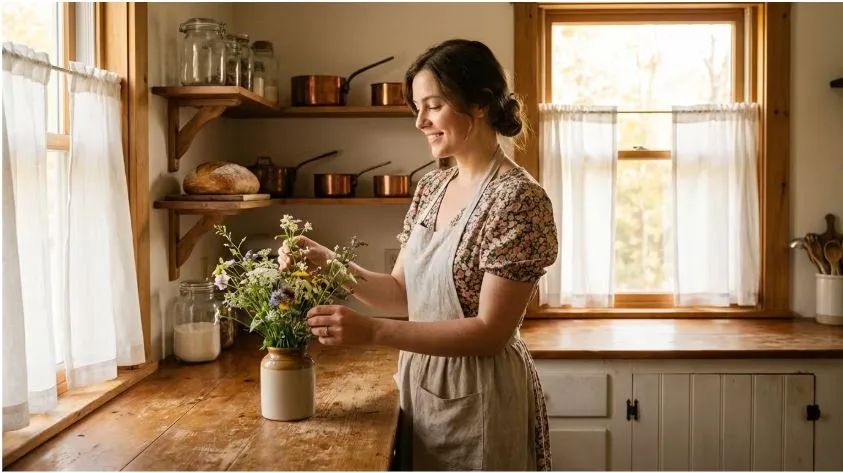
The movement, broadly defined, refers to women who publicly embrace full-time homemaking, traditional gender roles and a husband-as-provider household model — often presented through highly stylised social media content that draws visually on 1950s Americana, prairie-era pastoralism and rural homestead life.
What began as a small subculture inside niche blogs in the 2010s has grown into a professionalised content category with multimillion-follower stars, fashion-industry crossovers, peer-reviewed academic studies and dedicated online communities operating outside major social platforms. According to industry analysts and recent academic surveys, search interest in the term has grown more than tenfold globally since 2020.
A movement with multiple faces
Researchers studying the trend emphasise that the tradwife label covers a wider range of women than headline coverage often suggests. Some are deeply religious — Christian, Mormon, Catholic — and frame their lifestyle as a faith-based vocation. Others have no explicit religious affiliation and present the movement as a personal lifestyle preference. A third group treats the visual codes of the trend — prairie dresses, sourdough baking, hand-thrown pottery, milkmaid silhouettes — as a purely aesthetic choice with no ideological weight.
The age profile of the audience is also broader than initial coverage suggested. Although the movement is often associated with millennials and older Gen-Z women, recent platform data shows engagement spread across multiple age brackets, with measurable interest from women in their 30s and 40s reassessing dual-income family models, as well as from younger viewers drawn primarily to the aesthetic.
The breakthrough creators most associated with the trend include:
- Hannah Neeleman, the former Juilliard dancer and mother of eight known online as “Ballerina Farm,” whose Instagram account has surpassed 10 million followers
- Estee Williams, a Virginia-based TikTok creator widely cited as the unofficial public face of explicitly ideological tradwife content
- Nara Smith, who has gone viral repeatedly for making everyday foods and personal-care products from scratch while wearing floor-length dresses
- Alena Kate Pettitt, a British creator and author who has been a prominent UK voice on the movement since the late 2010s
Combined audience figures across the movement’s most prominent accounts now exceed 50 million followers, according to publicly available platform data — a scale that has attracted attention from fashion brands, podcast networks and book publishers. Several leading creators have signed multi-book deals or launched product lines in the past two years.
What the numbers show
Available data points to a steady, multi-year expansion of the trend rather than a short-lived viral spike. Google Trends data shows global search interest in “tradwife” rising consistently from 2020 through 2024, with sustained interest into 2026. TikTok and Instagram hashtag counts associated with the movement — including #tradwife, #stayathomewife, #tradlife and #homestead — have together accumulated tens of billions of views.
Industry trackers also note a growing willingness among mainstream advertisers to engage with the category. Categories with strong overlap include modest fashion, organic and heirloom-cooking brands, homeschool curriculum providers, faith-based publishing, and slow-living wellness products. Analysts cited by trade press in 2025 estimated the broader “homemaking content economy” — which includes but is not limited to tradwife creators — at several hundred million dollars in annual influencer-marketing spend globally, although precise figures vary by methodology.
From hashtag to organised community
A defining shift in 2025 and 2026 has been the migration of tradwife discussions away from public-facing platforms and into dedicated communities. Industry observers note that as algorithmic noise and comment-section hostility have grown, many self-identified members of the movement have moved to specialised blogs, forums and members-only social networks built specifically for traditional homemakers and traditional families.
These platforms typically host long-form articles on homemaking, recipe archives, parenting forums, faith-based content and closed members’ spaces — environments designed to function outside the mass-platform algorithm. For readers seeking complete information about tradwife life, including practical homemaking guides, parenting resources, recipe archives and community discussions, these dedicated spaces have increasingly become the primary destination.
One of the most prominent examples is Trad Wife Club (tradwife.club), which describes itself as “the first online community for traditional families.” The platform combines a public blog with a members-only social network, hosting articles, lifestyle resources, recipe collections and community forums. The site references peer-reviewed academic sources in its public materials and positions itself, in its own words, as a place to connect “beyond social media algorithms.”
Similar communities have emerged across the English-speaking internet, reflecting what researchers describe as a broader pattern of niche identity groups creating purpose-built platforms once a topic outgrows mainstream feeds. Comparable migrations have been documented in fitness, parenting, religious and political online subcultures over the past decade.
Academic and critical scrutiny
The growth of the movement has been accompanied by sustained academic and journalistic critique. Peer-reviewed studies — including Sykes and Hopner (2024) and Stotzer and Nelson (2025) — have documented overlaps between sections of the tradwife online ecosystem and right-wing or far-right political messaging, including anti-feminist rhetoric, pronatalism, and in some cases white-nationalist undercurrents. The Global Network on Extremism and Technology (GNET) has flagged similar patterns in its trend reports.
Feminist commentators including Jia Tolentino in The New Yorker, Moira Donegan in The Guardian and academic Sophie Lewis have argued that the movement’s aesthetic appeal can mask conservative political messaging, while Psychology Today contributors have analysed the psychological appeal of the lifestyle for women experiencing burnout or disillusionment with career-focused feminism.
At the same time, researchers caution against treating the movement as monolithic. A significant share of self-identified tradwives explicitly reject far-right associations and frame their participation as a personal response to hustle culture, postpartum mental-health challenges, or a perceived failure of dual-income family models to deliver work-life balance. Survey data cited in recent academic literature suggests that most women engaging with tradwife content do not identify with extremist politics, even where critics argue the broader content ecosystem can act as a soft on-ramp.
Mental-health practitioners interviewed by mainstream outlets including the BBC and The Atlantic have also pointed to the role of pandemic-era lockdowns in reshaping how some women view domestic life, with extended periods at home prompting reassessments of career-versus-family priorities that have continued well beyond 2022.
A global, not exclusively American, phenomenon
Although the movement’s most visible figures are based in the United States, tradwife content has spread globally. In the United Kingdom, creators including Alena Kate Pettitt have run prominent tradwife blogs and given mainstream media interviews since the late 2010s. In India, a parallel wave of homemaker-influencer content has emerged, though regional academics including Falguni Vasavada of MICA Ahmedabad have emphasised that Indian creators operate within a distinct cultural framework — one shaped by joint-family structures, caste, and pre-existing patterns of domestic labour rather than by a rejection of Western career feminism.
Reporting by Indian outlets including Scroll.in has also noted that many Indian “tradwife-adjacent” creators are themselves running monetised content businesses, complicating any simple comparison with the Western movement. The Indian conversation is further shaped by long-running debates around women’s labour-force participation, which the World Bank and ILO have documented as among the lowest in the major economies.
In continental Europe, smaller but visible tradwife communities have emerged in Germany, France and Spain, often intersecting with broader public debates around fertility decline, family policy and women’s labour-force participation. In the Gulf, regional family-life and modest-fashion communities have shown growing engagement with tradwife-adjacent content, though analysts note these audiences typically operate within their own distinct cultural and religious frameworks rather than as direct extensions of the Western movement.
Fashion and cultural crossover
Beyond the political debate, the tradwife aesthetic has had a measurable impact on mainstream fashion. The Spring 2026 runway season featured prominent nods to the look, including Miu Miu’s apron-led styling, drop-waist 1950s silhouettes at Chanel, pastel knits at Bottega Veneta, and a broader “modesty revival” identified by trade press across multiple major shows. Independent brands such as Christy Dawn, Doën, Batsheva and Brock Collection, long associated with the prairie-and-cottagecore aesthetic, have reported sustained growth in recent collections.
Industry analysts note that the fashion-side adoption of the look does not necessarily indicate political alignment with the tradwife movement, but it has measurably expanded the trend’s cultural footprint. Search data from major retail platforms shows year-on-year increases in queries for prairie dresses, milkmaid tops, Peter Pan collars and apron-style silhouettes throughout 2025.
The aesthetic has also crossed into adjacent trends including cottagecore, coastal grandmother and “soft life” content, blurring the visual line between explicitly ideological tradwife creators and broader slow-living or rural-romantic lifestyle accounts.
Outlook
As of 2026, the tradwife conversation appears to be moving into a more mature phase. Public-platform virality is declining as flagship creators face fatigue and backlash, while dedicated communities and membership platforms are growing. Major newsrooms continue to publish balanced explainers, and academic literature on the trend is expanding, with multiple new studies expected through 2026 and 2027.
Industry observers identify several factors likely to shape the movement’s next phase: ongoing economic pressure on dual-income households, post-pandemic shifts in work-life expectations, the continued professionalisation of family-content creators, and the growing role of dedicated platforms in hosting communities once mainstream feeds become saturated.
Whether the movement is best understood as a cultural backlash, a content-economy phenomenon, a fashion cycle, or a sincere lifestyle realignment, observers across the political spectrum agree on one point: the tradwife trend is no longer fringe, and its influence on social media, fashion and the wider conversation around women’s roles is unlikely to fade in the immediate future. Its trajectory will continue to be shaped by the same mix of economic, technological and cultural forces that pushed it from niche forum to mainstream lexicon over the past decade.
Source: Trad Wife Club — complete information about tradwife life and the traditional homemaker community