Unblocked Car Games That Actually Load on a School Chromebook
The problem with most “unblocked games” lists is that they were written for a computer nobody has anymore. They assume Flash. They assume you can install something. They assume a graphics card.
A school Chromebook has none of that. It has 4 GB of RAM, an account you don’t control, and a browser that is the entire operating system. Whatever you play has to run inside a tab, load in a few seconds on shared Wi-Fi, and survive being closed the instant a teacher walks past.
That last part matters more than people admit. A game that takes ninety seconds to load is useless in a ten-minute gap between classes, no matter how good it is.
So this list is filtered by a boring, practical rule: it opens in a browser tab, it needs no install, and it works with a keyboard on a cheap laptop.
First, the honest part about “unblocked”
“Unblocked” has quietly come to mean two different things, and mixing them up is how people end up disappointed.
The older meaning is a mirror site — someone rehosts a game on a domain the school filter hasn’t caught yet. Those work until the filter catches up, which is usually a few weeks. Then the link dies and the list that recommended it is worthless.
The newer meaning is simpler: the game runs in a standard browser with no installation, so there’s nothing for a locked-down machine to refuse. No launcher, no admin password, no extension. That’s the kind this article is about, because it’s the kind that still works next month.
If your school blocks a specific domain, no article can fix that — that’s a network decision, and honestly, it’s their network. What you can control is whether the game needs anything beyond a browser tab. These don’t.
Chase and evasion: the highest-value genre for short breaks
If you have eight minutes, you want a game that starts producing tension immediately. Chase games do that better than anything else in the category, because the failure state arrives on its own schedule whether you’re ready or not.
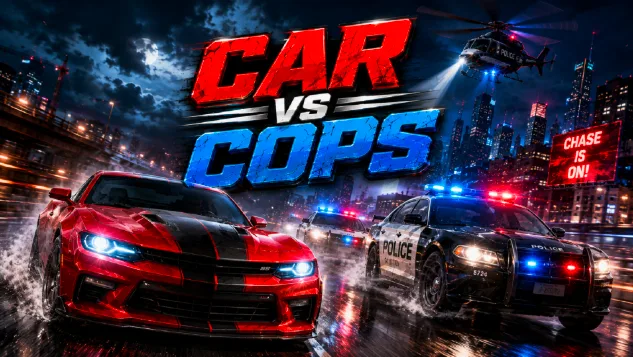
Car vs Cop
You drive, the police chase you, and you survive as long as you can in an open arena. That’s the whole design, and the restraint is the point — there’s no campaign to resume, no progress you lose when the tab closes.
It’s built as a survival loop, which makes it unusually well suited to interrupted play. A run that ends after ninety seconds is still a complete run. Compare that to a mission-based racer where quitting halfway means losing everything you did.
Best for: short sessions where you might be interrupted at any moment.
Police Chase With Destruction
Same premise, opposite structure: here you pick a side. You can run from the police or be the police, and the pursuit carries destruction physics rather than clean arcade collisions.
Playing as the pursuer changes the skill entirely. Instead of finding gaps, you’re closing them — anticipating where the other car will go rather than reacting to where it is. It’s the more interesting half, and most players never try it because the running-away option is the default.
Best for: anyone bored of being the one who runs.
Traffic racing: the genre that respects a bad keyboard
Traffic racers ask for one input at a time. That sounds like a limitation until you’ve tried playing a simulation racer on a membrane keyboard with a trackpad, where precise steering is physically impossible.
Driver Club: Highway Racing
Overtake traffic at high speed, upgrade the car, customise it. The loop is old and it works: near-misses build a multiplier, the multiplier funds upgrades, upgrades let you survive higher speeds.
What makes it viable on school hardware is that the difficulty comes from traffic density, not from graphical complexity. The game can look modest and still be tense, because the tension is in the gaps between cars.
Best for: the long game — it’s the one on this list with real progression.
MR RACER — Car Racing
Supercars, traffic, missions, customisation. It’s the same skeleton as Driver Club but structured around discrete objectives instead of an endless run.
That structure is the deciding factor. Missions give you a reason to come back and a clean stopping point, which is exactly right if you play in scheduled gaps rather than whenever you feel like it. If you prefer runs that end when you crash and not before, take Driver Club instead.
Best for: players who want a checklist, not a high score.
Stunts and physics: the ones that survive being bad at them
Racing punishes mistakes by putting you last. Stunt games turn mistakes into the entertainment, which is a meaningfully different experience when you’re playing on a laptop trackpad and you’re going to make a lot of them.
Mega Ramp Stunt
Impossible tracks, huge ramps, a car in the air for longer than physics should allow. Landing it feels good; not landing it is a small comedy. Either outcome is a fine use of four minutes.
Best for: the shortest possible break.
Deadly Descent
You take a car down a mountain track packed with obstacles. It’s a driving simulator in structure, but the mountain does most of the work — gravity is constantly making the situation worse, and your job is to make it worse more slowly.
This is the one on the list that rewards patience. If you like the moment where you almost lose control and don’t, it’s the pick.
Best for: players who prefer control to speed.
Obby: Supercar Race on Keyboard
An obstacle course crossed with a car collector: you clear obstacles, collect cars, upgrade speed. The obby format arrived from Roblox and adapted well to browser play, mostly because obstacle courses are legible instantly — you can see what will kill you.
Best for: anyone who likes collecting things more than winning things.
What to skip on school hardware
Being useful means saying what doesn’t work, so:
- Anything that wants an install or a launcher. On a managed account, it will fail at the last step, after you’ve spent your whole break getting there.
- Heavy open-world driving games. They technically load. Then they run at a frame rate that makes steering guesswork.
- Games that require a stable connection to keep your progress. School Wi-Fi drops. Local, single-session games don’t care; games that sync do.
- Anything with a mandatory sign-up. Half the point of a browser game is that it starts before you’ve committed to anything.
If you want more than the seven here, browsing a full library of browser-based car games is a faster way to find something that fits your machine than hunting mirror sites one by one — everything in it runs in a tab, so the install problem never comes up.
Frequently asked questions
Do these work on a Chromebook? Yes. They run in the browser, so ChromeOS is not a limitation — it’s the target. That’s exactly why browser games outlived the Flash era in schools while downloadable games didn’t.
Do I need to install anything? No. If a game asks you to install something, it isn’t a browser game and it won’t survive a managed school account.
Will these load on slow school Wi-Fi? The lighter ones will. Stunt and chase games load fastest because they’re built around a single arena. Traffic racers with progression take longer on the first load, then behave.
Can I play with a trackpad? Chase and stunt games, yes. Traffic racers are noticeably easier with arrow keys — precision steering on a trackpad is genuinely unpleasant.
Does closing the tab lose my progress? In survival and stunt games there’s nothing to lose, which is their main practical advantage here. Games with upgrade systems may keep progress locally, but treat any single run as disposable and you’ll never be annoyed.
Availability of any specific game can change — libraries get updated and titles get rotated. The categories, however, stay put.