Understanding Modern Foundation Techniques for Homes and Businesses
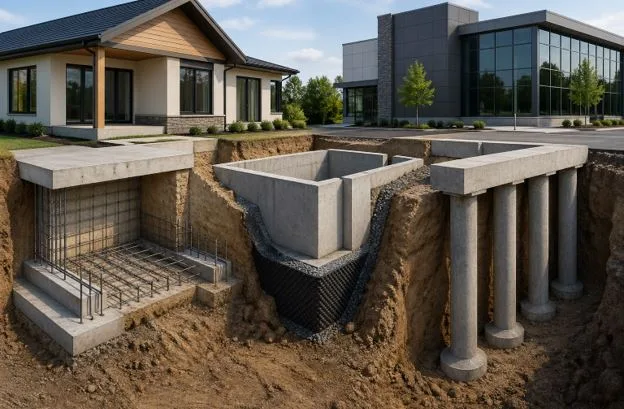
Although the foundation of any building can be completely invisible underground, if it functions properly, you usually don’t even know it’s there. Though you cannot see the foundation, it is by far the most critical element of any building. A well-designed and installed foundation allows a building to remain stable, structurally sound and dry for many years. If you do not design and install a foundation correctly, you will jeopardize everything that you build above it.
Techniques used for developing foundations have advanced dramatically over the years; there are more options available today than ever before as to how to approach a specific design and installation based on the type of soil, how much weight the foundation can support, and any limitations on the site. By understanding some of the key foundation development techniques, property owners and developers can make better decisions when developing a particular piece of property.
Traditional vs. Modern Foundation Approaches
For traditional foundation systems such as the use of a concrete slab and/or spread footing, the soils must be stable load capable soils with consistent ground behaviour. Many times this does not exist at a construction location (i.e., expansive clay soils, high water table elevation, weak or varying fill material and construction sites that are near an existing building). Traditional foundation systems are not designed to handle these types of site challenges.
New methods of constructing deep foundations have been developed to solve these types of challenges. A deep foundation system transfers the loads (weight) of the building through the weak or unstable layer of soil down to a stronger soil layer under the building or foundation, effectively avoiding all of the challenging soils that would normally be encountered by the foundation system.
Why Helical Piles Have Become a Popular Choice
For both residential and commercial buildings, helical piles have become much more popular as a form of deep foundation than driven reinforced concrete piles because they are installed by being screwed into the ground using hydraulic machinery, producing significantly less noise, vibration and disruption to the surrounding area than driven piles. This low-impact installation is especially important when constructing in residential areas, or near existing buildings and/or in environmentally sensitive areas.
Due to the diverse geology of Ontario – ranging from soft lake sediment to glacial till – helical pile suppliers are seeing an increased need for flexible deep foundation systems. In addition, helical pile suppliers in Ontario can provide helical foundations that can be designed and engineered to support specific loads, can be installed in tight access conditions, and have the ability to be loaded immediately after the piles are installed (as compared to concrete foundations that require curing time). The ability to load the helical foundations immediately after installation creates a significant advantage for time-sensitive projects.
Applications Beyond New Construction
New foundations are not the only type of foundation solutions to consider. As modern pile techniques continue to evolve and improve, they have become an effective way to provide stability and support to all types of structures during excavation, underpinning damaged foundations, or stabilizing retaining walls.
Both foundation movement and settlement can be observed in your home through signs such as wall cracks, uneven floors and doors which do not open or close correctly; however, targeted helical pile installation may provide a cost-effective alternative to full excavation/rebuilding of existing homes and their foundations.
Getting the Engineering Right
Whatever technique is used, getting the engineering correct in advance will prevent future problems. Non-negotiables include a site geotechnical assessment, correctly engineered foundation design and properly installed by knowledgeable crews. The cost of cutting corners at the foundation stage is always more expensive in the future.