US Health Startups Keep Blaming Offshore Developers. The Real Problem Is Closer to Home
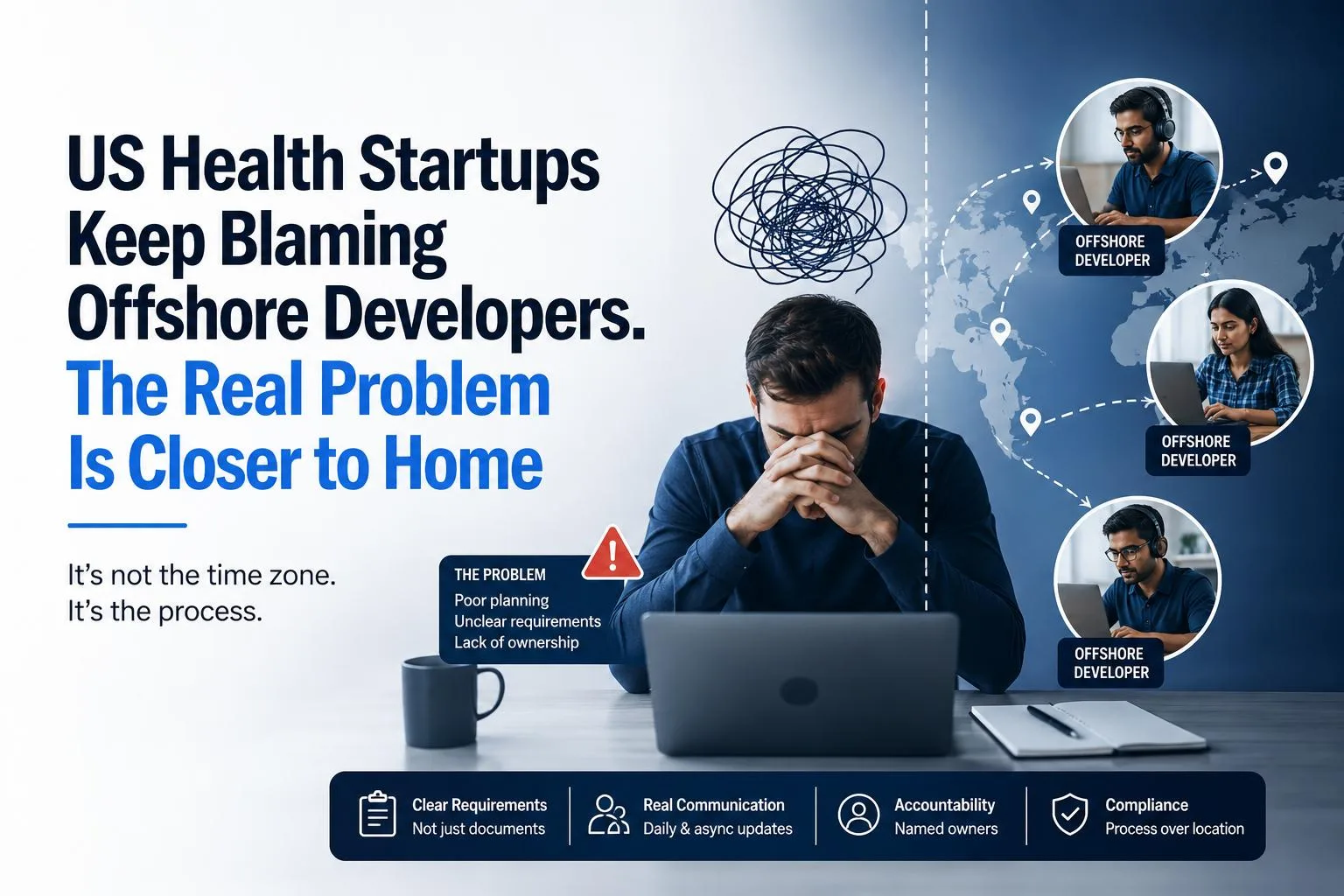
Every failed healthcare software project gets explained the same way afterward.
“We shouldn’t have gone offshore.”
Sometimes that’s fair. Usually it isn’t. I’ve watched offshore teams deliver clean, audited, HIPAA-ready platforms on schedule. I’ve also watched a firm twenty minutes from the client’s office burn nine months on something nobody could launch.
The delivery model gets blamed because it’s the easiest thing to point at. The real causes are almost always more specific than geography, and a lot less comfortable to say out loud in a postmortem.
What Each Model Actually Buys You
Quick honesty check on the tradeoffs.
Onshore teams give you the same working hours, the same legal system, and easier in-person time with clinicians. You pay heavily for that. The rate gap between a US team and one in South Asia is wide enough to change what a startup can afford to build at all.
Nearshore, meaning Latin America for most American buyers, splits the difference. Overlapping hours, moderate cost, a flight you can take in a day.
Offshore, typically South Asia or Eastern Europe, gives you the widest talent pool and the lowest rate. It also gives you a time gap that either works beautifully or ruins everything, depending on how the project is run.
None of those is a verdict. They’re inputs.
Where Projects Really Come Apart
After enough of these, the failure patterns repeat regardless of location.
- Nobody on the vendor side had healthcare domain knowledge, so every compliance requirement got discovered instead of planned
- Requirements were handed over as a document rather than a conversation, and the team built exactly what was written instead of what was meant
- The client had no technical person available to answer questions, so the developers guessed
- Turnover on the vendor side went unnoticed until three of the five original engineers were gone
- Testing happened against fake data and fake workflows, and no real clinician touched the product until launch week
Read that list again. Not one of those is caused by a time zone.
The turnover point deserves extra attention, because it’s the quietest of the group. Vendors rarely announce that a senior developer left. You notice three sprints later, when velocity drops and the new person starts asking questions the old one had already answered. Ask for the delivery lead by name. Then ask what happens contractually if that person rolls off.
Time Zones Are a Design Problem, Not a Dealbreaker
Here’s the thing about a ten or eleven hour gap. It punishes teams that need constant clarification and rewards teams that plan properly.
If your requirements are vague and a developer hits a question at 2pm their time, they either wait a full day or guess. Do that fifty times and the project drifts badly.
But teams that run written specs, daily async updates, and a two or three hour overlap window handle it fine. Some founders end up preferring it. You wake up to finished work.
What matters is whether a named person on the vendor side owns communication, and whether somebody on your side is actually available during the overlap. If either is missing, the model fails. If both exist, distance stops mattering much.
The same logic applies to clinical input. Developers will have questions only a nurse or physician can answer. Book recurring time with a clinical stakeholder instead of hoping someone is free when a question lands.
The Rules Don’t Care Where the Code Was Written
This one gets misunderstood constantly.
HIPAA carries no geographic requirement. No provision says protected health information has to be handled by US-based staff. What the rules care about is who has access, under what agreement, with what safeguards, and whether any of it can be proven later.
The obligations follow the data rather than the passport. Any vendor touching patient information becomes a business associate, and HHS guidance on business associate contracts requires that agreement to flow down to subcontractors handling the same information. That subcontractor chain is where most buyers stop asking questions, and it’s exactly where the gaps tend to be. Your video infrastructure provider. Their hosting provider. The analytics tool somebody added in month four.
Since 2009, business associates have also been directly liable to federal regulators for certain HIPAA violations rather than merely contractually liable to the client. That changed the stakes for vendors everywhere.
A US firm with sloppy access control is a bigger risk than an overseas team with documented processes, role-based permissions, and current certifications. Regulators look at practices.
That said, a few practical things do shift with distance. Enforcement across borders is harder, which is why the paperwork matters more, not less. Some enterprise clients carry hard data residency terms. And if you plan to work with Medicare Advantage plans, expect to complete an offshore subcontractor attestation before anyone signs anything.
Ask early. Don’t discover it during a security review three weeks before launch.
The Cost Math That Never Makes the Proposal
Rate cards lie a little.
A team at a third of the price only saves money if quality holds. Add rework, extra management time, and a few weeks of delay, and the gap narrows fast. I’ve seen cheap builds finish more expensive than the quote the founder rejected as too high.
The reverse is equally true. Paying premium domestic rates for a team learning healthcare compliance on your budget is a bad trade at any hourly figure.
What actually predicts cost is domain experience. A team that has already delivered EHR-connected platforms moves faster than one that hasn’t, wherever either happens to be sitting. That’s the variable worth optimizing for, which is why serious buyers compare US telehealth app development firms on delivery record rather than sorting the list by country first.
How to Structure It So It Holds
If you’re going global, a few things make the difference.
Insist on a named delivery lead who stays with the project. Ask about retention, not headcount.
Get the overlap window written into the contract. Two hours minimum. Four is better.
Ask for healthcare case studies with client names you can verify, not anonymized logos. Any credible HIPAA compliant app development partner can point at real work in a regulated environment without redacting it.
Check whether they hold a US entity, because it simplifies contracting and usually means somebody in your time zone picks up when things go sideways. That hybrid structure, engineering centers abroad with staffed offices in the States, is where a good deal of healthcare delivery has landed. Brain Station 23 runs on that model out of Virginia. So do several of its competitors, and comparing three properly teaches you more about your requirements than any vendor deck.
Final Note
The offshore debate takes up more oxygen than it deserves. Healthcare projects rarely come apart over where the developers were logging in from.
They come apart on domain experience, process discipline, unclear ownership, and questions nobody thought to ask in the first month. Those things vary far more between two firms in the same city than they do between two continents.
Worth remembering while the rate cards are being compared.