What Goes Into Planning a Rural Irrigation Well?
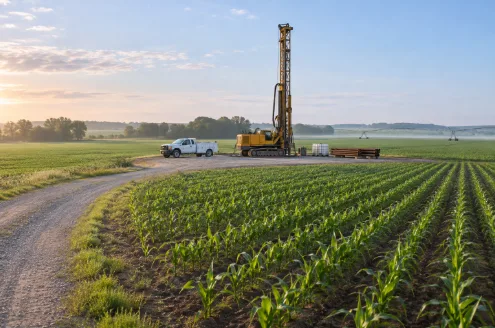
Illustration of a drill rig staging area at the edge of an irrigated field.
A rural irrigation well starts with a water budget. A grower needs to know how much water the crop needs during a demanding week, how much of that demand rainfall is likely to meet, and how many hours the system can run. Nearby well records and a site assessment then help frame the drilling plan. The completed well earns its place in the irrigation design through pumping tests that show how it responds under load.
The number that drives the project
Irrigation demand changes with the crop, its growth stage, weather, and effective rainfall, the portion of rain available to the crop. The Food and Agriculture Organization describes how to estimate irrigation need from crop water demand and effective rainfall [1]. On a farm, that depth of water has to be translated into a volume over the area to be irrigated. The system’s application efficiency then affects how much water must be delivered.
Consider an illustrative 10-acre planting with a net irrigation requirement of one inch over a representative peak week. One acre-inch is about 27,154 US gallons, so the crop area requires roughly 271,540 gallons of net water. At an assumed application efficiency of 80 percent, the gross delivery requirement would be about 339,425 gallons. Spread over 70 pumping hours that week, it averages about 81 gallons per minute. At 35 hours it averages about 162 gallons per minute. These figures are planning arithmetic for the assumed week. They do not predict what a well will produce.
The same crop demand can therefore support different equipment plans. A farmer running short irrigation windows may need higher delivery rates. A farmer with usable storage could let the well fill the storage at a steadier rate, then draw from it faster when a zone needs water. Multiple irrigation zones can also change the peak delivery rate. This is why the well, pump, water storage, and distribution plan should be discussed together early in the project.
What neighboring wells can tell a project team
A nearby log can show formations encountered, approximate water-bearing intervals, casing details, and occasionally a test or reported yield. Multiple logs are more informative than a single promising number. They can show whether water-bearing material is commonly encountered at comparable elevations or whether conditions change sharply across the area. Records with known locations, completion dates, and test methods are easier to interpret than an isolated statement that a neighbor has a good well.
Logs describe other holes. A well on the same road can intersect a different fracture network or a different thickness of water-bearing material. Well records also vary in what the driller measured and when. A reported water level may have been taken after drilling or during a different season. A reported yield may be an estimate made during construction. The design team can use these records to define plausible drilling conditions and the uncertainty around them. The actual borehole and its test data will carry more weight later.
A candidate site must also work for the farm after drilling. Consider how the pump will be powered, where the mainline will cross fields, how equipment will be serviced, and where test discharge can go. A short distance to the irrigation block is useful, but a proposed well point still has to be compatible with the site conditions and local requirements.
Turn the site assessment into a drilling brief
A drilling brief can specify the anticipated formation, likely depth range, preliminary casing and screen design where applicable, and room for the equipment. Borehole diameter has practical consequences. It must accommodate the casing and other completion requirements. The design of screened irrigation wells depends on the material the screen is meant to intercept, and a deeper borehole does not by itself solve an unsuitable screen or casing design [2].
| Decision | Useful early input | What the result affects |
|---|---|---|
| Peak demand | Crop area, irrigation window, effective rainfall | Required water volume and delivery rate |
| Candidate well site | Nearby logs, field layout, power and access | Preliminary target interval and pump access |
| Borehole construction | Formation, planned casing and screen | Hole diameter, drilling method, and equipment |
| Commissioning | Pumping rate, water levels, test duration | Initial operating plan and pump selection |
A crawler unit such as the HJi200 Crawler Water Well Drilling Rig is one equipment option a contractor could evaluate. HJi’s product page lists a 200-meter drilling depth and a 130–300 mm borehole range. Those values are useful for a first comparison with the project brief. The contractor still has to match the intended depth and diameter in the expected ground, as well as the support equipment and casing plan. A short distance across a firm access lane and a long approach across soft ground create different mobilization requirements, even for the same well design.
A broader equipment supplier such as HJi Group lists crawler, truck-mounted, and trailer-mounted rigs. The carrier affects how the package moves and sets up. The drilling system, tooling, circulation, and available pullback affect the hole it can construct. Separating those questions helps the buyer compare equipment proposals that may otherwise look similar on paper.
Agree on decisions before committing to equipment
A farm well project can be planned in stages so that early assumptions do not become expensive commitments. Before mobilization, the grower and contractor can agree on the preliminary hole design, the observations to record, and the points at which the plan might change. During drilling, the encountered materials may lead to a revised casing or screen plan. After development and testing, the pumping information can inform the final pump and its controls. Each decision uses a better description of the well than the one before it.
Give the contractor the range of rates that would be useful to the farm. A grower might prefer the 81 gallons per minute in the illustrative schedule and still have a practical option at a lower rate with a different run window. Another project might have a much narrower operating window because it needs to finish irrigation before other field operations start. Those are different business cases. A lower-than-expected yield has a different consequence when the schedule can change.
Field layout also affects which water rate matters. A steep rise or a long run of pipe can increase the head the pump has to overcome. A system with several irrigation zones may operate at a different flow when different valves are open. Treat the desired water rate and the pressure needed at the field as related inputs for pump selection. The well test describes how the source responds. The irrigation design describes what the distribution system demands. A pump needs to work where those two sets of conditions meet.
Confirm what the completed well can deliver
After construction and development, a pumping test records how the water level responds at a measured discharge rate. Drawdown is the difference between the starting water level and the water level while pumping at a stated time. Recovery describes the water level response after pumping stops. The University of Florida’s irrigation well guidance describes pumping tests as a way to evaluate well performance and inform permanent pump selection [2]. USGS distinguishes what different single-well tests can tell an analyst about the well and aquifer [3].
Suppose an illustrative test pumps 80 gallons per minute and records 20 feet of drawdown after a specified period. The corresponding specific capacity is 4 gallons per minute per foot at that rate and time. If a second well gives the same discharge with 40 feet of drawdown over the same period, it shows a different response in that test. A project team would still consider pumping duration, seasonal starting levels, and the possibility of interference from nearby wells. Multiplying specific capacity by a larger drawdown is a poor substitute for observing the response at the operating rate of interest.
The project also needs to connect the test to daily farm operations. If the tested well cannot supply the desired rate during the planned window, the team can compare a longer pumping window, changes to the irrigation zones, or storage. Any change has consequences for pump control, energy use, and field scheduling. A test gives the grower data to make that decision before committing to a permanent pump and distribution layout.
Seasonal follow-up can show whether the first operating plan still makes sense. Keep a baseline from commissioning, then record the pumping rate and water level under comparable conditions later in the season when practical. Note which zones are running and how long the pump has been on. A lower water level during a dry period does not by itself identify a well problem. Comparable records help distinguish a change in seasonal conditions from a change in well or pump performance that deserves closer examination.
Frequently Asked Questions
Is a deeper well likely to supply more water?
Depth alone tells you little about sustained yield. A well has to connect to water-bearing material that can deliver water to the borehole. Fractures, sediment characteristics, and well construction all influence performance.
Can I size a permanent pump from a driller’s estimate?
A drilling-stage estimate can inform early discussion. Use the pumping test, anticipated operating water levels, and distribution system head when selecting the permanent pump. These inputs describe the demand the pump will actually face.
Why does the borehole diameter differ from casing diameter?
The borehole must accommodate the casing and any annular space required by the completion design. A pump also needs to fit inside the casing. List the relevant diameters separately in the drilling brief.
Does every acre need water at the same moment?
Many farms irrigate in zones. The number of zones, run times, and storage arrangement change the delivery rate the system needs from the well or pump at a given time.
What should the owner keep after commissioning?
Keep the well log, completion details, test discharge and water levels, recovery data, and pump settings. The records provide a baseline if well output or pumping levels change later.
Put the project brief on one page
List the peak water requirement, hours available to pump, site access, and what the nearby logs suggest. Agree on the drilling assumptions and the test that will guide pump selection. With those inputs in the same brief, the grower and contractor can compare equipment and costs against a shared description of the job.
References
[1] Food and Agriculture Organization of the United Nations. Irrigation Water Management Training Manual No. 3, Chapter 4, Irrigation Water Needs.
[2] University of Florida IFAS Extension. Design and Construction of Screened Wells for Agricultural Irrigation Systems. Circular 1454, CH166.
[3] Ralph C. Heath. Basic Ground-Water Hydrology. U.S. Geological Survey Water-Supply Paper 2220, 1983.