
What Is a Dissertation? And Why It Matters More for Your Career Than You Think
If you have just been told you need to write a dissertation, you are probably picturing a very long essay. It is a reasonable guess, and it is wrong. After years of guiding research students through FIZ Business Solutions, I have come to see a dissertation as the first time university stops testing what you know and starts testing what you can do. It is less an essay and more a professional project in disguise.
So, what is a dissertation?
In plain terms, a dissertation is an extended, independent piece of research that you plan and carry out yourself, usually in the final year of an undergraduate degree or as the capstone of a Master’s. Instead of answering a question someone else set, you choose your own question, gather evidence to answer it, and present your findings in a structured written report. Undergraduate dissertations in the UK typically run from 8,000 to 12,000 words, and taught Master’s dissertations from 12,000 to 20,000, usually following a familiar shape: introduction, literature review, methodology, findings, discussion, and conclusion.
That definition is accurate, but it misses the point of why the task feels so different from everything before it.
Why it feels so unfamiliar
Every assignment up to now had a clear target. Read these chapters, answer this question, apply this formula. A dissertation takes the target away and hands you a compass instead. You decide what is worth investigating, how to investigate it, and what your results actually mean. That shift, from following instructions to setting your own direction, is the reason the task can feel overwhelming at first. It is also the reason it is worth so much more than the credits attached to it.
The skills a dissertation builds are the ones employers pay for
Here is the part that rarely gets explained. A dissertation is the closest thing an undergraduate degree offers to a real professional project, and it quietly trains the exact habits that make someone employable.
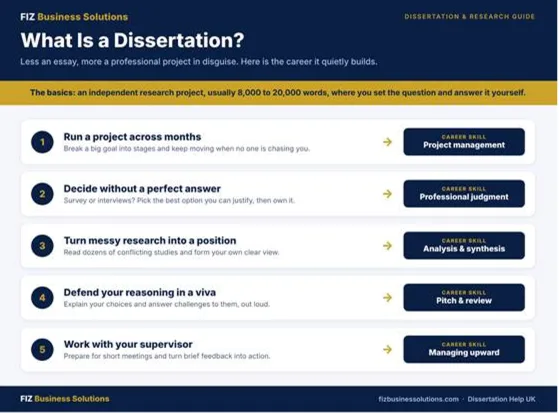
Managing a long project. A dissertation runs across months, not a single week. You have to break a large goal into stages, set your own milestones, and keep moving when no one is chasing you. That is project management, and it is the first thing a graduate employer looks for.
Making decisions without a perfect answer. Should you run a survey or interviews? Is this sample large enough? There is rarely one correct choice, only a best choice you can justify. Professional judgment is exactly this: deciding sensibly when the information is incomplete, then owning the decision.
Turning messy information into a position. The literature review asks you to read dozens of competing studies and form your own view of what they add up to. Analysts, consultants, policy advisers, and product managers do a version of this every week. Few other assignments train it so directly.
Defending your reasoning. In a viva or a supervisor meeting you have to explain why you did what you did and answer challenges to it. That is a performance review, a client pitch, and a board question rolled into one, practised in a safe setting.
Managing upward. A supervisor is, in effect, a busy senior colleague. Learning to prepare for short meetings, turn brief feedback into action, and keep the relationship productive is a workplace skill that most people only pick up years into a job.
The structure, seen as a project rather than an essay
When you view the standard chapters as stages of a project, they stop feeling arbitrary. The introduction is your project brief, setting the aim and why it matters. The literature review is your background research. The methodology is your plan, with its justification. The findings are your results. The discussion is your analysis of what those results mean, and it is usually where the strongest marks are won. The conclusion is your recommendation and your honest account of the limits. Seen this way, a dissertation is simply a well documented project, start to finish.
When a project this big feels too much
Most students hit at least one stage that stalls them, whether it is narrowing the topic, decoding a vague supervisor comment, or making sense of their own data. When that happens, the goal is never to hand the project to someone else, because the learning and the credit are yours to keep. Structured dissertation help UK students can rely on works best as guidance: a second set of eyes to help you plan the stages, understand feedback, and keep the project moving, so you finish it and can explain every part of it with confidence.
FAQ
What is a dissertation in simple terms?
It is a long, independent research project where you choose a question, investigate it yourself, and write up what you found in a structured report, usually in your final year or as a Master’s capstone.
How long is a dissertation?
In the UK, undergraduate dissertations are commonly 8,000 to 12,000 words, and taught Master’s dissertations 12,000 to 20,000. Always check your own handbook for the exact figure.
Is a dissertation just a long essay?
No. An essay answers a set question with existing knowledge. A dissertation asks you to set the question and produce new evidence or analysis of your own, which is a very different skill.
Do employers actually care about my dissertation?
They rarely ask about the topic, but they care a great deal about what it proves: that you can manage a long project, think independently, and defend your decisions. Those are exactly the points worth raising in an interview.
What is the difference between a dissertation and a thesis?
Usage varies, but in the UK a dissertation is most often the research project at undergraduate or Master’s level, while a thesis usually refers to the much longer work produced for a PhD.
The real takeaway
A dissertation is not an academic hoop to jump through. It is a rehearsal for professional life, compressed into one project and marked out of a hundred. Treat it as the first serious project of your career rather than the last essay of your degree, and two things happen at once. The work gets easier to plan, and the skills you build quietly become the ones you talk about long after the grade is forgotten.
About the author: Sajjad Akbar Ali is the founder of FIZ Business Solutions, which has supported university students across the UK and the Gulf with dissertations and academic work since 2015.