What Is Dropshipping? The Complete Beginner’s Guide for 2026
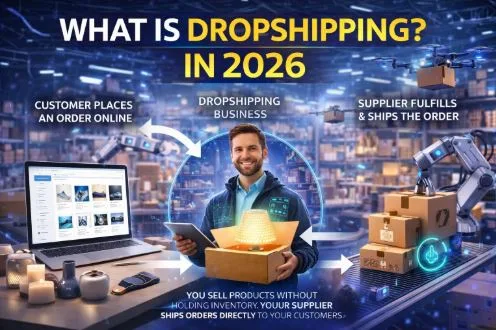
Dropshipping is one of those business models that sounds almost too simple when you first hear about it. You sell products online. When someone places an order, your supplier ships it directly to your customer. You never touch the inventory.
That is the basic version. The reality is a bit more nuanced, and understanding the nuances is what separates the people who build real dropshipping businesses from the people who give up after three months wondering what went wrong.
This guide covers everything a beginner needs to understand about dropshipping in 2026: how the model works, what the actual numbers look like, how to find products, how to choose a supplier, and what the common mistakes are.
How dropshipping actually works
In a traditional retail model, you buy inventory upfront, store it, and ship it yourself when orders come in. Dropshipping removes the inventory and storage step entirely.
Here is the basic flow:
- You list a product for sale on your online store at a retail price.
- A customer places an order and pays you.
- You forward the order to your dropshipping supplier and pay the wholesale price.
- Your supplier packs and ships the product directly to your customer.
- The difference between the retail price and the wholesale price, minus your costs, is your profit.
Your store is the front end. Your supplier is the back end. Your job is to connect the right customers to the right products and make the transaction smooth enough that they come back.
Is dropshipping still worth it in 2026?
Yes, but with more caveats than it had five years ago.
The global dropshipping market was valued at $365.7 billion in 2024 and is forecast to reach $1.25 trillion by 2030, a compound annual growth rate of 22% (Grand View Research). The model is growing, not shrinking.
What has changed is the competitive environment. Dropshipping became popular enough that many low-effort stores selling generic products from overseas warehouses saturated the market. Customers got burned by long shipping times and poor quality, and their expectations went up accordingly.
The stores that are doing well in 2026 are the ones that treat dropshipping as a real business rather than a passive income shortcut. That means niche selection, quality supplier relationships, proper store design, and a genuine focus on customer experience.
Research suggests that 10% to 20% of dropshipping stores are profitable in their first year (Dropship.io). That number is higher than the general failure rate for small businesses, but it highlights that success is not automatic.
What are the actual profit margins?
Margins in dropshipping vary significantly by niche. Low-price-point products in competitive categories like phone accessories or generic fashion often yield margins of 10% to 15% after ad spend. That is thin and leaves very little room for error.
Higher-ticket products in less competitive categories tell a different story. Sellers in furniture, home goods, garden equipment, and fitness typically operate on margins of 20% to 40% per sale (SellersCommerce, Drop Ship Lifestyle). A single $600 furniture sale at a 25% margin puts $150 in your pocket. You need far fewer transactions to build meaningful monthly revenue.
The lesson most experienced dropshippers eventually land on: higher-priced products in focused niches almost always outperform cheap, high-volume models over the long term.
How to find dropshipping products in 2026
Product selection is where most beginners spend too little time. Here is a practical framework:
Start with demand validation. Use Google Trends to check whether search interest in your product category is stable or growing. Avoid categories in sharp decline. Look for consistent upward trends or steady year-round demand.
Check competitor stores. Search for your target product on Google Shopping. If there are established stores selling it at a premium price with professional listings, that is a signal that margin exists. If every result is AliExpress listings at rock-bottom prices, the margin is likely gone.
Prioritise products with these characteristics: high enough price to support real margins (generally $100 and above), low enough weight and complexity to keep shipping manageable, not dominated by big brand names that a small store cannot compete with, and low return rates relative to category.
Some of the strongest performing product categories for dropshipping right now include home and indoor furniture, garden and outdoor equipment, home office setups, fitness and gym equipment, pet products, and storage systems. These categories share a common trait: consumers research before buying, which rewards sellers who invest in good content and product presentation.
How to choose a dropshipping supplier in 2026
Your supplier is the most important operational decision you make. They determine whether your customers get a good experience or a bad one, and you often do not find out which until after the sale.
What to look for in a reliable dropshipping supplier:
Warehouse location relative to your customers: If you are selling to European customers, your supplier needs EU-based warehousing. Shipping from overseas means longer delivery windows and potential customs charges at the customer’s door, both of which destroy conversion rates and generate disputes.
Real-time inventory sync: You need to know immediately when products go out of stock so your store reflects availability accurately. Manually checking supplier stock is not scalable.
Returns handling: In most markets, consumer protection laws give buyers a right to return products within a set window. You need a supplier that manages returns directly, not one that sends them back to you to figure out.
Transparent pricing: Be cautious with commission-based models where the supplier takes a cut of every sale. As you scale, those commissions compound. Flat monthly fee structures like the one offered by dropXL protect your margins as volume grows.
Platform integrations: Your supplier should connect seamlessly with Shopify, WooCommerce, or whichever platform you are building on. Manual order entry is a bottleneck that will cost you time and introduce errors.
For sellers in the home, garden, and furniture space targeting European or US customers, dropXL’s catalog of over 90,000 products with EU and US warehousing is worth looking at as a starting point. The combination of local fulfilment, direct returns handling, and platform integrations addresses the main supplier pain points in one place.
How to build your dropshipping store
Shopify and WooCommerce are the two platforms most dropshippers use. Shopify is easier to set up quickly and has a strong app ecosystem for dropshipping automation. WooCommerce offers more flexibility and lower long-term costs if you are comfortable with WordPress.
Whichever platform you choose, your store needs a few things to convert visitors into buyers:
Product pages that actually inform. Include multiple photos, clear dimensions or specifications, honest delivery time estimates, and a visible returns policy. Buyers in high-value categories research carefully. Give them what they need to make a decision.
A trust layer. New stores have no social proof. Compensate with clear contact information, a professional design, genuine product descriptions (not copy-pasted supplier text), and any reviews or testimonials you can generate early on.
A simple checkout. Every additional step between add to cart and payment loses a percentage of buyers. Keep checkout short, offer multiple payment methods, and be transparent about shipping costs before the final step.
Common mistakes beginners make
Choosing a niche based on personal interest rather than market data. Your passion for a product does not guarantee that enough people want to buy it. Validate demand before you build.
Picking the cheapest supplier without checking warehouse location. The margin you think you are saving on product cost gets eaten by returns, disputes, and customer service time when delivery takes three weeks.
Expecting paid ads to be profitable immediately. Most stores need two to four weeks of testing before ad campaigns run efficiently. Factor that into your budget planning.
Neglecting SEO. Paid traffic is expensive. Organic search traffic compounds over time and costs nothing per click. Invest in content from the beginning, even if the results take months to show.
Trying to sell everything. Broad stores with no focus rarely build the authority or SEO traction that niche stores do. Pick a category and own it before expanding.
What does a realistic dropshipping income look like?
This varies enormously depending on niche, traffic, and margins. But to ground the numbers: a store generating $10,000 in monthly revenue at a 25% net margin produces $2,500 per month in profit. Stores at $50,000 to $100,000 monthly revenue are genuinely achievable after 12 to 24 months for sellers who build methodically (TrueProfit, Zendrop case studies).
The sellers who reach those numbers are not doing anything mysterious. They picked a good niche, found a reliable supplier with local fulfillment, built a store that earns trust, and invested consistently in traffic. That is the whole model.
Dropshipping in 2026 is not a shortcut. It is a legitimate e-commerce business model that rewards the same fundamentals as any other business: good products, good supplier relationships, and a genuine focus on customer experience.