What Is Henna? Science, Safety, and Trending Mehndi Designs
Henna is a natural reddish-brown dye made from the powdered leaves of the Lawsonia inermis plant according to Encyclopaedia Britannica. People across South Asia, North Africa, and the Middle East apply this herbal paste in decorative patterns known as mehndi. The cultural significance of henna and mehndi has historically served as a vital form of temporary body art for weddings, religious holidays, and personal self-expression.
Modern styles blend ancient tradition with contemporary visual art. Artists today create everything from sharp geometric bands to delicate negative-space flowers. Understanding how natural henna (Wikipedia) works helps you select clean ingredients, protect your skin from harmful synthetic additives, and pick designs that perfectly fit your personal style.
The Science of Henna: How Natural Leaves Stain Skin
Pure henna works through simple plant chemistry rather than synthetic dyes. The leaves of the henna plant contain non-dyeing precursors called hennosides. When crushed dry leaves mix with a mildly acidic liquid, these precursors break down to release an active pigment molecule called lawsone (2-hydroxy-1,4-naphthoquinone).
Lawsone does not merely sit on top of your skin. It penetrates the dry outer layer of dead cells, known as the stratum corneum. Once inside, lawsone binds to keratin protein through a 1,4-Michael addition reaction. This reaction attaches the dye directly to the sulfur-rich amino acids in human skin. Because the pigment locks into your physical skin cells, you cannot wash the design away. The color fades only as your skin naturally exfoliates over two to three weeks.
Why Your Skin Location Determines Stain Color
The depth of your stain depends directly on skin thickness and keratin density:
- Palms and Soles: The stratum corneum is thickest on the palms and bottom of your feet. These areas hold large amounts of keratin. They produce the deepest, darkest mahogany and espresso shades.
- Back of the Hand: The skin on the back of the hand is much thinner. This region produces warm chestnut and copper-brown tones.
- Arms, Legs, and Body: Henna stains body skin with lighter amber tones because those areas have very thin outer skin layers.
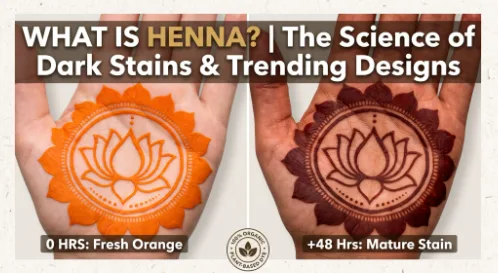
When you first scrape off dry henna paste, the fresh design appears bright pumpkin orange. This color comes from the dye in its initial reduced state. Over the next 24 to 48 hours, exposure to normal room air causes oxidation. The oxygen in the air deepens the mark into a rich, dark reddish-brown.
Natural Henna vs. Dangerous “Black Henna”
Real henna is always an organic, plant-derived product. Synthetic alternatives sold under the name “black henna” pose serious health hazards.
| Feature | Pure Natural Henna (Lawsonia inermis) | Adulterated Synthetic “Black Henna” |
| Active Staining Agent | Natural lawsone molecule | Paraphenylenediamine (PPD), coal tar, toxic chemicals |
| Initial Paste Color | Olive green or khaki brown | Inky black or dark charcoal |
| Scent | Earthy, sweet herbal, or tea aroma | Sharp, solvent, gasoline, or chemical odor |
| Color Timeline | Pumpkin orange turning to deep mahogany over 48 hours | Jet black instantly or within one hour |
| Skin Safety | Safe for skin; allergic reactions are rare | High risk of chemical burns, open blisters, permanent scars |
| Wear Duration | Fades evenly over 1 to 3 weeks | Irregular fading, skin discoloration, or peeling |
Natural henna never produces a black stain. Synthetic cones use hair dye chemicals like PPD to force an instant, artificial black color. PPD causes severe contact dermatitis, fluid-filled blisters, and lifelong allergic sensitization.
Always ask your artist about their paste ingredients before application. A reputable professional mixes their own cones using pure leaf powder, sugar, water or citrus juice, and skin-safe essential oils like lavender or cajeput.
5 Trending Mehndi Designs Leading Modern Trends
Mehndi design have moved away from heavy, solid coverage. Today, wearable layouts emphasize balance, skin contrast, and clean lines.
1. Minimalist Negative-Space Mandalas
Negative-space patterns, also called cutwork, rely on contrast rather than dense lines. The artist paints delicate floral outlines, such as lotus petals or rose blossoms, on the center of the palm. The artist then fills the empty space around the flowers with solid paste. When scraped away, the bare skin forms the bright focal shape against a rich, dark background. This style creates clean, graphic contrast that shows up crisply in photographs.
2. Fine-Line Khafif and Jewelry Accents
Khafif is an Arabic design style that uses needle-thin lines and open spaces. Instead of filling the palm, artists paint delicate chain patterns that look like real jewelry. A typical pattern features a wrist cuff connected to finger bands with micro-dot strands, resembling a South Asian haathphool hand piece. The center of the hand stays clear, making the design light and modern.
3. Asymmetrical Arabic Floral Trails
Arabic layouts, known as bel, follow a free-flowing diagonal path. The pattern starts at one side of the wrist, sweeps across the center of the hand, and finishes at the tip of a single finger, usually the index finger. These layouts feature large scalloped petals, bold outer borders, and soft inner line shading. Leaving the surrounding skin bare gives the hand an elongated, elegant appearance.
4. Indo-Western Geometric Fusion and Back Hand Layouts
This style pairs classical Indian linework with modern Western geometric balance. It serves as an ideal layout for a back hand mehndi design, where open skin helps fine details stand out clearly. Artists center a circular mandala or medallion over the back of the hand, framing it with tiny repeating dots, straight lines, and spaced chevron rings. The fingers feature matching micro-bands at each knuckle. This creates a balanced, accessory-like appearance that complements rings and bracelets without overcrowding the skin.
5. Architectural Arches (Jharokha Motifs)
Inspired by historic Rajasthani and Mughal palace architecture, this design uses scalloped window arches on the lower palm and wrist. A simple image sits inside the arch, such as a floating lotus, a tiny peacock, or a soft silhouette. Fine latticework surrounds the frame, giving the piece depth without cluttering the hand.
Step-by-Step Guide for a Dark, Long-Lasting Stain
You do not need chemical additives to achieve a dark, lasting stain. Following proper preparation and aftercare techniques yields rich color naturally.
- Clean Your Skin: Wash your hands with plain soap and warm water before application. Do not apply hand lotions, body butter, or oils, as they create a physical barrier that prevents dye penetration.
- Protect Movement Zones: Tell your artist to leave slight gaps over your knuckle creases. Thick lines applied over bending joints crack and lift before the paste releases its dye.
- Apply a Sugar-Lemon Seal: Once the paste dries on your skin, lightly dab it with a mixture of warm lemon juice and white sugar. The sugar keeps the paste sticky and moist against your skin, while the mild acid aids dye release.
- Keep the Paste Warm: Lawsone transfers best in warm conditions. Sit in a warm room or wrap the dry paste in breathable medical tape to trap natural body heat.
- Leave the Paste on the Skin: Keep the paste on your skin for 4 to 8 hours. Leaving it on overnight provides the deepest color.
- Scrape, Never Wash: Never wash fresh henna paste away with water. Gently flake the dried crust off using your fingernails, a butter knife, or a paper towel. Rub a small dab of coconut oil onto your skin to loosen stubborn flakes.
- Avoid Water for 24 Hours: Keep your fresh mark away from water and soap for the first 12 to 24 hours. Water stops the oxidation process and fades the top layers of dye. Coat the area with natural balm or shea butter before showering to block water.
Frequently Asked Questions
How long does a natural henna stain last on skin?
A natural henna stain typically lasts between one and three weeks. The longevity depends on your skin exfoliation rate, how often you wash your hands, and where you applied the design. Palms fade fastest because of frequent hand washing.
Why did my henna turn bright orange when I scraped it off?
Bright orange is the normal starting color for real henna. The lawsone molecule requires oxygen to develop its final tone. Your design will darken into a deep reddish-brown or mahogany over the next 24 to 48 hours.
Is natural henna safe during pregnancy?
Pure, natural henna mixed with gentle essential oils like lavender is safe for pregnant women. Avoid pre-packaged shelf cones, black henna, and pastes containing toxic chemical solvents or camphor. Always verify that your artist mixes their paste using clean, organic ingredients.
Can you make natural henna turn black?
No. True Lawsonia inermis can only produce tones ranging from warm orange to deep mahogany brown. Any product that turns skin jet black within an hour contains synthetic industrial chemicals like PPD, not pure henna.
How can I remove a fading henna design quickly?
You cannot wash away a fresh henna bond instantly because the pigment resides inside your skin cells. You can speed up fading by soaking your hands in warm salt water and gently buffing the skin with an exfoliating scrub or loofah twice daily.
Natural henna offers an ancient, plant-powered way to decorate the body without synthetic dyes or permanent needles. Focus on clean ingredients, allow ample time for oxidation, and choose design layouts that fit your personal aesthetic. Select an organic cone, protect your skin from early water exposure, and enjoy your custom hand-painted art.