What Is Mad Honey? The Complete Guide to the World’s RQarest Honey
A detailed look at where mad honey comes from, how it is made, what grayanotoxins do, how to stay safe and how to tell a genuine jar from a doubtful one.
Mad honey is honey made by bees from the nectar of certain rhododendron flowers, and it contains natural compounds called grayanotoxins. In small amounts these compounds can cause warmth, tingling and lightheadedness. In larger amounts they can slow the heart, lower blood pressure and cause serious illness. It is produced mainly in the Himalayas of Nepal and on Turkey’s Black Sea coast, and written accounts of it go back to at least 401 BCE.
It is often described as one of the world’s rarest honeys, and the reason lies in how it is made. In Nepal, wild giant honey bees build enormous combs on sheer cliff faces, and skilled hunters collect them from rope-and-bamboo ladders during short seasonal windows. Supply is small, strength varies from batch to batch, and demand has grown faster than genuine supply. That combination makes the story fascinating and the risks worth understanding.
This guide answers the questions readers ask most often: what mad honey is, how bees produce it, what grayanotoxins do in the body, where it comes from, how cliff honey hunting works, what its history looks like, what the evidence says about traditional uses, how to stay safe, and how to tell an authentic jar from a doubtful one. It is educational in intent, and where the evidence is thin or uncertain, the guide says so.
Quick Facts
- What it is: honey made from the nectar of certain rhododendron species, containing grayanotoxins
- Also known as: deli bal (Turkish for “mad honey”), cliff honey, red honey, grayanotoxin honey
- Active compounds: grayanotoxins, a family of diterpenoid compounds, with types I and III most often discussed
- Main producing regions: the Himalayas of Nepal and the eastern Black Sea coast of Turkey
- Nepal’s bee: Apis laboriosa, the Himalayan giant honey bee, the largest honey bee in the world
- Harvest: wild cliff harvesting in Nepal, concentrated in spring and autumn
- Typical appearance: reddish-brown, with a sweet start and a bitter or tingling finish
- Main safety concern: grayanotoxins can slow the heart and lower blood pressure, and strength varies widely between batches
What Is Mad Honey?
Mad honey is honey that contains grayanotoxins. These compounds are made by plants in the heath family, Ericaceae, and are found in the leaves, flowers, nectar and pollen of certain rhododendron and related species. When bees gather nectar from those plants and turn it into honey, the grayanotoxins are not removed. They carry through into the finished product.
The name is straightforward. In Turkey the honey is called deli bal, which translates as mad honey.The word “mad” points to the disorienting effects of eating too much of it, including dizziness, confusion and loss of coordination. It does not mean the honey is fake, rare in the sense of imaginary, or a drug in the modern sense. It is a real, naturally produced honey with a long written history.
What separates mad honey from ordinary honey is not sugar content or processing. It is the plants the bees visited. A jar of supermarket honey is usually a blend of nectar from many flowers, and any single plant’s chemistry is diluted. Mad honey is different when bees have access to large stands of grayanotoxin-producing rhododendrons and forage heavily on them, so the compounds remain concentrated.
Not every rhododendron produces significant amounts of grayanotoxins, and not every honey from a rhododendron region qualifies as mad honey. Strength depends on the plant species, the altitude, the season, the weather and how much other nectar the bees collected. That is why two jars sold under the same name can differ enormously in potency, and why claims about a “standard” mad honey should be treated with caution.
Colour, Taste and Texture
Genuine mad honey is usually darker and redder than typical table honey, often described as reddish-brown or deep amber. It can be thick, and some batches are slightly grainy. The flavour begins sweet and then turns bitter or astringent, and some people notice a tingling or mild burning sensation at the back of the throat. These traits are useful clues but they are not proof of authenticity, because some non-mad honeys are also dark and bitter, and because unscrupulous sellers can imitate the look of the real thing. Independent testing is the only reliable answer, which is covered later in this guide.
It Is a Food, and a Bioactive One
In most places where it is sold, mad honey is treated as a food product. That classification does not make it harmless. It contains a bioactive toxin, which is why doctors in regions where the honey is produced are familiar with the pattern of illness it causes. Understanding both sides of that description, a traditional food and a bioactive substance, is the key to approaching it sensibly.
How Is Mad Honey Made?
All honey starts as flower nectar. Foraging bees collect it, carry it back to the colony and pass it to other workers, who reduce its water content and add enzymes that change its sugars. The result is stored in wax comb and capped. The process is the same for mad honey as for any other honey, and there is no separate step in which grayanotoxins are added. They come from the plants.
Three conditions have to line up for a batch to end up as mad honey.
1. The Right Plants in Large Numbers
Grayanotoxin-producing rhododendrons must grow densely in the bees’ foraging range. In Nepal the forests of high hills and mountains include many rhododendron species, and Rhododendron arboreum, Nepal’s national flower, is the one most often mentioned in connection with the honey. In Turkey, Rhododendron ponticum and Rhododendron luteum are the plants usually blamed for the local honey’s effects.
2. Bees That Forage on Them Heavily
If there is a wide variety of other flowers in bloom, bees spread their visits across many species and the grayanotoxins are diluted. When rhododendrons dominate the bloom, especially during a short flowering peak, the nectar going into the comb is heavily weighted toward them. This is why timing matters so much, and why harvests from the peak rhododendron season tend to be described as stronger.
3. A Harvest That Preserves the Character of the Honey
Mad honey is not blended down the way industrial honey often is. Batches are collected in limited quantities at particular times, and reputable producers keep them separate so that each can be tested. Blending a strong batch with ordinary honey would dilute it, which is one reason low-priced products marketed as mad honey are viewed with suspicion.
Why Potency Varies So Much
Altitude, temperature, rainfall, flowering time, the health of the plants and the mix of other flowers nearby all affect how much grayanotoxin ends up in a comb. Even within one cliff or one hillside, different combs harvested on different days can vary. This natural variability is not a defect. It is a feature of how the honey is produced, and it is the main reason that batch-level testing matters so much for anyone who buys it.
What Are Grayanotoxins? The Science Behind Mad Honey
To understand why mad honey behaves the way it does, it helps to look at the compounds behind it. Grayanotoxins are a group of related diterpenoids. They are usually numbered, with grayanotoxin I and grayanotoxin III the ones most often described in the scientific literature on mad honey. Researchers have studied them for decades, largely because of the poisoning cases seen in clinics around the Black Sea and in Nepal.
What the Compounds Do in the Body
Grayanotoxins act on voltage-gated sodium channels, the tiny gates in nerve, muscle and heart cells that open and close to let sodium ions pass. Normally these channels open briefly to send a signal and then close and reset. Grayanotoxins bind to the channels and hold them open for longer than normal. That disturbs the way cells fire and recover.
Because the nervous system and the heart depend heavily on these channels, the effects show up there first. This is the reason for the characteristic pattern of symptoms: tingling and numbness, dizziness, sweating, nausea and vomiting, a slow heart rate (bradycardia), low blood pressure (hypotension) and, in serious cases, fainting or disturbances of heart rhythm.
Not a Classic Psychedelic
Mad honey is sometimes described online as “psychedelic honey” or “hallucinogenic honey.” That framing is misleading. Classic psychedelics such as psilocybin act on serotonin receptors in the brain. Grayanotoxins work on sodium channels, and their effects at ordinary exposure levels are mostly physical: warmth, tingling, lightheadedness and a sense of relaxation or heaviness. Some people also describe a mild change in mood or perception, but vivid visual hallucinations are not the typical pattern in the medical literature. Poisoning reports focus on dizziness, weakness, blurred vision, confusion and heart-related symptoms, not on the experience users of psychedelics describe.
Onset and Duration
Clinical descriptions generally place the onset of symptoms somewhere between a few minutes and a couple of hours after eating the honey, depending on the amount eaten and the batch. In most published cases the symptoms fade within a day or so with rest and supportive care. Onset, duration and severity vary from person to person and with body size, food intake, other medications and the strength of the honey.
Why Dose Is Hard to Predict
This is the key scientific point for consumers. Because grayanotoxin concentration varies with each harvest, and because individuals differ in their response, there is no universal safe amount that applies to every jar. Two spoonfuls from two different batches may contain very different quantities of active compound. Guidance that gives one fixed dose for “mad honey” in general should be treated with scepticism. The responsible approach is to rely on batch-specific information from the producer, the advice of a qualified health professional and a strongly cautious attitude to quantity.
Mad Honey vs Regular Honey
Readers often ask how mad honey differs from the honey they buy in a supermarket. The two share a basic identity, since both are made by bees from flower nectar, but they diverge in almost every practical respect.
| Feature | Regular honey | Mad honey |
|---|---|---|
| Nectar source | Blend of many flowers, such as clover, wildflower or acacia | Heavily weighted toward certain rhododendron species |
| Bees | Usually managed Apis mellifera | Wild Apis laboriosa in Nepal, managed hives in Turkey |
| Notable compounds | Sugars, enzymes and trace nutrients | Grayanotoxins in addition to the usual honey components |
| Colour | Pale gold to amber | Often dark reddish-brown |
| Taste | Sweet and mild, varying by flower | Sweet start, bitter or astringent finish, sometimes tingling |
| Effects on the body | None beyond ordinary nutrition for most adults | Can cause tingling, dizziness, slow heart rate and low blood pressure |
| Harvest | Commercial apiaries and managed hives | Wild cliff hunting in Nepal, hive collection in Turkey |
| Availability | Mass-produced and widely available | Limited, seasonal and batch-dependent |
| Testing that matters | Purity and origin | Grayanotoxin content, purity and batch traceability |
The biggest difference is not on the table. Ordinary honey is a low-risk food for most adults, which is why people are used to eating it by the spoonful without thinking. Mad honey carries a bioactive compound that acts on the heart and nerves, so the habits people bring from everyday honey, such as adding it freely to tea or eating a generous spoonful, do not carry over safely. Respecting that difference is one of the most useful things a first-time buyer can do.
The price gap follows from the same logic. Wild cliff harvesting is risky and limited, batch testing costs money and international shipping adds to the total. A higher price is therefore expected for genuine, tested honey, although price alone is never proof of quality.
Where Does Mad Honey Come From?
Mad honey is produced principally in two parts of the world: the Himalayan region of Nepal and the eastern Black Sea region of Turkey. Rhododendrons grow in many other places, including parts of Europe, East Asia and North America, and isolated cases of grayanotoxin honey have been reported elsewhere. But the combination of the right plants, dense blooms and bees that forage on them is well documented mainly in these two regions.
Nepal: Cliff Honey of the Himalayas
Nepal is home to the most dramatic version of the story. In the hills and mountains of the country, from the Annapurna region through districts such as Lamjung and Gorkha and on toward the Everest region, forests of rhododendron cover large areas at altitude. The honey there is made by Apis laboriosa, the Himalayan giant honey bee.
Apis laboriosa is the largest honey bee species in the world. Unlike the European honey bee that lives in boxes in orchards and gardens, it builds single, large, open combs that hang from rock overhangs and sheer cliff faces, often hundreds of feet above the ground and commonly at altitudes above about 2,500 metres. A single colony can produce a very large comb, and the colonies return to the same cliffs year after year. The bees are wild. They cannot be kept in conventional hives, which is a major reason that Nepali mad honey remains limited in supply.
The people most closely associated with harvesting this honey are the Gurung and, in some areas, Magar communities of the central hills. Their tradition of cliff honey hunting is passed down through families and by apprenticeship. It is covered in detail in the next section.
Turkey: Deli Bal of the Black Sea
On the eastern Black Sea coast, in provinces such as Trabzon and Rize, the honey is known as deli bal. Here the setting is quite different. The bees are generally kept in managed hives rather than wild cliff nests, and the main plants involved are Rhododendron ponticum and Rhododendron luteum, which grow in the damp, misty forests of the region.
Deli bal has been part of local life for centuries. It has been eaten in small amounts as a traditional remedy, and the region has also produced a steady stream of hospital cases over the years, which is why so much of the modern medical literature on mad honey comes from Turkish clinics. Turkish honey is generally described as milder than the honey from Himalayan cliffs, although this is a broad generalisation and individual batches vary.
Other Places
Reports of grayanotoxin honey exist from other rhododendron regions, and the honey can occasionally be produced in places such as the eastern United States when conditions allow. These cases are rare and usually accidental, and they do not form an established trade in the way that Nepal’s and Turkey’s honeys do.
Nepal and Turkey Compared
| Feature | Nepal | Turkey |
|---|---|---|
| Bee | Wild Apis laboriosa (Himalayan giant honey bee) | Mostly managed hives of local honey bees |
| Setting | Cliff faces and high Himalayan forests, commonly above about 2,500 m | Forested hills of the eastern Black Sea coast |
| Main plants | High-altitude rhododendrons, including Rhododendron arboreum | Rhododendron ponticum and Rhododendron luteum |
| Harvest method | Wild cliff hunting with rope-and-bamboo ladders and smoke | Collection from managed hives |
| Typical seasons | Mainly spring, with a smaller autumn harvest | Depends on bloom in the Black Sea region |
| General reputation | Often described as stronger and more distinctive | Generally described as milder |
| Supply | Limited and seasonal | More accessible historically |
The differences matter for a practical reason. Because the bees, plants, altitude and harvest methods differ, so does the character of the honey. Many people who follow the subject describe Himalayan cliff honey as the stronger and more distinctive of the two, but strength is best judged by lab data on a particular batch, not by the country label alone.
The Ancient Art of Cliff Honey Hunting
Honey hunting in the Nepali hills is one of the most dramatic food-gathering traditions still practised anywhere. It is a physical, dangerous and deeply cultural activity, and it is also the reason that authentic Himalayan mad honey cannot be produced in large volumes.
The Setting
The combs of Apis laboriosa hang from cliff faces that may be steep, exposed and hundreds of feet high. Access from below is rarely possible, so hunters work from above, descending the rock face on long ladders made from rope and bamboo. Weather, light and the mood of the bees all affect the timing of a hunt, and a single mistake can be fatal.
The Team and the Tools
A hunt is a team effort. Some members work at the top of the cliff, managing and anchoring the ladder. Others work at the base, receiving baskets of comb. The lead hunter goes down the ladder. Traditional tools include the rope-and-bamboo ladder itself, smoke to calm the bees and long bamboo poles, sometimes called tangos in accounts of the practice, used to cut sections of comb loose from the rock.
Smoke plays a vital role. Bees that sense smoke tend to behave less aggressively, and a good smoke source can make the difference between a hunt that proceeds and one that has to be abandoned. Even so, stings are common, and accounts of honey hunts frequently mention hunters being covered in bees.
Ritual and Respect
Cultural accounts of the practice describe rituals before a hunt, including offerings and prayers to forest and cliff spirits. These are reported as sincere parts of the tradition rather than performance, reflecting a belief that the cliffs and the bees are protected by powers that need to be respected. Whatever one’s own beliefs, the rituals show how the hunt is understood by the communities that carry it out: as an act that needs permission, care and gratitude, not simply a harvest.
Taking Only Part of the Comb
Traditional practice usually leaves part of the comb in place so that the colony can survive and rebuild. Taking the whole nest would risk destroying the colony and losing the harvest in future years. This selective approach is often cited as a form of built-in sustainability, and it reflects generations of practical knowledge about how the bees behave.
Seasons
Harvests are seasonal and follow the rhythm of the rhododendron bloom. Accounts commonly describe a main spring harvest, roughly from April into June, and a second, generally smaller autumn harvest, roughly October to November. The spring harvest is often described as the more potent, because it comes after the main flowering period, although again this is a general pattern and not a guarantee for any particular jar.
Why Is Mad Honey Called One of the World’s Rarest Honeys?
Mad honey is often described as one of the rarest honeys in the world. There is no official ranking behind that phrase, so it is best read as a description of how limited the supply is, not as a measured fact. Several real constraints explain why the description keeps appearing.
Grayanotoxin Plants Grow Only in Certain Places
The rhododendrons that produce grayanotoxin-rich nectar grow densely only in particular regions and at particular altitudes. Where they do not dominate the bloom, bees mix nectar from many flowers and the honey never reaches the concentration that earns the name.
The Bees Cannot Be Farmed
Nepal’s cliff honey comes from wild Apis laboriosa colonies that nest on rock faces. Unlike European honey bees, they cannot be moved into boxes and managed in an orchard. Production depends on wild colonies returning to the same cliffs year after year.
The Seasons Are Short
Harvests follow the flowering cycle. Accounts describe a main spring harvest and a smaller autumn one, and weather can shorten or cancel either. There is no way to produce more honey by adding more hives or running the operation year-round.
The Work Is Skilled and Dangerous
Each hunt needs experienced climbers, a coordinated ground team, suitable weather and calm bees. The number of people who can do this work is limited, and each expedition yields a modest amount of honey.
Every Batch Is Different
Because plants, altitude and timing vary, no two harvests are identical. Producers who test batches individually end up with small lots of different strengths, not one large uniform product.
Rare Does Not Automatically Mean Better
Scarcity is a reason for a higher price, but it says nothing about whether a particular jar is stronger, safer or more valuable. It is also a marketing phrase that some sellers use loosely. The sensible response is to ask for evidence: a named harvest region, a harvest season, and independent lab results for the specific batch.
A History of More Than 2,400 Years
Mad honey has one of the longest written histories of any natural food. The earliest accounts read more like military reports than culinary history.
Xenophon and the Ten Thousand, 401 BCE
The best-known early account comes from the Greek soldier and writer Xenophon. In the Anabasis, his account of the march of the Ten Thousand, he describes how Greek soldiers moving through the region near the Black Sea came across many beehives and ate the honey. Those who ate a little became disoriented and behaved as if drunk. Those who ate more became seriously ill, unable to stand, vomiting and in some cases apparently at death’s door. Xenophon reports that they recovered within a day or two and that no one died.
It is one of the earliest descriptions of mass mad honey poisoning in Western literature, and it fits the modern clinical picture closely: dizziness, weakness, vomiting and recovery within a short time.
Other Classical Voices
Later writers also noted the strange honey of the Black Sea coast. Ancient authors including Strabo and Pliny the Elder are commonly cited as having recorded toxic honey from the region, and there are further scattered references in classical and later texts. Some scholars have also suggested that certain ancient descriptions of prophetic or oracular honey may have alluded to it, although that idea is speculative and should not be treated as established.
Mithridates and Pompey
Another well-known episode dates to the first century BCE, during the wars between Rome and King Mithridates VI of Pontus. According to ancient sources, Mithridates’ forces left containers of the local honey along the path of Roman troops led by Pompey. The soldiers ate the honey, became incapacitated and were attacked while they were unable to defend themselves. The story is often cited as one of the earliest recorded uses of a natural substance as a weapon of war, and it is repeated in many modern accounts, although as with much ancient history the details come from later writers and the exact numbers are uncertain.
Into Europe
By the eighteenth century, honey of this kind had reportedly reached Europe, where it was imported and added to alcoholic drinks to strengthen their effect. Physicians in the same period also began to write about cases of poisoning, and by the nineteenth and twentieth centuries the illness had a formal place in medical case reports.
The Himalayan Tradition
In the Himalayas the tradition is older in oral form than in written form. Gurung and other hill communities have collected cliff honey for many generations, using it as food, as trade goods and as a traditional remedy. Written records of the practice by outsiders are much more recent, but the technique, the ladders and the associated rituals appear to be deeply rooted.
The Modern Era
In recent decades mad honey has moved from a regional curiosity to a global talking point. Documentaries and travel writers have carried images of cliff hunters to worldwide audiences. Online sales have made the honey available far beyond the hills where it is produced. Along with the attention has come pressure on traditional harvesting, a rise in low-quality or fake products and, in some places, closer scrutiny by regulators and marketplaces.
What Is Mad Honey Used For? Traditional Uses and the Evidence
Across Nepal and Turkey, mad honey has been used in small amounts as a folk remedy. It is important to separate what people have traditionally believed from what has been demonstrated in modern research, because the two are often blurred in popular articles and product descriptions.
Reported Traditional Uses
Accounts from the regions where the honey is produced commonly mention the following.
- Blood pressure: small amounts have been used traditionally by people who believe it helps with high blood pressure. This is the use that has the most obvious biological logic, because grayanotoxins lower blood pressure, but that same action is what makes overconsumption dangerous.
- Digestive complaints: traditional use for stomach discomfort, indigestion and ulcer-type complaints is described in folk medicine and in some review papers.
- Joint and general aches: it has been used as a warming tonic in some communities.
- Relaxation and sleep: its calming, heavy feeling has led to use as an evening remedy.
- Vitality and libido: in both Nepal and Turkey it has a reputation as a tonic and aphrodisiac. This is one of the most widely repeated claims and also one of the least well supported by controlled research.
The State of the Research
Scientific literature on mad honey is dominated by case reports and case series of poisoning, not by clinical trials of benefits. Laboratory and animal studies have looked at effects of grayanotoxins on blood pressure, heart rate and nerve activity, and there is some early work on other properties, such as antioxidant or anti-inflammatory activity. However, large, well-controlled human trials testing mad honey as a treatment are lacking.
That means traditional use is not proof of benefit. It also means no responsible source can promise that mad honey will treat, cure or prevent any condition. It is best understood as a traditional food with bioactive properties, not as an approved medicine or a supplement with proven health outcomes.
A Note on the Word “Benefits”
Search results for mad honey are full of pages promising benefits. A careful reader should ask what kind of evidence sits behind each claim. Is it a study on people, a study on animals, a laboratory experiment, an old text or simply a seller’s assertion? The distinction is essential for a product that acts on the heart and blood pressure.
What Are the Effects and Side Effects of Mad Honey?
Because grayanotoxins act on sodium channels, the effects of mad honey show up mainly in the nervous system and the cardiovascular system. What people feel depends on how much they consume and how sensitive they are.
Milder Effects
At low exposure, people report a range of sensations. These may include a feeling of warmth, tingling around the mouth or in the hands and feet, lightheadedness and relaxation. Some describe a gentle change in mood. Others feel very little. The experience is often compared by users to a mild physical wave rather than a mental one, but this is subjective, and the line between a mild effect and an unpleasant one can be thin.
Signs of Too Much
When the amount is larger than the body tolerates, symptoms become more serious. Medical reports describe the following.
- Dizziness and weakness
- Sweating and excessive salivation
- Nausea and vomiting
- Tingling and numbness
- Blurred vision
- Slow heart rate (bradycardia)
- Low blood pressure (hypotension)
- Fainting or near-fainting
- Confusion
- In serious cases, disturbances of heart rhythm
What Happens Medically
In clinical case series, most patients recover within about a day with supportive care such as rest, monitoring and intravenous fluids. Doctors sometimes give a medication such as atropine when the heart rate is dangerously low. Fatalities are described as very rare in modern reports, but rare does not mean impossible, and people with underlying heart conditions or those on certain medications are at higher risk.
When to Seek Help Immediately
Anyone who has eaten mad honey and develops any of the following should get urgent medical care rather than waiting to see whether it passes.
- A very slow or irregular pulse
- Fainting or near-fainting
- Chest pain or pressure
- Difficulty breathing
- Persistent vomiting
- Severe confusion
- Vision changes that do not settle quickly
Tell the medical team what was eaten, how much and when. This information helps them decide what to monitor and what treatment to use.
Why Combinations Matter
Alcohol, sedatives, blood pressure medication and drugs that slow the heart can all interact with the effects of grayanotoxins. Someone who is already on medication that lowers blood pressure or slows the heart could be far more sensitive than the average person. This is one of the strongest reasons to speak to a doctor before trying mad honey at all.
Is Mad Honey Safe?
The central fact about safety is simple: mad honey is not ordinary honey, and treating it like a normal sweetener is the mistake that leads to most poisoning reports. The following points reflect widely repeated cautions.
There Is No Universal Safe Dose
Potency varies widely from batch to batch, and personal sensitivity varies from person to person. For that reason, this guide does not give a dose. Any fixed amount quoted for “mad honey” in general is a guess. If you decide to try it, the sensible approach is to rely on batch-specific information from the producer, to consult a qualified health professional first and to treat any amount with caution.
Who Should Avoid It
Health authorities and clinicians generally advise the following people to avoid mad honey.
- Children and anyone under 18
- Anyone who is pregnant or breastfeeding
- People with heart rhythm problems, a slow heart rate or heart disease
- People with low blood pressure
- Anyone taking medication for the heart or for blood pressure, including beta-blockers and calcium-channel blockers
- Anyone with a health condition who has not first spoken to a doctor
Practical Precautions
- Do not combine mad honey with alcohol or other sedating substances.
- Do not drive, operate machinery or take part in activities that need full alertness after eating it.
- Do not treat it as a recreational product or try to “chase” an effect by taking more.
- Do not give it to anyone without their knowledge.
- Keep it well out of the reach of children and label the jar clearly.
- Make sure someone else knows what you have eaten if you are trying it for the first time.
Buy From Sellers Who Take Safety Seriously
Responsible sellers include clear safety information, explain who should avoid the product and provide batch-level test data. Be cautious of any seller that markets mad honey mainly as a way to get high, promotes large quantities or dismisses the risks.
Is Mad Honey Legal? Why the Answer Depends on Where You Live
Legal rules on mad honey are not the same everywhere. In many countries it is sold and bought as a food product, but food safety laws, import rules and labelling requirements differ from one jurisdiction to another. Some countries restrict or prohibit imports of honey products altogether for biosecurity reasons, and some online marketplaces restrict listings of mad honey or require sellers to comply with specific rules.
Because these rules can change, this guide does not attempt to give a country-by-country legal table. Anyone who is thinking about ordering should do the following.
- Check the current food safety and import rules for their own country or region, using official government sources
- Read the terms of any marketplace or shipping carrier they plan to use
- Ask the seller how they handle shipping and customs for the destination country
- Keep in mind that a product being on sale does not guarantee it is permitted in every location
How Can You Tell if Mad Honey Is Real?
The rise in interest has attracted sellers of every kind. The market includes genuine, carefully sourced honey, and it also includes diluted, mislabelled and entirely fake products. No single test can settle the question at home, but a combination of checks can separate transparent sellers from doubtful ones.
Ask Where It Was Harvested
A credible seller can name the region, and ideally the district or hills, where the honey was collected. Vague labels such as “Himalayan” or “from Nepal” with no further detail are less convincing than named locations.
Ask When It Was Harvested
Because harvests are seasonal, an honest seller should be able to state the season and year. A seller who claims to have unlimited stock of fresh cliff honey at all times of the year is describing something that does not fit how the honey is produced.
Look for Independent Lab Testing
This is the most important marker. Independent laboratory analysis can measure grayanotoxin content and check for adulteration, moisture and other quality indicators. The most useful reports are tied to a specific batch, so that the number on the paper matches the jar in your hand. Reports that are generic, undated or impossible to trace to a batch tell you little.
Check for Batch Traceability
Some producers assign batch codes or seal numbers to each jar so that the buyer can match the product to its test results and harvest details. Traceability of this kind lets you verify that the report you are reading belongs to the honey you received.
Be Realistic About Price
Wild cliff harvesting is dangerous, seasonal and limited, and testing and international shipping add cost. Honey sold at ordinary supermarket prices under a mad honey label should raise questions. Price alone does not prove quality, since a high price can also be a marketing tactic, but a suspiciously low price is a warning sign.
Do Not Rely on Colour and Taste Alone
Genuine mad honey is often dark, reddish and slightly bitter, but colour and taste can be imitated and can vary with the batch. Some sellers add dark syrups or other ingredients to mimic the appearance. Treat appearance as a hint, not as verification.
Look at How the Product Is Marketed
Be cautious if the marketing centres on getting high, promises medical cures, gives specific dosing instructions without reference to batch potency or plays down risks. Responsible sellers describe the product as a traditional food, explain the risks and provide safety information.
Questions Worth Asking a Seller
- Where and when was this batch harvested?
- Who harvested it, and how is it sourced?
- Can I see the lab report for this specific batch?
- What does the report measure, and which laboratory produced it?
- How is the honey stored and shipped?
- What safety information comes with the product?
- What is your policy if I have a concern about a jar?
A seller who answers these clearly and in detail is generally more trustworthy than one who avoids them.
Common Myths About Mad Honey
Because mad honey sits between food, folk medicine and internet curiosity, a number of myths circulate about it. Sorting them out helps readers avoid both unnecessary fear and unwise enthusiasm.
Myth: Mad honey is a hallucinogen like psychedelic mushrooms
Grayanotoxins do not act on the serotonin system in the way classic psychedelics do. The typical effects are physical, involving warmth, tingling, dizziness and changes in heart rate and blood pressure. Perception can change for some people, but the label “hallucinogenic honey” overstates what the medical literature usually describes.
Myth: More is better
With mad honey, more is not better. Larger amounts push the body toward the unpleasant and dangerous end of the range, including vomiting, a slow pulse and fainting. Experienced hunters and traditional users are familiar with the honey from a lifetime of exposure, and their habits should not be treated as a guide for newcomers.
Myth: If it is natural, it is safe
Nature produces many potent compounds, and grayanotoxins are one of them. A product being natural, traditional or wild-harvested says nothing about whether it is safe for a particular person in a particular amount.
Myth: Mad honey is a proven medicine
Traditional use is real and well documented, but proof of benefit from controlled human trials is lacking. Anyone who promises a cure or a treatment is going beyond the evidence.
Myth: Dark, bitter honey is always mad honey
Several kinds of honey are dark or bitter, and imitations are made by adding colourings or syrups. Appearance and taste are hints at best. Batch-specific lab testing is the reliable check.
Myth: All mad honey is equally strong
Potency depends on the plants, the altitude, the season and the batch. Himalayan and Turkish honeys differ on average, and individual jars from the same region can differ a great deal.
Myth: Only foolish tourists get poisoned
Case reports involve local families, visitors and people who received the honey as a gift or bought it as a health tonic. Anyone can be caught out by an unfamiliar batch, which is why information and caution matter more than experience or confidence.
Storage and Shelf Life
Pure honey has a very long shelf life because of its low water content and natural acidity, and mad honey follows the same general rule. It does not spoil in the way that many foods do when it is kept sealed and stored properly.
- Keep the jar tightly closed to avoid moisture and contamination.
- Store it in a cool, dark place away from direct sunlight and heat.
- Use a clean, dry spoon each time.
- Expect crystallisation over time. This is a natural change that does not mean the honey has gone off. Gentle warming in a warm water bath can return it to a smoother texture.
- Label the jar so that others in the household know what it is, and keep it away from children.
Producers and sellers often note that potency can change over long periods, so it is worth following any guidance provided with a particular batch. If a jar smells fermented, has visible mould, or has been contaminated with water, do not use it.
Sustainability and the Future of Honey Hunting
Behind every jar of genuine cliff honey is a set of people and a set of ecosystems, and both are under pressure.
A Tradition Handed Down by Apprenticeship
Cliff honey hunting is learned through years of practice alongside experienced hunters. Many observers note that younger people in mountain communities are increasingly drawn to work in towns and cities or abroad, which can reduce the number of people who carry the skills forward. Some accounts describe the tradition as being at risk, although the picture varies from village to village.
Pressure From Demand
Rising demand can encourage overharvesting, harvesting of the whole nest and cutting corners on safety. It can also encourage sellers to dilute or fake product in order to meet demand at a lower cost. Choosing sellers who describe their sourcing openly and who work directly with harvesting communities can help support more careful practice.
The Bees Matter Too
Apis laboriosa depends on undisturbed cliffs and on healthy forests of flowering plants. Habitat loss, climate change and unsustainable harvesting could all affect the bees. Conservation of both the bees and the rhododendron forests is part of the long-term future of the honey.
What Buyers Can Do
- Prefer sellers who name their harvesting region and explain how they work with hunters
- Be wary of products that claim endless supply
- Avoid marketing that encourages careless or excessive consumption
- Treat the product with the respect that its origins and its strength deserve
Buying Authentic Mad Honey From Original Mad Honey
For readers who have read this far and want to explore authentic Himalayan mad honey, the practical question is where to look. The checklist above applies to any seller, and the same tests should be applied to any brand, including the one described here.
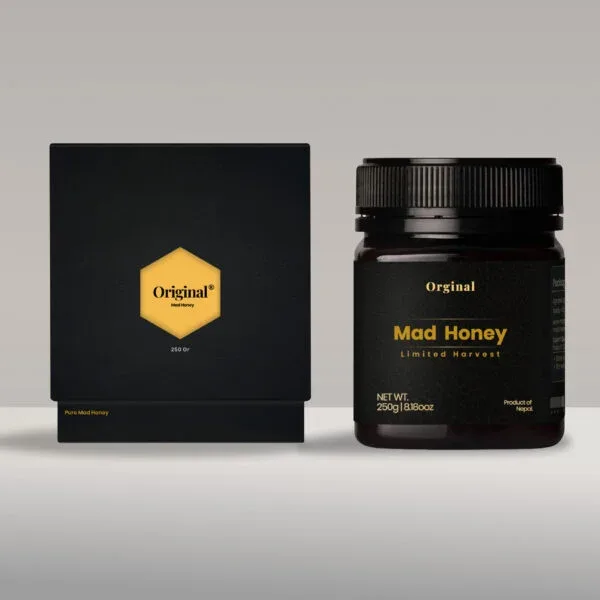
Original Mad Honey offers limited seasonal harvests of Himalayan mad honey sourced directly from Gurung honey hunters in the Lamjung and Annapurna region of Nepal. Batches are tested for potency and purity and are traceable, and the results are published as batch lab reports that readers can review before deciding.
Jars are offered in two sizes, 250 g and 500 g, so that first-time buyers can begin with the smaller one. Whatever size you consider, read the batch details and safety guidance first, compare the lab data with the questions listed above and speak to a doctor if you have any health condition or take any medication.
Frequently Asked Questions
What is mad honey made of?
It is made from the nectar of certain rhododendron flowers, processed by bees in the same way as any other honey. The grayanotoxins in that nectar carry over into the finished honey.
Is mad honey a drug?
It is sold as a food product in many places, but it contains a bioactive toxin, and rules differ between countries. It is not a classic psychedelic. Check local regulations and speak to a doctor before use.
What does mad honey taste like?
It is usually sweet at first, followed by a noticeable bitter or astringent finish. Some people feel a tingling or slight burning at the back of the throat.
How is mad honey harvested?
In Nepal it is collected by hand from wild cliff colonies of Apis laboriosa, using rope-and-bamboo ladders, smoke and long cutting poles. In Turkey it is generally collected from managed hives.
Where does real mad honey come from?
Mainly from the Himalayas of Nepal and the eastern Black Sea coast of Turkey, with rare reports from other rhododendron regions.
Why is mad honey called “mad”?
The name comes from the disorienting effects of eating too much of it. In Turkish it is called deli bal, meaning “mad honey.”
Is mad honey dangerous?
It can be. Grayanotoxins can slow the heart and lower blood pressure, and potency varies between batches. Most reported cases resolve within a day with supportive care, but serious cases can occur, especially in people with heart conditions or on relevant medication.
Who should avoid mad honey?
Children, pregnant or breastfeeding women, people with heart rhythm problems, low blood pressure or heart disease, and anyone taking heart or blood pressure medication should avoid it, and anyone with a health condition should speak to a doctor first.
Does mad honey expire?
Like other pure honey, it keeps very well when stored sealed, cool and dark, although its character and potency can change over long periods.
How can I tell if mad honey is real?
Look for a named harvest region and season, batch-specific independent lab reports, traceable sourcing and honest marketing. Colour and taste alone are not reliable.
Is there a safe dose?
There is no universal safe dose, because potency and personal sensitivity vary. Rely on batch-specific information from the producer and advice from a qualified health professional.
Can mad honey be bought online?
It is sold online in many places, but rules for sale, shipping and import differ by country and by marketplace. Check current local rules before ordering.
Is mad honey the same as regular honey?
No. It is produced from grayanotoxin-bearing rhododendron nectar and has different effects, risks and sourcing from ordinary honey.
Final Thoughts
Mad honey is not a myth, a marketing invention or a party trick. It is a real, historically documented honey with a written record that stretches back to classical Greece, a living harvesting tradition in the Himalayas and a body of medical literature that describes both its traditional use and its dangers. Its power comes from a simple fact of nature: bees feeding on the nectar of certain rhododendrons, high on the slopes of Nepal and along the coast of the Black Sea.
That same power is the reason for caution. Because grayanotoxins act on the nerves and the heart, and because potency varies from batch to batch, the best approach is a knowledgeable one. Understand what the honey is, respect the risks, rely on independent testing, ask sellers difficult questions and speak to a doctor if there is any doubt.
For readers who choose to explore further, transparent sourcing, published lab data and honest safety information are the marks of a brand worth considering, and Original Mad Honey aims to provide those for its harvests. Knowledge first, caution always and authenticity above all: those three principles apply to every jar.
This article is for educational purposes only. Mad honey is a natural product containing bioactive compounds. It is not intended to diagnose, treat, cure or prevent any disease. Consult a qualified healthcare professional before use.