What Is the Best Size Ceiling Fan for a Large Room?
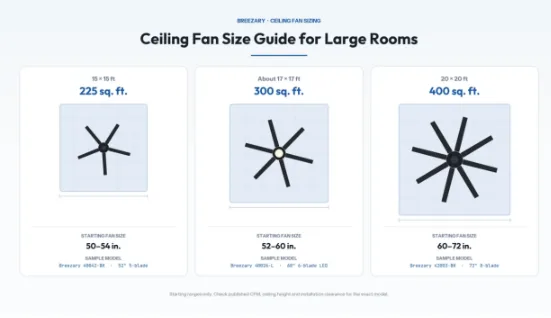
For many large rooms between about 175 and 400 square feet, a ceiling fan in the 52- to 60-inch range is a sensible starting point. Rooms near 400 square feet, especially open-concept spaces, may benefit from a 60- to 72-inch fan. Once a space extends well beyond 400 square feet, a 72-inch or larger model – or more than one fan – may provide better coverage.
These ranges are useful starting points, not universal rules. The best size also depends on the room’s shape, ceiling height, furniture layout, blade clearance and the airflow published for the individual model. A well-designed 60-inch fan can be a better choice than a larger fan whose airflow or mounting requirements do not suit the room.
Ceiling Fan Size Guide for Large Rooms
Start by calculating the room’s square footage, then use the table below to narrow the range. The dimensions are measured wall to wall, and the suggested spans assume that the fan can be centered with adequate clearance from walls, doors, cabinets and nearby fixtures.
| Room dimensions | Approx. area | Starting fan size | What to consider |
| 10 x 10 ft | 100 sq. ft. | 42-48 in. | Usually a small or medium room; avoid oversizing. |
| 12 x 12 ft | 144 sq. ft. | 44-52 in. | Check wall clearance before moving up to 52 inches. |
| 15 x 15 ft | 225 sq. ft. | 50-54 in. | Compare published airflow, not diameter alone. |
| About 300 sq. ft. | 300 sq. ft. | 52-60 in. | A common range for a large bedroom or living area. |
| 18 x 20 ft | 360 sq. ft. | 56-72 in. | Room shape and furniture zones may justify a wider span. |
| 20 x 20 ft | 400 sq. ft. | 60-72 in. | Look closely at CFM, ceiling height and airflow coverage. |
| Over 400 sq. ft. | Great room / open plan | 60-72+ in. or multiple fans | One large fan may not serve every occupied zone evenly. |
Note: Sizing charts vary among manufacturers. Always compare the room recommendation and installation instructions for the exact model you are considering.
How to Measure a Room for the Right Ceiling Fan Size
Calculate the square footage
Measure the room’s length and width in feet and multiply the two numbers. A 12 x 12 room contains 144 square feet, a 15 x 20 room contains 300 square feet, and a 20 x 20 room contains 400 square feet. Use the entire connected space if air can move freely through it rather than measuring only the furniture grouping beneath the fan.
Account for the room’s shape
Square footage alone does not describe how air must travel. A long, narrow room can have the same area as a square room but may be difficult for one centrally mounted fan to cover. An L-shaped great room or an open living-and-dining area may also contain separate occupied zones. In those cases, two appropriately spaced fans can create more even circulation than one oversized fan at the center.
Measure the available clearance
Check the proposed fan center against every nearby wall, tall cabinet, door swing, beam and light fixture. A wider fan is only useful if its blades can rotate with the clearances required by the manufacturer. This measurement also prevents a large fan from appearing visually crowded in a room that has enough floor area but limited open ceiling space.
Is a 52-, 60- or 72-Inch Ceiling Fan Best for a Large Room?
When a 52-inch fan may be enough
A 52-inch fan is often suitable for a medium-size room and may work in the lower end of the large-room range when its published airflow matches the space. It can be a practical option for a large bedroom, a compact living room or an area where beams and walls limit blade clearance. However, the familiar 52-inch diameter should not be treated as proof that every model will perform the same way.
When to move up to a 60-inch fan
A 60-inch fan is a versatile starting point for many rooms from roughly 225 to 400 square feet. The wider sweep can suit larger seating areas and open layouts without automatically dominating the ceiling. Homeowners comparing wider spans for spacious interiors can review different types of Large Ceiling Fans, while still checking each model’s published airflow, mounting requirements and room recommendation.
When a 72-inch fan makes sense
A 72-inch fan becomes more relevant as a room approaches 400 square feet or opens into adjacent living areas. It may also look better proportioned in a great room with a broad ceiling. Before choosing one, confirm that the blade tips have sufficient clearance, the electrical box is fan-rated, the complete installed height is safe, and the model’s airflow is appropriate for where people sit and move.
What Size Ceiling Fan Do You Need for a 20 x 20 Room?
A 20 x 20 room measures 400 square feet, placing it at the upper end of many large-room sizing charts. A 60- to 72-inch ceiling fan is a reasonable range to investigate, but there is no automatic winner within that range. A 60-inch model with strong published airflow may serve a conventional square room well, while a 72-inch fan may provide broader coverage in an open great room.
Look beyond the total floor area. If the room contains a dining table at one end and a seating area at the other, the occupants may not spend much time beneath the center of the ceiling. Two smaller fans positioned over the active zones may deliver more consistent comfort. The final arrangement should also account for lighting locations, beams, sloped ceilings and the required distance between multiple fans.
Is a Bigger Ceiling Fan Always Better?
No. A larger diameter increases the area swept by the blades, but it does not guarantee higher airflow, quieter operation or better comfort. Motor design, blade shape, blade pitch, rotation speed and installation height all affect how the fan performs. Two fans with the same span can publish very different airflow figures.
A fan can also be too large for the usable ceiling area. Inadequate clearance may conflict with the installation instructions, while excessive airflow can feel uncomfortable over a bed, desk or dining table. Visually, an oversized fan can make a room feel compressed even when the blade tips technically clear the walls. The goal is balanced coverage, not the largest diameter that can be made to fit.
Why CFM Matters as Much as Fan Diameter
CFM, or cubic feet per minute, describes the volume of air a fan moves under a stated test condition. It is one of the most useful numbers for comparing models intended for large rooms. Diameter tells you how broadly the blades sweep; CFM helps indicate how much air the complete fan design moves. Both values should be considered together.
Use manufacturer-published performance data rather than estimating airflow from blade count, motor wattage or diameter. A five-blade fan is not automatically more powerful than a three- or four-blade design, and a higher speed count does not prove that the highest setting moves more air. If CFM is not published, avoid presenting an assumed number as a specification.
For a large space, compare the highest published CFM, the model’s recommended room size and its efficiency information when available. Then consider where the airflow needs to reach. A high number is valuable only when the fan can be mounted in a position that distributes air through the occupied part of the room.
How Ceiling Height Changes the Choice
Rooms with 8-foot ceilings
In a room with an 8-foot ceiling, the complete installed height matters more than the downrod length by itself. The motor housing, light kit and blade position all contribute to the lowest point of the fixture. A short downrod may still place a deep fan too low, so compare the full dimensions and consider a low-profile mounting design when necessary.
High and vaulted ceilings
A high ceiling may require an extended downrod to bring the blades closer to the occupied zone. Mounting a fan too close to a very high ceiling can reduce the air people feel below, while dropping it too far can create clearance or visual-balance problems. For vaulted ceilings, verify the maximum supported slope, compatible mounting hardware and the clearance between the blades and the angled ceiling.
Blade clearance and installed height
Before ordering, calculate where the blades and the bottom of any light will sit after installation. Check the product manual, local requirements and the dimensions of the actual room. Do not assume that a standard downrod works for every ceiling height or that a wider fan automatically needs a longer downrod.
Should a Large-Room Ceiling Fan Include a Light?
A lighted fan makes sense when the ceiling position must provide both circulation and general illumination. It can be especially useful in a bedroom, family room or multipurpose space with limited ceiling junction boxes. If the room already has recessed lighting or decorative pendants, a fan without a light may create a cleaner ceiling plan.
When one fixture must handle both tasks, Large Ceiling Fans With Lights can be compared by fan diameter, published airflow, lumen output, color temperature and complete installed height. Confirm whether the exact model supports dimming or replaceable lamps instead of assuming those features are standard.
Is a Remote Control Useful in a Large Room?
A remote becomes valuable when the fan is mounted over a large seating area, above a bed or on a high ceiling where a pull chain would be inconvenient. It can also reduce the need to cross a room whenever the desired speed or lighting level changes. Available functions vary, so verify whether the model controls fan speed, light output, color temperature, timers or motor direction.
For high ceilings or layouts where a wall control is inconvenient, Large Ceiling Fans With Lights and Remote Control provide a practical way to manage the supported fan and lighting functions from the occupied area. Check what happens if the remote is lost, whether a wall control is included, and whether replacement controls must be matched to a specific receiver.
Large Ceiling Fan Selection Checklist
- Measure the room’s full length and width.
- Calculate the square footage.
- Identify whether the room is enclosed, open concept, square or unusually narrow.
- Use a sizing chart to establish a starting diameter range.
- Compare published CFM and the manufacturer’s room recommendation.
- Measure the ceiling height and calculate the complete installed height.
- Confirm blade-tip clearance from walls, doors, cabinets, beams and fixtures.
- Decide whether the ceiling fan must also provide general lighting.
- Choose a practical control method for the room and mounting height.
- Verify flat- or sloped-ceiling compatibility and the supported slope limit.
- Confirm that the fan’s dry, damp or wet location rating matches the installation area.
- Use a fan-rated electrical box and follow the installation manual and local requirements.
Frequently Asked Questions
What size ceiling fan is best for a large room?
For many rooms between about 175 and 400 square feet, 52 to 60 inches is a useful starting range. Rooms near 400 square feet or open-concept layouts may call for 60 to 72 inches. Check the exact model’s published airflow, room recommendation and installation clearances before deciding.
What size ceiling fan do I need for a 20 x 20 room?
A 20 x 20 room is 400 square feet. Start by comparing 60- to 72-inch fans, then use published CFM, ceiling height and room layout to narrow the choice. A zoned or irregular space may be better served by more than one fan.
What size ceiling fan should I choose for a 300-square-foot room?
A 52- to 60-inch fan is a practical range to investigate for a 300-square-foot room. The better option is the model whose airflow, mounting dimensions and recommended room size match the space.
Is a 52-inch ceiling fan too big for a 12 x 12 room?
A 12 x 12 room measures 144 square feet. A 52-inch fan may fit some rooms of that size, but it is near the upper end of common recommendations. Confirm the blade clearance, installed height and airflow so the fan does not feel crowded or overly strong.
What size room is suitable for a 52-inch ceiling fan?
A 52-inch fan is commonly considered for medium and lower-range large rooms, but there is no single square-foot rule that applies to every model. Compare the manufacturer’s room guidance and CFM rather than relying on the 52-inch label alone.
Should I choose a 48- or 52-inch ceiling fan?
Choose based on the available ceiling area and the performance of the two specific models. A 48-inch fan may be easier to place in a compact room, while a 52-inch fan offers a wider blade sweep. Published airflow can matter more than the four-inch difference.
What happens if a ceiling fan is too large for a room?
An oversized fan may have inadequate clearance, look visually cramped or create an uncomfortable concentrated breeze. If it cannot be installed according to the manufacturer’s instructions, choose a smaller span or a different mounting design.
Do more ceiling fan blades produce more airflow?
Not necessarily. Airflow depends on the entire fan design, including the motor, blade shape, pitch, speed and diameter. Use published CFM rather than blade count as the main performance comparison.
The Bottom Line
The best ceiling fan size for a large room is not simply the widest fan that fits. Begin with the room area: 52 to 60 inches covers many large rooms, while 60 to 72 inches becomes more relevant near 400 square feet and in open layouts. Then validate the choice with published airflow, ceiling height, blade clearance and the way the room is occupied. That combination produces a more useful answer than diameter alone.