What Makes A Safe Extension Cord? Americord Engineers Break Down Key Safety Features
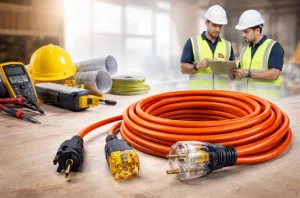
Every year, electrical fires cause billions of dollars in property damage across the United States, and a good number of those fires can be traced back to an item most people pay little mind to: the extension cord.
The Electrical Safety Foundation International reports that extension cords are involved in about 3,300 residential fires each year, causing hundreds of injuries and deaths. It’s a startling statistic when you consider that most of those cases could have been avoided.
When shopping for an extension cord, safety should be the first thing on your mind, not the last. But what really separates a safe extension cord from a dangerous one?
Engineers at Americord have broken it down to the basic features that matter most, and we will go through each in this guide, also sharing with you how to choose a safe extension cord.
1. Wire Gauge: The Foundation of Extension Cord Safety
The wire gauge (or “size”) of an extension cord is the most important factor in how much electrical current (or “amperage”) it can safely handle. Gauge is a measure of copper thickness—the lower the gauge number, the more electricity the wire can carry.
For example, an 18 AWG cord, such as Nema 5-15P to 5-15R Extension Cord 18/3 SJTW, is designed to handle much lighter loads. On the other hand, a 14 AWG cord like the Nema A 5-15P to 5-15R Flat Lighted Extension Cord 14/3 can safely handle the load from many power tools.
Americord supplies extension cords in 18/3, 16/3, 14/3, and 12/3, down to the ultra-heavy-duty 10/3 for the most demanding applications out there. That “3” in there represents the number of conductors within a cord: hot, neutral, and ground.
Using an improper gauge is one of – if not THE – most common extension cord safety mistake people tend to make when using them. When a cord is undersized for the load being drawn through it, the wire heats up. Enough heat, and the insulation melts. The rule here is simple – match the amperage that your device needs, or use a thicker one if you are unsure.
2. Amperage and Voltage Ratings: Know Your Numbers
Every extension cord has an amperage rating, and it is there for a reason. Americord extension cords are rated from 10A at 125V on the lighter end, up to 20A and even 30A at 125V on the heavy-duty side. Some higher-voltage variants rated at 250V are designed for specialized equipment running on 220V circuits.
Running a device that draws more amperage than your cord is rated for causes the cord to overheat progressively. This is called overloading, and it is one of the leading causes of cord-related fires. If you are using a 10A cord to power something that pulls 15A continuously, you’re operating in an unsafe situation.
What makes an extension cord safe in this regard is that its amperage rating should always be equal to or greater than what the connected device actually draws. Americord clearly shows this information on every cord through standardized labelling and product specs right on the packaging, so you’ll never have to guess.
3. UL and CSA Certification: Third-Party Verification You Can Trust
You may have seen the letters UL or CSA on an extension cord and not thought twice about it. But these certifications are some of the most reputable ways to tell what the safety features of extension cords are that have actually been tested.
Both UL (Underwriters Laboratories) and CSA (Canadian Standards Association) test cords for heat resistance, insulation integrity, current-carrying capacity, and more. Americord products are both UL and CSA approved, meaning a third-party laboratory has verified that the cord is safe to perform as it says it will.
These marks mean you’ve got a cord that was actually tested versus one that looks like it. If you’re wondering how to choose a safe extension cord, one of the first things you may want to look for is the UL or CSA listing mark before even considering anything else.
4. Jacket Type and Insulation: Indoor vs. Outdoor Rated Cords
Not all extension cords are made for all environments. The outer jacket of a cord is what designates where it can be safely used, and using an indoor cord outside is a real hazard.
Americord extension cords come in different jacket types. The most common is SJTW. S for service grade, J means the cord is rated at 300V, T means the jacket is thermoplastic, and W means the cord is approved for outdoor use. An SJTOW cord adds oil resistance on top of that.
SJOOW cords are made with rubber rather than thermoplastic insulation, which makes them more flexible in cold temperatures and good for harsh environments. The cold-weather extension cords at Americord use oil-resistant TPE-rubber construction that maintains flexibility even at sub-zero temperatures, to prevent cracking that could expose live conductors.
If you’re running a cord across a driveway, or anywhere it might get wet, you need an outdoor-rated jacket; an indoor-only cord used outside is a short-circuit waiting to happen.
5. Grounded Three-Prong Plugs: That Third Prong Isn’t An Option
Certain extension cords feature two-prong, ungrounded plugs. That’s okay for small, double-insulated loads, but not for any device drawing a meaningful load; a grounded three-prong plug is a required safety feature.
The Americord NEMA 5-15P to 5-15R is one of the best extension cords for safety due to its standard three-prong grounded configuration. This means that there is a third wire in the cord and plug, which is part of a path that connects to ground if something were to go wrong inside of an appliance you have plugged into the cord. If this isn’t present, and something does go wrong, your appliance’s chassis could become energized and also become an electric shock hazard.
This grounding feature also helps stabilize voltage and reduce electrical noise in sensitive electronics. For example, if someone has removed the third prong from their extension cord because it was ‘making it not fit’, you should probably retire that extension cord immediately.
When Should You Replace an Extension Cord?
That’s not a question people ask until something happens. Still, the truth is that extension cords don’t last forever, and continuing to use a damaged one is one of the most dangerous extension cord mistakes you should avoid.
Replace an extension cord if you see any of the following:
- A cracked or frayed outer jacket
- A plug that feels warm after use
- A cord that has been pinched under furniture or run through a doorframe
Cords from Americord are designed to last and are manufactured using quality materials suitable for long-term operability. Nevertheless, from time-to-time and under heavy daily usage, all cables need their regular evaluation.
Final Thoughts
While it’s not rocket science to figure out what makes an extension cord safe, you do need to pay attention to the details. The wire gauge, amperage rating, jacket type, certification marks, plug construction, and grounding all work together to determine how safe a cord really is under actual use.
Americord engineers build extension cords with all of these things in mind, from the start, not added as an afterthought. When you buy a cord, you are making a decision about safety inside your home, at work, or wherever else you need power. Take the time to get it right, and the extension cord you choose will serve its purpose for many years to come.