What Really Defines the Best Waterproof Outdoor LED Strip Lights?
In the outdoor lighting industry, few terms are used as frequently—and misunderstood as often—as “waterproof.” Product specifications, marketing brochures, and project proposals routinely reference waterproof LED strip lights, often accompanied by impressive-looking IP ratings. Yet despite these assurances, premature failures remain common in outdoor installations worldwide.
This disconnect has prompted lighting professionals to ask a more fundamental question: what truly defines the best waterproof outdoor LED strip lights? The answer lies not in labels or certifications alone, but in a deeper understanding of materials, construction methods, thermal behavior, and real-world environmental stress.
As outdoor lighting applications expand across architecture, infrastructure, and commercial spaces, the industry is gradually shifting from rating-based selection toward performance-based evaluation. This article provides a technical breakdown of what genuinely differentiates high-performing waterproof LED strip lights from those that merely appear compliant on paper.
Why IP Ratings Alone Are Not Enough
Ingress Protection (IP) ratings are widely accepted as the baseline standard for assessing resistance to dust and water. While useful, they are often misinterpreted as a comprehensive measure of outdoor durability.
What IP Ratings Actually Measure
An IP rating evaluates a product’s resistance to:
- Solid particle ingress (first digit)
- Liquid ingress (second digit)
For example:
- IP65 indicates protection against dust and water jets
- IP67 indicates protection against temporary immersion
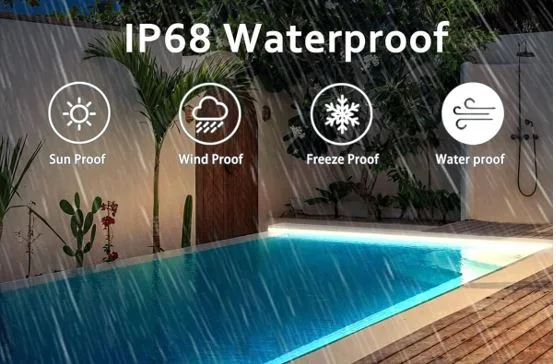
- IP68 indicates protection against continuous immersion under defined conditions
However, IP testing is conducted under controlled laboratory environments, typically over short durations. It does not account for long-term exposure to sunlight, temperature cycling, mechanical stress, or chemical pollutants.
The Gap Between Testing and Reality
Outdoor LED strip lights are rarely exposed to isolated conditions. Instead, they endure a combination of moisture, heat, UV radiation, and mechanical movement over years of operation. A product that passes IP testing may still degrade rapidly when these stress factors interact.
This is why many installations fail not due to immediate water ingress, but due to gradual material degradation, seal fatigue, or thermal imbalance—factors outside the scope of basic IP classification.
The Core Components of Waterproof LED Strip Construction
To understand what defines the best waterproof outdoor LED strip lights, it is necessary to examine how they are built from the inside out.
1. Encapsulation Materials: Silicone vs. Resin
The choice of encapsulation material plays a central role in waterproof performance.
Silicone-based systems are widely regarded as superior for outdoor applications due to:
- High flexibility across temperature ranges
- Excellent UV resistance
- Long-term elasticity that reduces cracking
Epoxy or polyurethane resins, while offering high initial hardness, tend to:
- Yellow under UV exposure
- Become brittle over time
- Trap heat more aggressively
High-performance outdoor LED strips often rely on engineered silicone compounds rather than generic coatings, balancing protection with flexibility.
2. Structural Waterproofing Methods
Not all waterproof LED strips are sealed in the same way. The method of waterproofing significantly affects long-term reliability.
Silicone Extrusion
This method involves extruding a continuous silicone sleeve over the LED strip. Advantages include:
- Uniform thickness
- Minimal air gaps
- Consistent optical diffusion
Extrusion-based systems typically perform well in architectural applications where flexibility and uniform appearance are critical.
Full Potting (Encapsulation)
Potting fully encapsulates the LED strip in resin or silicone, offering maximum protection against water ingress. However, it introduces challenges:
- Reduced heat dissipation
- Increased weight
- Lower flexibility
Potting is often reserved for environments with extreme exposure, such as ground installations or marine-adjacent projects.
Hybrid Sealing Systems
Some of the best waterproof outdoor LED strip lights use hybrid systems that combine extrusion with selective potting at vulnerable points, such as solder joints or connectors. This approach balances durability with thermal performance.
The Hidden Weak Point: End Caps and Connection Points
Field failure analysis consistently reveals that most waterproof LED strip failures originate not in the middle of the strip, but at end caps, connectors, and solder joints.
Why Sealing the Ends Matters
Even the most robust encapsulation can be compromised if moisture enters through:
- Poorly bonded end caps
- Inadequate adhesive curing
- Inconsistent manual sealing during production
High-quality manufacturers treat end sealing as a critical process step rather than a cosmetic finish.
Factory-Sealed vs. Field-Cut Strips
Pre-sealed strips manufactured to fixed lengths generally outperform field-cut installations. When cutting is unavoidable, professional-grade systems include compatible sealing accessories and documented procedures to maintain waterproof integrity.
Thermal Management: The Overlooked Factor in Waterproof Design
One of the greatest engineering challenges in waterproof LED strip design is managing heat without compromising environmental protection.
Waterproofing vs. Heat Dissipation
Waterproof materials, particularly thick encapsulants, can act as thermal insulators. If heat generated by the LEDs cannot dissipate efficiently, junction temperatures rise, accelerating lumen depreciation and color shift.
The best waterproof outdoor LED strip lights integrate:
- High thermal conductivity substrates
- Optimized LED spacing
- Compatibility with aluminum mounting profiles
Waterproofing that ignores thermal performance ultimately undermines long-term reliability.
UV Resistance and Material Aging
Ultraviolet radiation is one of the most destructive forces affecting outdoor LED strips. Even materials that appear stable initially can degrade under prolonged exposure.
Signs of UV Degradation
Common symptoms include:
- Yellowing or clouding of encapsulation
- Loss of elasticity
- Micro-cracking that allows moisture ingress
Premium outdoor LED strips use UV-stabilized silicone compounds and conduct accelerated aging tests to simulate years of sun exposure before release.
Mechanical Stress and Flex Fatigue
Outdoor installations are rarely static. Expansion and contraction caused by temperature changes exert constant mechanical stress on LED strips.
Why Flexibility Matters
Rigid waterproof coatings may resist water initially but fail under repeated flexing. Flexible materials accommodate movement without cracking, preserving waterproof seals over time.
This is particularly important in:
- Curved architectural features
- Long linear installations
- Surfaces exposed to vibration
Electrical Safety and Insulation Integrity
Beyond water resistance, waterproof LED strip lights must maintain electrical safety throughout their lifespan.
Key considerations include:
- Dielectric strength of encapsulation materials
- Stability of insulation under humidity
- Resistance to conductive contamination
Professional outdoor systems are designed to maintain insulation performance even after years of exposure to moisture and pollution.
Testing Protocols That Matter
Not all testing is created equal. Manufacturers producing the best waterproof outdoor LED strip lights typically go beyond minimum compliance.
Meaningful Tests Include:
- Thermal cycling tests, simulating seasonal temperature changes
- UV aging tests, replicating long-term sunlight exposure
- Salt spray tests, especially for coastal environments
- Extended burn-in tests, under elevated temperature and humidity
These tests provide a more realistic picture of long-term performance than standalone IP certification.
The Role of Manufacturing Consistency
Even the best design can fail if manufacturing processes lack consistency. Variations in material mixing, curing time, or sealing pressure can lead to unpredictable performance.
Established manufacturers with in-house testing and controlled production environments tend to deliver more consistent results across large project volumes. This consistency is especially important for architectural and commercial installations where uniform appearance and performance are critical.
Industry Perspective: Moving Toward Performance-Based Specification
Across the lighting industry, there is a gradual shift away from selecting outdoor LED strips solely based on IP ratings or price. Specifiers increasingly request detailed construction data, testing documentation, and long-term performance references.
Some manufacturers with backgrounds in professional linear lighting and signage have responded by publishing more transparent technical information, reflecting a broader industry push toward accountability and durability.
Conclusion: Redefining “Best” in Waterproof Outdoor LED Strip Lighting
The term “waterproof” alone is no longer sufficient to define quality in outdoor LED strip lighting. True performance depends on a complex interaction of materials, construction methods, thermal management, and manufacturing discipline.
The best waterproof outdoor LED strip lights are those designed with long-term environmental exposure in mind—products that maintain optical quality, electrical safety, and structural integrity long after installation. As outdoor lighting continues to play a central role in architecture and urban design, understanding these technical foundations is essential for making informed, future-proof lighting decisions.