What Sleep Research Says About Why So Many People Are Sleeping Cold This Year
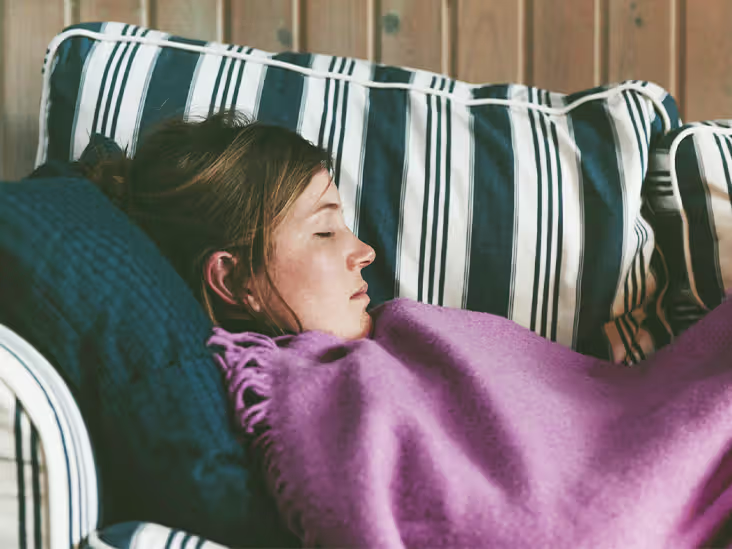
Most guidance on bedroom temperature converges on a fairly narrow range. Sleep Foundation-reviewed research puts the ideal sleeping temperature at roughly 65 to 68 degrees Fahrenheit, and a study of older adults published in recent years found sleep quality reliably declined once rooms dropped below 68 degrees or climbed above 77, with sleep efficiency falling noticeably at the warmer extreme. The lead researcher on that study, gerontologist Amir Baniassadi, framed the finding carefully: the point wasn’t a single perfect number, but that “personalized temperature adjustments based on individual needs and circumstances” matter more than a fixed thermostat setting.
That distinction, comfort as a personal range rather than a fixed target, turns out to matter a lot this particular winter, because fewer people are able to control room temperature the way that guidance assumes.
The Thermostat Isn’t the Only Variable
A 2026 winter preparedness survey found that 67% of households plan to keep their thermostats lower this year, and 68% reported their electric bills rising even without changing their usage at all. Average reported monthly electricity costs came in around $187, with natural gas adding roughly $65 more for households that use it to heat. For a lot of people, the sleep-science guidance of “keep the room around 65 to 68 degrees” is running into a much less flexible reality: rooms are running colder than that recommendation this year, not by choice so much as by budget.
That gap is where bedding research actually offers something more useful than the room-temperature guidance alone. Research published in the Journal of Thermal Biology found that blanket weight and coverage change the comfortable temperature range dramatically. With a thin duvet, participants stayed comfortable across a narrow window, roughly 62 to 72 degrees. With a heavier duvet, that comfortable range widened to an 18-degree span, as low as 46 degrees, without any drop in sleep quality. The same research found that what mattered most wasn’t room temperature at all, but the temperature directly under the covers, which stayed remarkably consistent, in the high 80s Fahrenheit, regardless of how cold the room around it got.
In other words, a well-insulated microclimate right against the body does more for sleep quality than turning up a thermostat that’s expensive to run in the first place. For people not ready to change how they sleep entirely, that principle still applies to something as simple as swapping in bamboo blankets, which trade the heaviness of a traditional duvet for breathability without giving up the trapped-air effect the research keeps pointing back to.
Why the Gaps Matter More Than the Blanket Itself
That microclimate effect depends on the covering staying in place, which is precisely where a standard blanket tends to fail overnight. Shifting during sleep creates gaps at the shoulders, feet or sides, letting the warmed air escape and forcing the body to recondition a new pocket of air repeatedly through the night, exactly the kind of disruption the research associates with poorer sleep efficiency in colder rooms.
It’s a plausible part of why the wearable blanket, sold in adult sizes as an adult sleep sack, has picked up interest well beyond the baby product it was adapted from. A sealed, zip-closed design doesn’t shift or gap the way a loose blanket does, which lines up with what the thermal-biology research identifies as the actual mechanism behind comfortable cold-weather sleep: not a warmer room, but an uninterrupted layer of trapped air against the skin.
None of this makes a wearable blanket a substitute for a functioning heating system, and the research doesn’t specifically test that product category. What it does suggest is that this winter’s version of “just add a blanket” has a real physiological basis behind it, at a moment when a majority of households are being pushed toward exactly that kind of low-cost adjustment whether the science backs it or not.