What to Know Before Hiring a Security Guard Service in Ontario
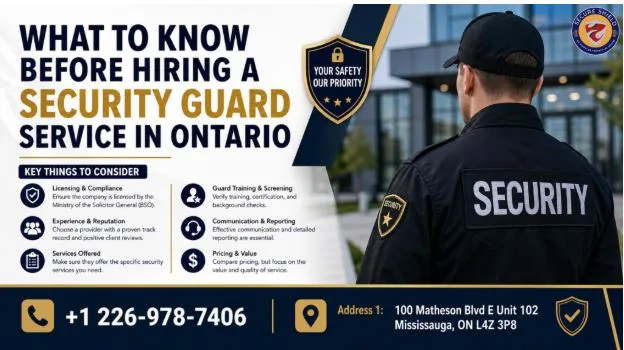
Most businesses don’t think about security until something goes wrong. A break-in, a confrontation on site, an employee who feels unsafe walking to their car at night. By that point, you’re already reacting instead of preventing.
If you’re in Ontario and considering a security guard service — whether for a commercial property, a private event, or personal protection — this guide covers what you actually need to know before signing anything. Not sales language. Just the practical stuff: what types of guards exist, what the licensing rules mean for you, and how to tell a real professional operation from someone with a uniform and a flashlight.
What a Security Guard Service Actually Covers
People use “security guard service” as a catch-all, but the range of what that covers is wider than most realize.
A proper security guard company can deploy on-site uniformed guards for retail stores, offices, condominiums, and construction sites. They can run mobile patrol routes, manage access control, handle event security for concerts or corporate functions, and provide executive protection for high-profile individuals. Some also offer armed guard services for higher-risk environments.
The key word is company. Hiring a single freelance guard off a job board is not the same as working with a licensed security guard agency. In Ontario, both the agency and every individual guard it deploys must be licensed under the Private Security and Investigative Services Act, 2005 (PSISA) — enforced by the Ministry of the Solicitor General. If an agency can’t confirm their guards hold individual PSISA licences, that’s a reason to walk away.
The Different Types of Security Guards — and When You Need Each One
Not every situation calls for the same type of guard. Here’s how they break down.
Uniformed On-Site Guards
The most common type. Visible presence is the point — it deters theft, unauthorized access, and general trouble before it starts. These guards work retail environments, office lobbies, condo buildings, construction sites, and warehouses. They check IDs, monitor entry points, write incident reports, and respond to situations on the ground.
If your main concern is access control and visible deterrence, this is what you need.
Tactical Security Guards
Tactical guards work higher-risk assignments. They’re trained for rapid response and more complex operations — think industrial facilities, high-value asset protection, or environments where a standard guard presence isn’t enough. Some tactical teams also handle de-escalation in volatile situations where things can turn physical quickly.
Don’t hire tactical security for a situation that doesn’t call for it. It’s expensive, and an over-militarized presence can create friction rather than calm. But when the risk level is genuinely elevated, a tactical security guard is the appropriate choice.
Armed Guards
Armed guards are a specific category with their own strict rules. In Ontario, an armed security guard must carry both a valid firearms licence and an Authorization to Carry (ATC) permit from the federal government at all times while on duty, and must present them on request. The employing agency is also required to notify the Ministry of the Solicitor General within five days of authorizing any guard to carry a firearm.
Use cases include cash-in-transit operations, high-risk retail environments like jewelry stores, and certain government or financial facilities. Armed guards are not the default — they’re the escalation.
Personal Bodyguard / Executive Protection
A personal bodyguard is not the same as a guard stationed at your front door. The role is mobile and person-centric. A private security bodyguard focuses on one individual — usually an executive, a public figure, or someone who has received credible threats. The job involves threat assessment, advance route planning, close protection during travel, and real-time decision-making.
In Ontario, personal bodyguard services still require PSISA licensing, the same as any other security role. The difference is training depth and operational focus. If you’re looking for someone to stand in a lobby, hire an on-site guard. If you need someone to think three steps ahead and move with you, that’s executive protection.
Security Guard Licensing in Ontario — What It Means for You as a Client
This section matters more than most people realize.
Every security guard working in Ontario must hold a valid individual PSISA licence. Getting that licence requires completing an approved 40-hour training program that covers legal responsibilities, use of force, emergency response, and ethics. Guards must also pass a government-regulated test, submit a Criminal Record and Judicial Matters Check (CRJMC), and pay an application fee.
Since September 2023, Ontario moved to a fully digital licensing system. Guards no longer carry physical cards — they carry a digital licence accessible through their ServiceOntario account, which includes a QR code for verification.
What this means when you’re hiring:
Ask the agency to confirm that every guard they plan to deploy to your site holds a current, valid individual licence. Not just that the agency is licensed — every individual guard. An agency operating under PSISA can face fines up to $250,000 for non-compliance, and directors can face up to a year in prison. That tells you the province takes this seriously, even if some cut-rate operators don’t.
If an agency hesitates when you ask about guard licensing, that’s your answer.
Armed Guard vs. Personal Bodyguard — People Confuse These Two
It’s worth being specific, because they serve different purposes.
An armed guard is typically posted at a fixed location. The job is property protection — securing a building, a vault, a shipment. The firearm is there because the assets or environment demand a higher level of deterrence.
A private security bodyguard is mobile and person-focused. The job is threat neutralization around a specific individual. A bodyguard reads crowds, controls access to their principal, plans alternate routes, and makes split-second calls. They’re not standing at a door. They’re moving with you.
Both require proper licensing in Ontario. Neither is excessive if the threat level justifies it. A corporate executive traveling between downtown Toronto meetings in a threatening situation needs a personal bodyguard. A jewelry store owner closing alone at night needs an armed guard. Same province, same legal framework — completely different deployment.
How to Choose the Right Security Guard Service
A few things are worth checking before you commit.
Match the guard type to the actual threat. A lot of businesses over-hire or under-hire because they didn’t sit down and think through what they’re actually protecting against. A condo lobby doesn’t need a tactical team. A high-profile product launch with VIP guests doesn’t need a single unarmed guard at the door. It sounds obvious until you see what people actually end up booking.
Verify every guard’s individual licence — not just the agency’s. The agency licence and the individual guard licence are separate things. Each guard they plan to deploy to your site must hold their own valid PSISA licence. You can check this through the Ministry of the Solicitor General’s online portal. If an agency gets weird when you ask about this, you have your answer.
Look at how they report incidents. A professional operation gives you real-time logs, GPS-tracked patrol data, and a clear chain of communication when something actually happens. If the answer is “our guards call you if something comes up,” that’s not a system — that’s a hope.
Ask where they’ve actually worked. Years of condo concierge experience don’t automatically translate to executive protection or high-risk retail. Sector experience matters. Ask specifically.
Price is a useful signal, just not the one most people think. The cheapest bid usually tells you something — undertrained guards, thin compliance, or a company that’ll disappear when you need them. Security is not the place to go bargain hunting.
What Hiring a Professional Security Guard Service Actually Looks Like
When you work with a serious provider, here’s what the process looks like in practice:
They start with a site assessment or threat evaluation — not a quote sent by email after a five-minute phone call. From there, they build a deployment plan specific to your environment: what type of guard, how many hours, what their post orders are, and who they report to.
Guards arrive uniformed and licensed. Incidents get documented in real time, not after the fact. You get regular reviews of how the service is performing and whether the current setup still fits your needs.
Agencies in Ontario also undergo compliance inspections from the Ministry — new agencies within six months of licensing, established agencies every two years, with random site visits in between. Working with a company that treats compliance as standard — not optional — means fewer gaps in your protection.
Top 10 Security Companies in Mississauga
Final Thought
Hiring a security guard service isn’t complicated, but it does require some due diligence. Know what you need. Verify the licensing. Ask the uncomfortable questions about compliance and training before you sign. And pick a company that treats your situation as its own specific problem, not a template they apply to every client.
If you’re in Ontario and trying to figure out what level of service you actually need — whether that’s on-site guards, tactical security, armed protection, or a personal bodyguard — Secure Shield Security works across the province and will walk you through the options without pushing you toward something you don’t need.