What to Look for in Last Mile Delivery Software
You already know last-mile costs are bleeding your margins. Every failed delivery, every idle driver, every customer call asking “where is my order” chips away at profit. The question is not whether you need better tools. It is which tool actually fixes the problem.
This post breaks down the criteria that separate real last mile delivery software from the dashboards that just look nice in a demo.
What Most Tools Get Wrong
Most delivery management platforms solve for one scenario. They handle your own fleet or they connect you to third-party couriers. Rarely both. That forces you into workarounds — juggling two systems, duplicating data entry, losing visibility the moment a package leaves your warehouse on a different carrier.
Generic tools also treat tracking as a backend feature. Your ops team can see the driver. Your customer cannot. That gap generates support tickets, missed deliveries, and refund requests.
You pay for software that creates new problems alongside the ones it was supposed to fix.
What a Good Last Mile Delivery Management Tool Actually Does
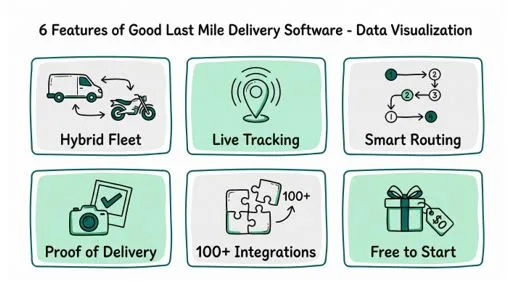
Hybrid Fleet Management
A useful platform lets you dispatch your own drivers and third-party networks from the same screen. No switching apps. No re-entering addresses. You choose the cheapest or fastest option per order, not per system.
Real-Time Tracking with a Customer-Facing Page
Internal tracking is table stakes. What matters is a branded tracking page your customer can see. It cuts “where is my order” calls by half or more. It also reduces failed deliveries because customers know exactly when to expect the driver.
Automated Driver Assignment and Route Optimization
Manual dispatch wastes hours every morning. Good delivery software assigns drivers based on proximity, capacity, and delivery windows. It also sequences stops to reduce drive time and fuel spend.
Proof of Delivery
Photos, signatures, timestamps, PIN codes. Without proof, disputes become he-said-she-said. Every unproven delivery is a potential chargeback. A solid last mile delivery management software captures proof automatically at the door.
Deep Integrations
Your POS, your Shopify store, your ordering platform — the delivery tool must plug into all of them. If you have to export CSVs or copy-paste orders, you will fall behind by noon. Look for 100 or more native integrations.
A Free Tier or No-Commitment Entry Point
You should not pay thousands upfront to find out the tool does not fit. A free starting plan lets you test with real orders before you scale spend.
Habits That Make Your Delivery Operation Faster
Batch orders by zone before dispatching. Group deliveries by neighborhood. Even basic route tools perform better when starting with clustered stops.
Set delivery windows, then hold to them. Customers remember missed windows. Tight, realistic windows beat generous ones you cannot keep.
Use proof of delivery on every order. Not just high-value ones. The $12 order that “never arrived” costs the same to reship. A delivery management platform with automatic proof capture removes the debate entirely.
Review failed delivery rates weekly. A spike in failures signals a routing issue, a driver issue, or a communication gap. Catch it in days, not months.
Let customers self-serve tracking. Every tracking link you send is a support ticket you prevent. Good delivery software generates these links automatically.
Your Competitors Are Already Doing This
Same-day and next-day delivery is no longer a premium offering. It is the baseline. Retailers who still dispatch manually or rely on fragmented tools lose customers to competitors who deliver faster and communicate better.
The math is straightforward:
- A single failed delivery costs $15-20 in redelivery, support time, and potential refund
- Multiply that across hundreds of orders per week
- Fuel costs keep climbing — driver wages are not going down
Operations managers who adopt the right last mile delivery software cut delivery costs by *20-30%* through better routing and fewer failures. Those savings compound every month.
The gap between companies that invest in the right tools and those that keep patching manual processes is widening. Every week you wait, that gap gets harder to close.