When a Chiller Fails in Singapore, Every Hour Counts
There is a particular kind of dread that comes with a 7am call from a building supervisor telling you the chiller is down.
For facility managers and building owners across Singapore, it is not a hypothetical. In a city where temperatures sit around 31°C year-round and commercial buildings run cooling systems continuously, chiller failure is one of the highest-consequence events in the facility management calendar. Office temperatures climb fast. Server rooms approach thermal limits. In pharmaceutical or manufacturing facilities, temperature-sensitive processes can be compromised within hours.
Yet many commercial buildings still do not have a clear plan for what happens when their chiller goes down — who gets called, how quickly they can respond, and whether the fault can be resolved before a full day of operations is lost. That gap is worth closing before the next hot Tuesday morning in Singapore.
What a Chiller Actually Does, and Why It Fails
A chiller is the heart of a central cooling system. It removes heat from water, which is then circulated through the building to absorb heat from occupied spaces via air handling units (AHUs) and fan coil units (FCUs). The cooled water returns to the chiller, and the cycle repeats, continuously, for as long as the building needs cooling.
In Singapore’s climate, that means chillers run long hours, under sustained thermal load, every single day. The stress accumulates. Components wear. Refrigerant charges drift. Heat exchangers foul with scale and biofilm. Control systems drift from their original calibration. None of this is unusual. All of it is manageable with proper maintenance. But when it goes unaddressed, the degradation compounds, and the chiller that looked fine last month suddenly shuts down on a Wednesday afternoon.
The most common causes of commercial chiller failure include refrigerant leaks, compressor faults, fouled evaporator or condenser tubes, pump failures, and control system errors. Some of these faults develop slowly and give warning signs. Others are abrupt. Either way, the cost of dealing with them as emergencies is significantly higher than the cost of catching them during routine maintenance.
Fouled tubes alone can push a chiller’s operating energy consumption up by eight to ten percent compared to a well-maintained system. Over a year, across a large commercial building, that figure adds meaningfully to the electricity bill — before any actual breakdown occurs.
The Warning Signs That Most Facilities Miss
Chillers rarely fail without warning. The problem is that the warnings are easy to dismiss or misread, especially when there is no baseline data to compare against.
A gradual rise in the return chilled water temperature, for instance, often points to fouled heat exchanger tubes or a refrigerant charge issue. Unusual vibration or noise from the compressor can indicate bearing wear or refrigerant flooding. A chiller that takes longer than usual to reach setpoint, or one that trips on high-pressure faults during peak afternoon hours, is telling you something. These patterns show up in building management system (BMS) logs for anyone who knows what to look for.
Facilities that monitor chiller performance data regularly, against established baselines, catch these trends early. Those that only look at the system when something is visibly wrong tend to encounter fully developed faults that require more extensive and more expensive intervention.
The difference between a refrigerant top-up at a scheduled maintenance visit and a full compressor overhaul after an emergency shutdown is a gap of several thousand dollars, and potentially several days of disrupted operations.
What Happens During a Professional Chiller Repair
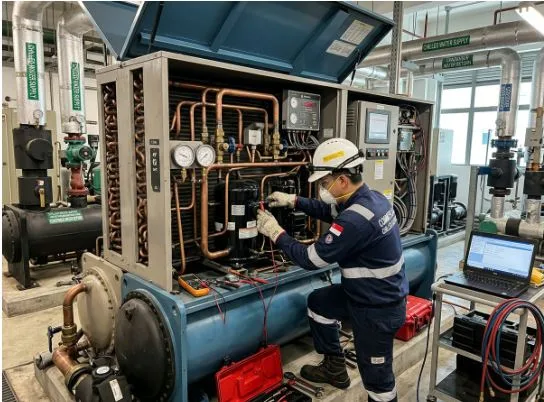
Not all chiller faults are equal in scope or urgency. A professional contractor will triage the situation quickly: establish whether the unit has completely shut down or is in a degraded state, identify the fault category through diagnostics, and give the facility manager a clear picture of what repair options exist and how long each will take.
For straightforward faults — a refrigerant leak, a failed sensor, a faulty valve — experienced technicians can often resolve the issue within hours. For more involved work, such as a compressor overhaul, tube bundle cleaning, or controls replacement, the timeline extends. In cases where the primary chiller will be offline for an extended period, temporary chiller rental provides a bridge, maintaining cooling continuity to the building while permanent repairs are completed.
A thorough repair engagement covers more than fixing the immediate fault. It includes a diagnostic review of the broader chiller system — refrigerant pressures, oil condition, electrical panel health, pump performance, and cooling tower condition — to identify any secondary issues that could cause the next callout. Addressing these in the same mobilisation saves both cost and disruption compared to a return visit weeks later.
Major brands serviced in Singapore’s commercial sector include Carrier, Trane, York, Daikin, McQuay, and Smardt, among others. A capable contractor must be proficient across all of them, since a facility that only has access to single-brand service is exposed when its equipment is from a different manufacturer.
Choosing a Chiller Repair Contractor in Singapore
The contractor selection conversation often happens in a hurry, which is exactly the wrong time to make it. Facilities that have not pre-qualified a chiller repair contractor before a breakdown occurs end up calling whoever answers the phone, with limited visibility into their actual technical capability or response time.
A few criteria matter most when evaluating contractors for chiller repair work.
BCA Mechanical Engineering Licence. Singapore’s Building and Construction Authority licences HVAC and chiller contractors by ME grade. For substantive commercial chiller repair or maintenance work, you want a contractor holding at least ME01 Grade L4 or L5, confirming they have the technical standing and track record for complex mechanical work.
24/7 emergency response. In a tropical climate with no seasonal downtime, chiller faults do not keep business hours. Confirm that a contractor’s emergency capability is backed by field personnel on-call, not just a contact number.
Multi-brand competence. Commercial buildings typically run chillers from several different manufacturers across their portfolio or service life. The contractor you call needs to be capable with your specific equipment.
Diagnostic depth. The ability to identify root cause, not just replace the failed component, is what separates a contractor who closes the fault from one who keeps getting called back for the same system.
Parts availability. Response time means little if the right parts are not accessible. Established contractors maintain stock of critical components and have procurement relationships that shorten lead times on specialist parts.
For facilities in Singapore looking for a contractor with this combination of credentials, chiller repair by Aircond Network covers the full scope — emergency response, diagnostics, overhaul, preventive maintenance, and temporary chiller rental during extended repairs. Holding a BCA ME01 Grade L5 licence with ISO 9001:2015 and ISO 45001:2018 accreditations, and with 80 skilled technicians available around the clock, Aircond.Network has been handling complex chiller repair work across commercial, industrial, hospitality, and healthcare properties in Singapore for over 25 years.
The Case for Getting Ahead of the Problem
Singapore’s building stock is ageing. A significant portion of the commercial and industrial chiller systems currently in service were installed ten to fifteen years ago, some longer. These systems are not necessarily at end of life, but they are at the age where maintenance discipline becomes the deciding factor between reliable service and recurring faults.
Buildings that invest in structured preventive maintenance programmes — regular inspections, annual shutdowns, performance trend monitoring, and water treatment — consistently see fewer emergency callouts, lower energy consumption, and longer equipment life. Buildings that maintain reactively tend to cycle through the same faults on an accelerating schedule until the equipment reaches a point where repair is no longer economical.
Chillers represent one of the single largest energy loads in a commercial building. They also represent some of the highest downtime risk. Treating chiller maintenance as a strategic asset management decision, rather than a cost line to be minimised, is one of the more straightforward ways a facility manager can improve building performance and reduce total cost of ownership over the long term.
The 7am call about a failed chiller is going to happen eventually. The only real question is whether you are prepared for it.