When Cabinet Refacing Beats a Full Kitchen Tear-Out
Solid Kitchen & Bath
A familiar kitchen problem
Most kitchens do not wear out all at once. The layout still works, the counters are in decent shape, and the appliances do their job, but the cabinets look tired. Doors may be scratched, the finish may have yellowed, or the style may simply feel dated. When that is the main problem, it is worth asking whether the whole kitchen needs to come apart, or whether the cabinets themselves are the only thing that needs attention.
Cabinet refacing is a middle path between painting over a worn finish and replacing every box in the room. In a refacing project, the existing cabinet boxes stay in place, while doors, drawer fronts, and visible panels are replaced and the exterior surfaces are given a new finish to match. The result can look like a new kitchen without the disruption of a full tear-out, but it is not the right answer for every kitchen. Knowing the difference saves both money and regret.
This guide walks through how to judge your own cabinets, what refacing can and cannot fix, and when a fuller remodel makes more sense.
Start with the boxes, not the doors
The single most important question in a refacing decision is the condition of the cabinet boxes. Open a few doors and look inside with a flashlight. Solid, square, sturdy boxes with shelves that are not sagging and sides that are not swollen from water are good candidates. If the boxes are sound, new doors and a matching finish can give them a genuinely new life.
The same check applies to the layout. Refacing keeps the kitchen where it is. If you like where the sink, stove, and refrigerator sit, and you have enough storage and counter space, refacing preserves a layout that already works. If you are constantly bumping into family members, cannot open the oven and the dishwasher at the same time, or wish the kitchen opened into the living room, no new door style will fix that. Layout problems call for a larger project, and it helps to compare kitchen remodeling options before committing to a cosmetic fix for a functional problem.
Drawers deserve a close look too. Doors get the attention, but drawers do the daily work. Slides that stick, boxes that are falling apart, or drawers that are too shallow for pots and pans will still annoy you after refacing unless they are repaired or replaced as part of the work. Ask what is included for drawers and hardware, not just doors, so the finished kitchen works as well as it looks.
Refacing versus painting
Painting is the lighter, lower-cost cousin of refacing, and it suits cabinets whose doors are in good shape and whose style you already like. A careful paint job, with proper cleaning, sanding, priming, and a durable topcoat, can transform oak or maple cabinets that are structurally fine. It will not, however, change a raised-panel door into a flat slab door, or hide doors that are warped, chipped, or coming apart at the joints.
Refacing goes further because the doors and drawer fronts are new. That means you can change the door style, update the look of the visible end panels, and add new hardware. The trade-off is cost and time: refacing involves more material and more precise fitting than painting, though it is still usually less disruptive than removing and replacing every cabinet.
Either way, preparation decides the result. Cabinets that are greasy from years of cooking, or finished over old grime, will peel and chip no matter how good the paint or veneer. A careful contractor will explain the cleaning and preparation steps, and a homeowner should be wary of any quote that skips them.
What refacing cannot fix
Honesty about limits matters more than enthusiasm for the method. Refacing cannot repair boxes that have been soaked, are coming apart, or smell of long-term damp. It cannot add storage where there is no wall space, move plumbing, or correct a kitchen that is simply too small for the household using it. In those cases, spending on new doors is spending on the wrong problem.
It also cannot change the interior of the boxes. If the shelves are fixed at awkward heights, the corners are hard to reach, or the interiors are damaged, those frustrations will remain. Some interior organizers and pull-outs can be added, and those upgrades are worth discussing, but they do not turn a poorly planned interior into a well-planned one.
A useful test is to imagine the kitchen with brand-new doors but everything else unchanged. If that picture makes you happy, refacing is a strong candidate. Homeowners weighing these choices can also review the work of Solid Kitchen & Bath when comparing local kitchen and bath firms. If you still find yourself listing complaints about storage, layout, and workflow, a fuller remodel deserves a serious look, even if it means waiting and saving a little longer.
Questions worth asking before you decide
Before signing anything, walk the kitchen with a notepad and answer a few practical questions. Are the boxes square and dry? Do the drawers work? Does the layout serve the way you actually cook, or only the way the previous owner cooked? How long do you plan to stay in the home, and does the investment match that plan? These answers matter more than any single sample door.
Ask for a written scope that names what is being replaced, what is being refinished, and what happens to hardware, hinges, and drawer slides. Ask how the new finish will be matched at the visible ends of the cabinets, and how long the work will take room by room. A clear scope protects both sides and prevents the most common disappointment in cabinet work, which is discovering after the fact that something you assumed was included was not.
It is also sensible to look at the rest of the kitchen with fresh eyes. If the counters are damaged, the floor is failing, or the lighting makes the room feel dark, a cabinet project alone may leave the kitchen feeling half-finished.
A practical way to choose
Refacing is at its best when the kitchen works and only the cabinets look old. Painting is at its best when the doors are sound and only the color or finish needs updating. Full replacement is at its best when the boxes are failing, the layout is wrong, or the storage simply does not fit the household. Most kitchens fall clearly into one of those three groups once the boxes and the layout have been honestly checked.
Homeowners sometimes feel pressure to choose the biggest project, as if a smaller project were a compromise. It is not. A well-executed refacing job that matches the kitchen’s real condition is a better investment than a tear-out that was never needed, and a tear-out that fixes a bad layout is a better investment than new doors on a kitchen that never worked. The right size of project is the one that solves the actual problem.
Compare samples in your own kitchen’s light, and live with a door sample for a few days before deciding. When the boxes are sound and the layout works, refacing can give an old kitchen a genuinely new chapter without tearing the room apart.
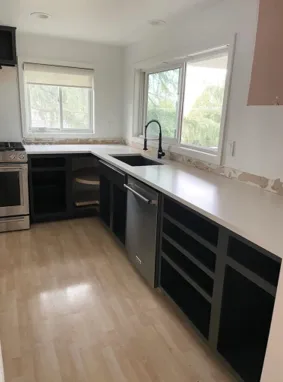
Illustrative stock image — not a photo of Solid Kitchen & Bath’s actual project.