When Recruiting Automation Starts Making Decisions About What to Do Next
Recruiting teams have spent years automating isolated chores. Calendar links replaced long scheduling threads, templates sped up outreach, and applicant tracking systems made it easier to move people between stages. The newer conversation around agentic ai in recruiting is different because the software is expected to respond to what happens during the process, rather than simply run a fixed sequence of instructions.
That difference matters most when hiring does not follow the neat path imagined at the start. A search may return too few suitable candidates. An outreach message may receive no response. A candidate may give a vague interview answer that needs another question. Traditional automation can handle prewritten branches, but a more adaptive system can use the latest result to decide what should happen next.
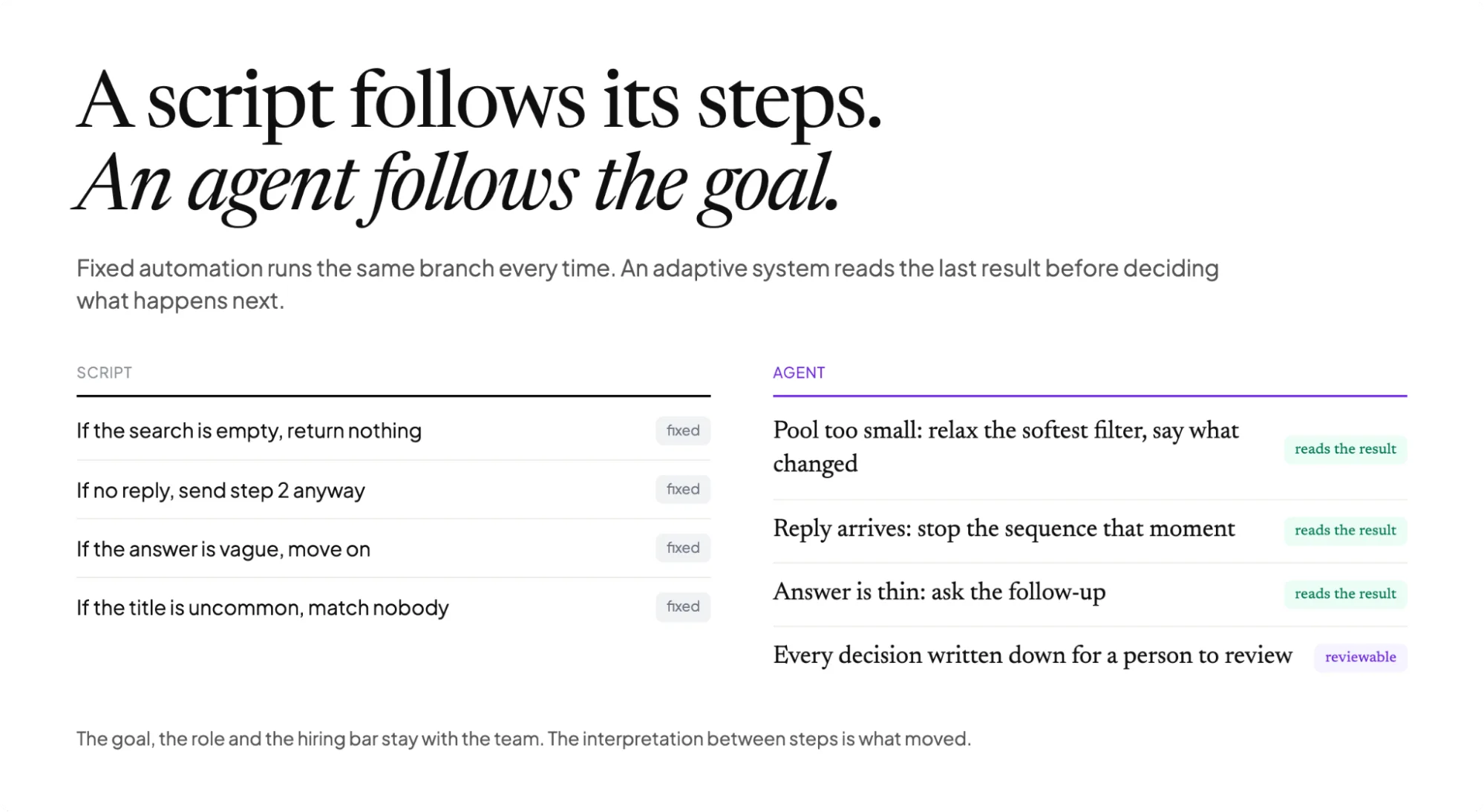
A script follows its steps; an agent follows the goal, reading each result before deciding the next action.
Why Fixed Workflows Reach Their Limit
A conventional recruiting workflow is useful when the next action is predictable. If a candidate applies, send a confirmation. If an interview is booked, send a reminder. If a recruiter changes a stage, notify the hiring manager. These rules remove repetitive work without changing how the team evaluates talent.
Problems appear when the process depends on judgment. Recruiters regularly change search terms after seeing a weak talent pool, adjust outreach based on the type of candidate they are approaching, and probe one interview answer more deeply than another. Those actions are not difficult because they involve clicking buttons. They are difficult because somebody must interpret new information first.
The clearest example is candidate sourcing. A recruiter writes a brief in a sentence, say machine learning engineer, recommendation systems, worked at a Series B company, remote. A scripted tool turns that into filters and returns whatever matches, which for an uncommon title is often almost nobody. An adaptive system runs the search, reads the real result count, loosens the softest filters until the pool is large enough to rank, reports what it broadened, and attaches a reason to each match. The recruiter still set the goal. The system handled the part that used to be 30 minutes of trial and error.
The Value of a Goal Rather Than a Script
An agentic approach starts with a goal, a role definition, and a clear hiring bar. The system can then work through tasks such as sourcing, contacting, scheduling, interviewing, and organizing evaluation evidence. The useful distinction is not whether a product calls itself an “agent.” It is whether it can adapt when the previous step changes what should happen next.
Human oversight still matters. A hiring team should decide what the role requires, what evidence is important, and who moves forward. Software can reduce the volume of manual work around those decisions, but it should not turn an employment decision into an unexplained automated verdict.
The same test applies across the whole of full cycle recruiting. Outreach that stops the moment a candidate replies, rather than sending the next step of a sequence to someone who has already answered, is adapting. An interview that follows up on a thin answer, while scoring every candidate against the same rubric, is adapting. Recruitment automation that cannot do either is a script with a new label.
Measurement Becomes More Important, Not Less
As recruiting technology takes on more activity, teams need better visibility into what is happening. This is where recruitment analytics software becomes important. Leaders need to know whether added automation is improving the funnel or merely increasing activity.
Useful measures can include how many sourced candidates are genuinely relevant, how many people respond to outreach, where candidates drop out, how long each stage takes, and whether interview evidence is consistent enough for hiring managers to review efficiently. Raw activity counts, such as messages sent, can look impressive without showing whether the process is producing stronger shortlists.
A team should also compare results before and after a change. If screening becomes faster but hiring managers spend more time correcting weak recommendations, the apparent efficiency may not be a real improvement. Good recruiting analytics make that comparison possible by recording, for every automated step, what the system decided and why, so the review is of reasons rather than of outputs alone.
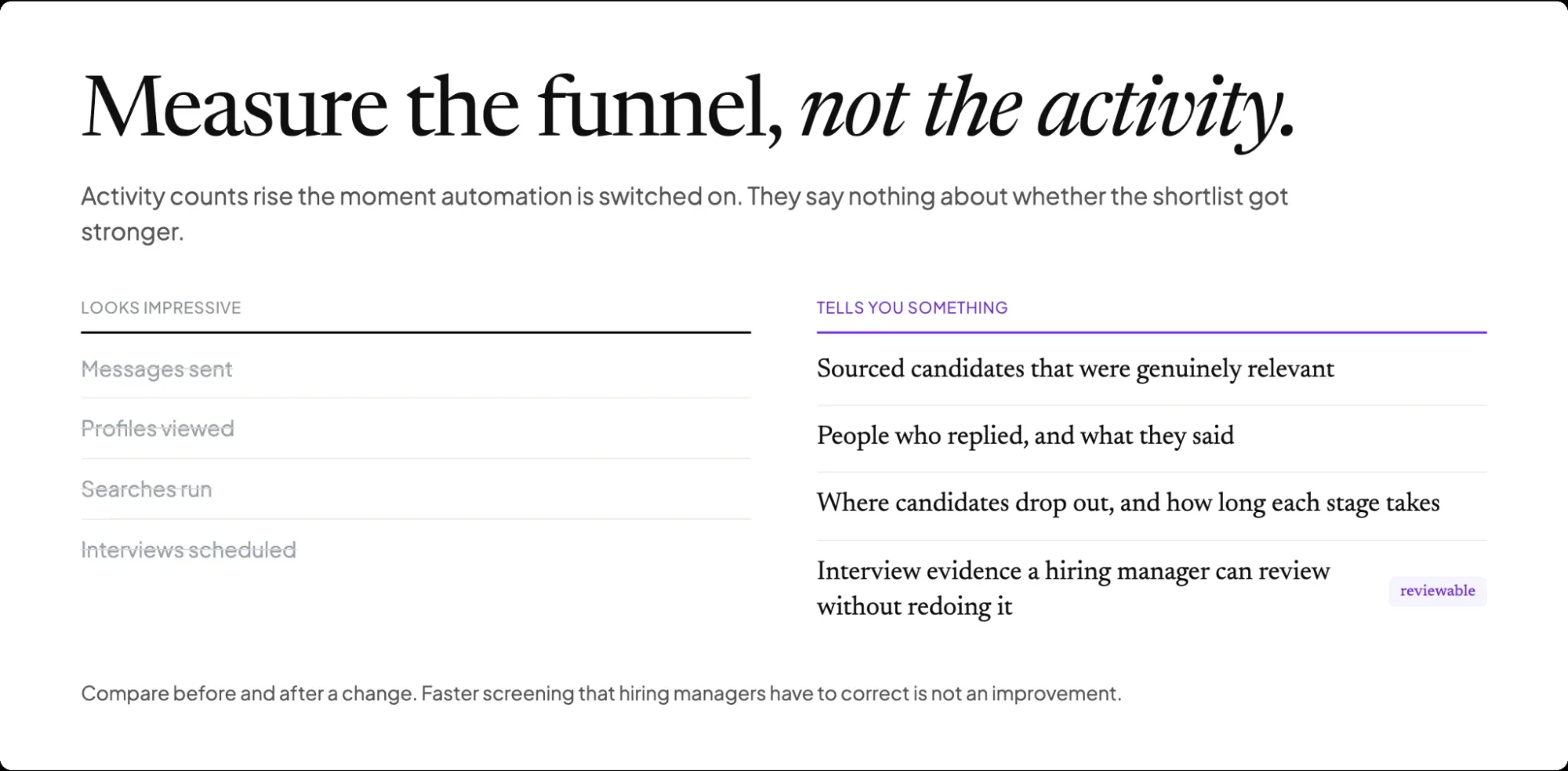
Measure the funnel, not the activity: messages sent and profiles viewed say little; relevance, replies, drop-off and reviewable evidence say whether the shortlist got stronger.
A Practical Way to Introduce More Autonomy
Companies do not need to automate the entire hiring process at once. A safer starting point is one role with a clear definition and a measurable bottleneck. For example, a company struggling to source specialist candidates could test an adaptive sourcing workflow while keeping interviews unchanged. Another team may have plenty of applicants, but too little interviewer capacity, so structured screening becomes the better starting point.
Before expanding the system, teams should review the quality of its output. Are recommended candidates actually relevant? Can reviewers understand why an interview score was given? Are recruiters correcting the system frequently? The answers reveal whether the technology is reducing useful work or simply moving it somewhere else.
I run The Cognitive, and this is the standard we hold our own AI recruiting tools to: a sourcing agent that relaxes its own filters and explains each match, an outreach agent that stops on reply, and an interviewer that follows up while scoring on a fixed rubric, with every decision written down for a person to review. Treat that as one worked example of the category, not a neutral survey.
Conclusion
The most valuable recruiting work is rarely the repetitive part. It is deciding what good looks like, understanding why a candidate may succeed in a particular environment, discussing trade-offs with a hiring manager, and persuading the right person to join.
Agentic technology is most useful when it gives recruiters more room for those responsibilities. The goal is not to create a hiring process with no people in it. It is to stop talented people from spending large parts of the week on tasks that software can complete consistently, while keeping consequential judgments visible, reviewable, and human.
Sparsh Goyal is the founder of The Cognitive. The platform sources candidates from ~900M profiles, reveals verified emails and phone numbers, runs outreach that stops on reply, and conducts live two-way AI interviews that score every candidate on the same rubric.