When Should You Trim or Remove a Tree? Costs, Timing and Emerald Ash Borer Risk
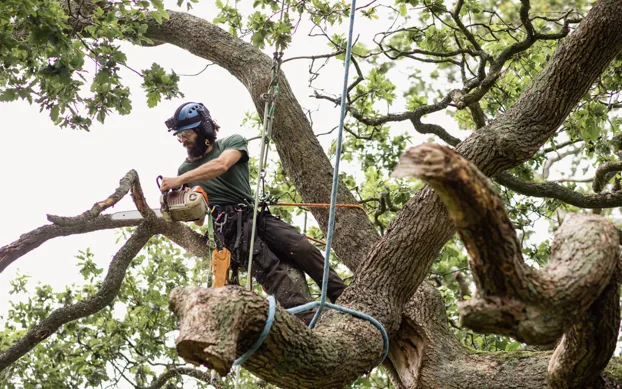
Most homeowners only think about their trees twice: when a limb comes down in a storm, and when the bill for removing it arrives. Planned care costs less, carries less risk, and keeps healthy trees healthy longer. On Colorado’s Front Range, an invasive beetle has added a new reason to pay attention, because it is steadily killing one of the most common shade trees in the region.
This guide covers what tree trimming and removal cost, when to trim versus remove, how emerald ash borer changes the math, and why tree work is a job for professionals.
In this article:
- What tree work costs
- Trim or remove: a decision framework
- The emerald ash borer factor
- When to schedule tree work
- Why tree work is dangerous
- How to vet a tree service
1. What Tree Work Costs
National 2026 cost data from Lawn Love:
Tree trimming
| Tree Height | Typical Cost |
| Under 30 feet | $80 to $420 |
| 30 to 60 feet | $210 to $790 |
| Over 60 feet | $470 to $1,840 |
| Typical per-tree range | $412 to $612 |
Tree removal
| Tree Height | Typical Cost |
| Up to 30 feet | $285 to $435 |
| 30 to 60 feet | $435 to $870 |
| 60 to 80 feet | $870 to $1,160 |
| Over 80 feet | $1,160 to $2,000 |
| National average | $850 |
Factors that raise the price
| Factor | Typical Added Cost |
| Emergency removal | $450 to $3,000 total |
| Diseased or storm-damaged tree | $400 to $1,000 or more |
| Stump removal | $180 to $525 |
| Power lines, structures or tight access | Varies, often significant |
Key takeaway: Emergency removal can cost several times more than a planned removal of the same tree. Regular inspection is the cheapest insurance.
2. Trim or Remove: A Decision Framework
| Condition | Likely Action |
| A few dead or crossing branches | Trim |
| Limbs over the roof, driveway or power lines | Trim for clearance |
| Canopy thinning from the top down | Inspect for disease or pests before deciding |
| Trunk cracks, cavities or fungal growth at the base | Assess for removal |
| Tree leaning more than it did last year | Assess urgently |
| More than half the canopy dead | Remove in most cases |
| Infested ash tree in poor health | Remove and replant |
| Healthy ash tree of high value | Consider treatment |
Rule of thumb: Trimming preserves a tree’s value. Removal becomes the better choice when a tree is a hazard, is declining beyond recovery, or will cost more to maintain than to replace.
3. The Emerald Ash Borer Factor
Emerald ash borer (EAB) is an invasive beetle whose larvae tunnel under ash bark and cut off the tree’s flow of water and nutrients. Untreated infested ash trees typically die.
EAB on the Front Range: key data
| Data Point | Figure | Source |
| First Colorado detection | Boulder, September 2013 | Colorado State Forest Service |
| Confirmed in Lafayette | August 2017 | Colorado State Forest Service |
| Estimated ash trees in Lafayette | About 22,000, mostly on private property | Colorado State Forest Service |
| Front Range cities with confirmed EAB | More than 20 as of 2025 | Colorado State Forest Service |
| Share of Colorado urban trees that are ash | About 15% or more | Colorado State Forest Service |
| Natural spread rate | About half a mile per year | Colorado State Forest Service |
Signs of EAB
- Thinning leaves in the upper canopy
- D-shaped exit holes in the bark, about 1/8 inch wide
- Vertical bark splits
- Heavy woodpecker activity on ash trees
- New sprouts at the base of the trunk
Treat or remove? The Colorado State Forest Service recommends evaluating each tree individually. A healthy, well-placed ash that provides significant shade may be worth protecting with treatment. A declining ash, or one in a poor location, is often better removed and replaced with a different species. Waiting too long raises the cost, because dead ash becomes brittle and more dangerous to take down.
How to identify ash: Look for compound leaves with 5 to 9 leaflets and branches that grow directly opposite each other.
4. When to Schedule Tree Work
| Season | Best For | Notes |
| Late winter (dormant season) | Most structural pruning | Branch structure is visible and wounds close well in spring |
| Spring | Inspecting for storm damage and EAB | Canopy thinning is easiest to spot as leaves emerge |
| Summer | Clearance trimming and dead wood | Avoid heavy pruning during heat stress |
| Fall | Planning removals and replanting | Good time to plant replacement trees |
| Any time | Hazard and emergency work | Do not wait on a hazardous tree |
Winter pruning can cost a little more in some markets because demand rises, but the tree typically benefits.
5. Why Tree Work Is Dangerous
Tree care ranks among the more hazardous kinds of outdoor work. A CDC analysis of federal fatality data found:
| Statistic | Figure |
| Tree care worker deaths, 1992 to 2007 | 1,285 |
| Average deaths per year | 80 |
| Share caused by being struck by a tree or branch | 42% |
| Share caused by falls | 34% |
| Share caused by electrocution | 14% |
| Deaths that occurred at private residences | 44% |
| Victims who were trimming or pruning | 44% |
Key takeaway: Most of these deaths happened during ordinary trimming jobs at homes. Climbing, chainsaws and power lines are a job for insured professionals with proper equipment and training.
6. How to Vet a Tree Service
- [ ] Proof of liability insurance and workers’ compensation coverage
- [ ] Written estimate listing the trees, the work and cleanup
- [ ] Clear plan for work near power lines (utility coordination where required)
- [ ] Experience identifying EAB and other local pests
- [ ] Ability to handle both treatment decisions and removals
- [ ] Stump grinding and debris removal included or priced separately
- [ ] Local references in your area
Applying This Checklist in Lafayette
Because Lafayette was one of the first Colorado cities where EAB was confirmed, and because most of its estimated 22,000 ash trees stand on private lots, homeowners there face the treat-or-remove decision earlier than much of the Front Range. That makes the last three items on the checklist especially relevant in Boulder County, Colorado: a crew with local pest experience that can handle both tree health care and removal.
This matters because an ash tree affected by EAB does not automatically need the same response as the next one. Its condition, canopy decline, structural stability and remaining treatment options should determine whether treatment, pruning or removal makes sense. A contractor who handles both tree health care and removal can assess those options without limiting the conversation to one type of service.
That is the practical reason to consider a tree trimming and removal service in Lafayette, CO with experience across both sides of that decision. Affordable Tree Service LLC is one local example because its services include tree health treatment as well as trimming, removal and stump grinding.
The same standard should apply to any company on your shortlist. Ask why treatment or removal is being recommended, what condition the tree is in, and what the quoted work includes. Then confirm insurance and get the scope and price in writing before work begins.
Summary
| Question | Answer |
| Average trimming cost | $412 to $612 per tree |
| Average removal cost | About $850 |
| Best time for pruning | Late winter, during dormancy |
| Biggest local threat | Emerald ash borer, present in 20+ Front Range cities |
| Treat or remove ash? | Evaluate each tree on health, location and value |
| DIY? | Not for climbing, chainsaws or work near power lines |
A tree inspected on schedule costs far less than one removed in an emergency. On the Front Range, that inspection should now include a close look at every ash tree on the property.