When the Emergency Hits, Every Contact Has to Work: How Mid-Size Agencies Are Modernizing Their Directory Infrastructure
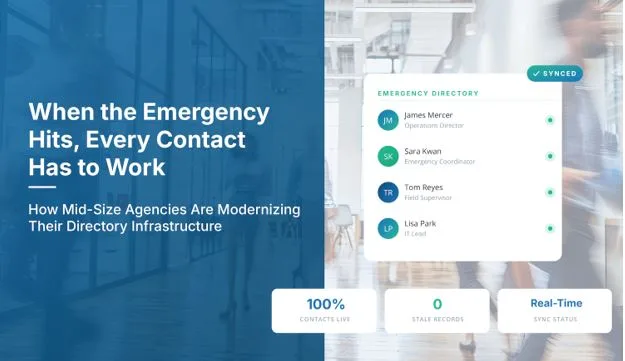
A severe storm moves through the region overnight. Roads flood. Power outages spread. By 6 a.m. the county’s emergency operations center is activated, and a disaster response coordinator needs to reach the regional public works manager right now.
The number in the emergency contact directory goes to voicemail. The manager retired three months ago. His replacement was added to one department’s spreadsheet but never made it into the agency-wide list. Several calls later, someone finally tracks down the right person. The response is already behind.
Scenarios like this rarely make the news, but they happen more often than most agency leaders realize. Emergency communication breaks down for the obvious reasons: a network outage, damaged infrastructure, a cyberattack. It also breaks down for a far more mundane one. People cannot find the right contact when they need it most.
Agencies have spent years investing in cloud platforms, modern collaboration tools, and stronger cybersecurity. Many still manage operational contact information the way they did a decade ago. That gap is worth taking seriously, because directory infrastructure is not just an administrative convenience. During a crisis, it is part of whether the agency can function at all.
The hidden weakness in emergency preparedness
Government agencies plan hard for emergencies. They run continuity-of-operations exercises, test disaster recovery, harden their networks, and stand up response-coordination systems. Yet many of those plans still rest on contact directories kept in spreadsheets, shared drives, static PDFs, or email distribution lists that someone is supposed to update by hand.
The trouble is that agencies never stop changing. Employees retire. Departments reorganize. Leadership turns over. Contractors rotate in and out. Regional responsibilities shift. Every one of those changes is a chance for a contact record somewhere to fall out of date. During normal operations the drift is invisible. During an activation, when decisions speed up and coordination expands across departments and jurisdictions, a single wrong number can stall a response before it starts.
Why agency contact data drifts so quickly
The problem is not unique to any one agency or level of government. State agencies, municipalities, public safety organizations, transportation departments, utilities, and emergency management offices all run into it. In a mid-size agency spread across several offices and jurisdictions, contact information usually lives in many places at once:
- Active Directory and Entra ID
- HR systems
- emergency notification platforms
- Outlook address books
- shared spreadsheets
- department-maintained lists
- individual mobile devices
Over time, these sources diverge. A title changes in one system but not another. A phone number gets updated in HR and nowhere else. A reorganization creates reporting lines that never reach the operational directory. What you end up with is several slightly different versions of the truth, and no reliable way to tell which one is current.
Why accuracy matters most during emergencies
During an emergency, an agency operates nothing like it does on a normal Tuesday. Decisions accelerate. Communication volume spikes. Coordination reaches across departments, jurisdictions, and outside partners. In that environment, accurate contact information stops being clerical and becomes operational infrastructure. A few familiar situations show why.
When an emergency operations center activates, it needs immediate lines to transportation, utilities, law enforcement, and public health. Stale contacts slow the response before it begins. A ransomware incident demands fast coordination among IT leadership, legal, department heads, and outside partners, where a missing number costs minutes that containment cannot spare. Storm response pulls together public works, emergency management, utility providers, and elected leadership, all of whom need to work from the same current list. And when public safety personnel need to escalate an issue or find a decision-maker, a dead phone tree turns into a real delay. In every case the requirement is the same: reach the right person at the right time.
The risks of spreadsheet-based directories
Spreadsheets are the most common way agencies manage contacts, and it is easy to see why. They are familiar, cheap, and simple to pass around. They are also nearly impossible to keep accurate at scale. Multiple versions circulate at once. Updates land unevenly. Ownership is fuzzy. The file goes stale, and no one notices until an emergency, when two departments discover they are working from two different lists. The confusion arrives exactly when the agency needs clarity.
Organizational change keeps fragmenting the directory
Agencies are in near-constant transformation: cloud migration, hybrid work, shared services, regional collaboration, frequent reorganizations to improve service delivery. Approaches built for a static org chart cannot keep up, and the strain is worst for agencies operating across multiple locations and jurisdictions. Without a deliberate strategy, the directory fragments by default.
Many agencies are standardizing on Microsoft 365 government environments and cloud identity platforms such as Microsoft Entra ID. Those are a strong foundation for identity and access management. But identity infrastructure does not, on its own, get accurate contact information into the hands of the people who need it: field personnel, response teams, department leadership, mobile users, and outside partners. Managing identities and distributing current operational contacts are related but different problems, and the second one is the one that bites during a crisis.
Why directory modernization belongs in continuity planning
Federal continuity guidance is unusually clear on this point. FEMA’s Federal Continuity Directive 1 defines the pillars of any continuity capability as leadership, staff, communications, and facilities. Communications sits alongside leadership and facilities, not beneath them. FEMA’s continuity plan templates devote a full section to it, framing the ability to connect leadership, staff, partners, and the public during a disruption as a core continuity requirement. And the guidance does not treat this as a one-time setup. It directs organizations to review their continuity communications on a recurring basis to confirm the information is still accurate and still capable of supporting essential functions.
A contact directory is the most basic layer of that communications pillar. If the directory is wrong, every plan built on top of it inherits the error. Looked at through the same lens agencies already apply to other critical systems, the questions are straightforward:
- Is the information current?
- Is it centrally managed?
- Is it available during an emergency?
- Is it reachable from a mobile device?
- Is it synchronized across systems?
- Is ownership clearly defined?
Answer those honestly for most spreadsheet-based directories and the gap is obvious. Reframed this way, directory modernization is a resilience measure, not an IT chore.
Practical steps for agency leaders
Closing the gap does not require a rip-and-replace project. A few steps move the needle:
- Establish a single source of truth. Pick one authoritative system for operational contacts, and steadily retire the disconnected spreadsheets feeding off it.
- Define ownership. Assign clear responsibility for directory accuracy and governance, so the job does not quietly become everyone’s and therefore no one’s.
- Automate updates. The fewer manual steps between a personnel change and the directory reflecting it, the less stale data you carry into an emergency.
- Prioritize mobile access. Responders work from phones in the field, often with degraded infrastructure. Critical contacts need to live on the device, not only in a portal.
- Audit regularly. Review emergency contact lists, departmental directories, and leadership rosters on a set schedule, the same way FCD 1 calls for reviewing continuity communications.
- Tie it to emergency planning. Treat the directory as part of operational readiness and continuity, not solely as an IT deliverable.
A handful of platforms now automate this directly. CiraSync, for example, can sync an agency’s Microsoft 365 directory to every employee’s phone on a set schedule, and push contractor and external-partner contacts from a CRM into that same native address book, so responders reach the right coordinator without anyone maintaining a list by hand. The specific tool matters less than the principle: the workforce directory deserves the same treatment as any other system the agency depends on in a crisis.
The future of emergency readiness includes better contact data
Agencies have modernized their infrastructure, their applications, and their cybersecurity programs. One piece of operational resilience still gets overlooked: the ability to connect people quickly and accurately in the moments that matter most. As cloud adoption and digital transformation continue, directory modernization is the natural next step.
When the next emergency hits, no one should be hunting for a phone number. They should already have it. Because in a crisis, every contact has to work.