White Background vs. Transparent PNG: Which One Actually Boosts Your Conversion Rate?
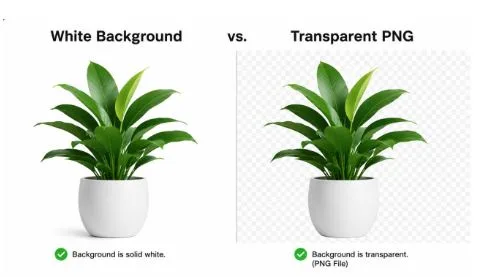
You’ve got a killer product. The photo? Not so much. Perhaps, the background is not right, the picture is flat on your listing, or your advertisements are simply not halting thumbs in between scrolling. This is the unpleasant fact that most sellers overlook, your product may be fine, but is your background format.
The white background or the transparent PNG is not only a preference in design. It’s a conversion decision. And thousands of ecommerce brands are currently spurting thousands of clicks, carts, and customers because they are using the wrong format in the wrong place. Collaborating with expert ecommerce photo editing services may be the only factor between a product that is lost in the feed and a product that sells.
By the end of this post, you will have all the details on which format to apply, when to apply it, and both will be working even harder to your bottom line.
Why Your Image Background Matters More Than You Think
To begin with, one figure that must awaken 93 percent of the product sellers, the product images affect the purchase decisions. Not the copy. Not the price. The image.
That is, your background, which most brands consider as a secondary consideration, is either working as your salesperson without speaking or as your liability. Using a wrong background and a 200 product is made to look like it is in a sale bin. The right one would turn a product with a price of 20 into a luxury item.
Here’s a real-world scenario:There are two sellers who sell the same skincare serum on Etsy. One employs a pure white background that is clean. The other one uses a clear png overlaid onto a messy, low contrast lifestyle template. The listing on the white background receives the 4.8% CTR. The transparent PNG listing? 1.2%. Identical product, identical price, significantly different outcomes, all they do is execute it on the background.
Professional background removal services does not simply remove pictures on your profile. It preconditions all the subsequent conversions. In the absence of crisp and accurate cutouts and calculated backgrounds, you are ceding money before the customer even reads your title.
White Background: Simple, Clean, and Reliable
White background is just what you are thinking it is: your product, single on a pure RGB (255, 255, 255) white surface. It is not called the industry standard in vain.
Amazon requires it. Google Shopping prefers it. Marketplaces trust it. It presents a clear, ad-free view that ensures that the buyer is fixed on the product and not the landscape. It further provides visual language consistency within a catalog which is a positive indicator of professionalism and brand trust at scale.
Pros: Compatible with all, simple to copy, loads quickly, and is compatible with all platforms.
Cons: Your product can literally fade away on a white background web site. It provides zero lifestyle backdrop and may be clinical in categories where emotion motivates a purchase think gifting, fashion or wellness.
Best for: Amazon and marketplace listing, product catalog page, Google Shopping advertisement, and high-volume SKU consistency.
Transparent PNG: Flexible and Eye-Catching
Transparent PNG completely eliminates the background leaving only the product with transparent layer behind it. It is available in an infinity of ways, which makes the encouragement of designers – you can drop it on a pastel, on a gradient, on a photo, on a banner – and it fits.
This is flexible and invaluable in brand storytelling. Imagine Instagram carousel advertisements, seasonal email notices, or an opening page hero a spot where the product must reside within a moment of lifestyle, and not suspended in white space.
Pros: Can be used on any background, can be used on creative campaigns and can make dynamic variations of the ad, without re-shooting.
Cons: Low cutout performance reflects immediately – halos, jagged edges and floating artifacts are killers of confidence. File sizes run larger. And even in the absence of design skill, transparent PNGs can be clumsy and amateurish.
Best for: Social media advertisements, email marketing, branded land pages, display advertisement, and lifestyle content.
What Actually Makes People Click? (The Psychology Behind It)
Attention directly is influenced by color contrast. White backgrounds, however, level the field in a marketplace, whereas on a landing page, a clear PNG on top of a prominent brand color can add visual prominence and direct the eye to the CTA.
Perceived product quality is also influenced by background. According to research in the visual psychology field, isolated objects against a white backdrop are perceived as more accurate and utilitarian, whereas the products in a context (through transparent PNGs on lifestyle backgrounds) evoke an emotional reaction and trigger aspirational purchasing actions.
A/B test results also tell a very interesting story. High-intent environments are always dominated with white backgrounds – search results, comparison grids, marketplace listings. Clear PNGs perform better in low-intent, scroll-heavy environments such as social feeds, display networks, email, and, in these cases, the visual must interrupt instead of inform.
In mobile, the thumb-stop factor is being biased towards clear PNGs on the top of dark backgrounds. This can only be seen in a small screen where the contrast comes out.
When to Use the Right One at the Right Time
The golden rule: the purpose of the platform should determine your background format. The following is your brief decision framework:
- Amazon / Etsy listings: White Background
- Facebook / Instagram Ads: Transparent PNG
- Google Shopping: White Background
- Email Banners: Transparent PNG
- Hero Section of Website: Depends on brand aesthetic
The smartest brands create both formats for each hero product and use them strategically. That’s the move.
Hidden Image Mistakes That Hurt Your Conversions
Even by using the right format, brands undermine their efforts by failure in execution.
Bad cutouts are the silent murderer of transparent PNGs. Sharp edges, halo coloring of the original background, and omissions of hair or cloth details are all indicators of low quality, and customers subconsciously take note of this before their conscious intellect processes the prices.
White which is not really white is just as fatal. The background is off-white (RGB 245, 245, 245), which is disapproved of by the Amazon algorithm and appears yellowish with some screen options. Marketplace does not compromise on pure RGB 255, 255, 255.
The size of files is bloated with poor PNG optimization, and this decreases the speed of loading pages, which loses two birds with one stone: the search engine and the user.
And lastly, mixed-image styles within a shop kill the view of brand integrity. Even a high-end catalog would appear dislodged when combining three types of shadow and four types of backgrounds.
How to Get High-Converting Images
Simple cutouts may be dealt with by such tools as Canva, Adobe Express, and even AI-based removers, such as Remove.BG, by solopreneurs and small catalogs. They are usually not sufficient to provide catalog consistency and pixel-perfect edges.
It is at this point that professional ecommerce photo editing services become worth their money. With continuous white point calibration, transparent cutouts that are clean, shadow matching, and processing the batch at scale are provided by a proficient editing team, and you do not have to spend hours in Photoshop.
Quick quality checklist before going live:
- Is the background true RGB 255, 255, 255?
- Are zero halos or fringing on all edges?
- Does the size of the file get optimal without compromising on resolution?
- Is the picture in line with the rest of your catalog?
In 50 or more SKU catalogs, it is not a luxury but a time and revenue choice to have batch processing by a professional photo editing service based on the ecommerce.
Conclusion: Choosing the Right Background for Better Sales
No one can say which one is a universal winner between white backgrounds and transparent PNGs. However, there is a right solution to your particular use case, platform and buyer psychology.
Own the marketplace using white backgrounds. Feeds should be owned with transparent PNGs. Get professional ecommerce photo editing services to ensure that whatever you settle on is well done to convert.
Because a great product deserves a great image – and a great image deserves the right background.
Frequently Asked Questions (FAQs)
1. Which background format converts better: white or transparent PNG?
There is no ultimate winner, it will happen as far as the image is utilized. White backgrounds are more effective on such marketplaces as Amazon and Google Shopping, and transparent PNGs are more likely to work in advertisements and social media where high-quality visuals are significant.
2. Why do marketplaces prefer white background images?
Marketplace will prefer white backgrounds as it is a clean and distraction-free way of viewing. This makes it easy to have product comparisons by the customers and creates a trust by being consistent between listings.
3. Are transparent PNGs better for ads and social media?
Yes, clear PNGs tend to be better in advertisements since they may be put on bright backgrounds. This gives it the ability to make scroll-stopping visuals to enhance the engagement and the click-through rates.
4. Can I use both white background and transparent PNG for the same product?
Absolutely. Indeed, being able to utilize both formats is the most intelligent approach. White backgrounds are suitable to be used with the listings, whereas transparent PNGs can be used in marketing creatives such as ads, emails, and banners.
5. How does background choice impact conversion rates?
Backgrounds determine the perceptions of your product by customers. There is a level of trust and clarity, which is created by the clearness of the white backdrop; and the level of emotional appeal and increasing interest, which are directly influenced by a well-designed transparent PNG- both of which are directly proportional to conversions.
6. What are the most common mistakes with transparent PNG images?
The most significant ones are unsatisfactory cutouts, ragged edges, and halos. These weaknesses make the product appear unprofessional and diminish the trust of the buyer immediately.
7. Why is pure white (RGB 255,255,255) important for product images?
White, however, is pure which makes sure that you are following the rules in the marketplace and your pictures look clean and professional at the same time. Backgrounds of off-white could be boring or even irregular and could also be rejected on certain sites.
8. Do image file sizes affect conversions?
It is true that large image files may slow down your site resulting to increased bounces and decreased conversions. Compression of files is important to achieve quality with minimal file size to enhance search engine optimization and user experience.
9. Should I hire professionals for product image editing?
When you have a big catalog or you wish to obtain regular and high-quality results, then it is a wise investment when you hire professionals. They provide accurate cutouts and backgrounds and optimized images which are intended to turn into conversions.