Why Analog Photography is Making a Global Comeback
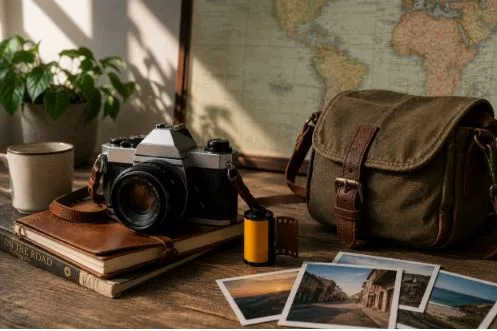
Secondhand film camera sales have been climbing steadily across several countries over the past few years, driven largely by buyers who never previously owned anything but a digital camera or a phone. The trend shows up in online marketplace data, in the growing waitlists at repair shops, and in the renewed interest among film camera specialists in Sydney and similar retailers overseas, who report more first-time buyers than at any point in the last decade.
It would be easy to dismiss this as a short-lived aesthetic fad, another retro trend borrowed from social media filters. Plenty of it probably is exactly that. But the pattern has held for long enough now, across enough different countries and age groups, that it looks like something with more staying power than a passing look.
A Trend Visible Well Beyond Any One Country
What makes this particular revival notable is how widely distributed it is. Camera repair specialists in Japan, the traditional home of film camera manufacturing, report growing waitlists for cleaning and repair work on cameras that had sat unused for decades. Secondhand shops in the UK and continental Europe describe similar demand, particularly for compact point-and-shoot models. In the United States, some discontinued film stocks have returned to production after manufacturers noticed sales climbing rather than declining.
Australia has followed a similar pattern, with growing interest concentrated in capital cities where secondhand camera shops and collector communities already existed in smaller form before the recent surge in demand.
Why People Are Choosing Something Slower
The most common explanation people give for taking up film photography has little to do with the cameras themselves and everything to do with how differently the process feels. A modern phone removes almost every obstacle between having an idea and capturing it: take twenty variations of the same shot, check each one instantly, delete what does not work, and move on within seconds.
Film removes that safety net. A standard roll allows 24 or 36 exposures, and that is the end of it. There is no screen to check results against, and no way to quietly retake a shot that did not work. Each frame effectively costs something, so people tend to slow down, look more carefully at what they are framing, and commit to a single moment rather than collecting several versions of it. For a generation used to scrolling past hundreds of images without really absorbing any of them, that constraint appears to be part of the appeal rather than a limitation.
The Financial Reality of the Hobby
Anyone considering the hobby should understand what it actually costs before committing, because it is a genuine ongoing expense rather than a one-time purchase. A single roll of 35mm colour film typically costs somewhere between 15 and 30 Australian dollars depending on the brand, and developing plus scanning that roll adds a similar amount again. A full roll of finished photographs can therefore cost 30 to 60 dollars in total, not counting the price of the camera, and turnaround from a lab can take anywhere from a few days to a couple of weeks.
The camera itself does not need to be expensive to get started, however. Many of the most respected compact and mechanical cameras from the last fifty years can still be found secondhand for relatively little, provided the specific unit being bought is actually in proper working condition rather than merely looking the part.
Why Working Condition Matters More Than It Looks Like It Should
This is where film cameras differ meaningfully from most other secondhand electronics: a camera can look completely fine and still not function correctly. The foam light seals fitted inside most cameras made before the mid-1990s degrade with age, eventually crumbling and letting in stray light that fogs the edges of every exposed frame. Light meters can drift out of calibration over decades of use. Shutter speeds can become inconsistent in ways that are effectively invisible until a roll of film has actually been developed.
None of these issues show up in a photograph of the camera or in a quick handling test. They only become apparent once film has been run through the camera, developed, and examined, which is exactly why a camera’s testing history matters so much before it changes hands.
Buying With Confidence, Wherever You Are
Because these faults are invisible until it is too late, provenance matters more with film cameras than almost any other category of secondhand goods. A private seller with no way to test a camera is not necessarily doing anything wrong, but the risk of an untested purchase falls entirely on the buyer.
For that reason, many buyers, in Australia and elsewhere, increasingly look to dedicated secondhand retailers that document a camera’s condition and testing history rather than general marketplace listings with no such record. Specialist second hand film camera retailers across Australia have grown accordingly, organising stock by brand and documented condition rather than presenting an undifferentiated pile of secondhand equipment, which gives buyers considerably more confidence than an untested private sale.
That shift has also changed what buyers expect as standard. A decade ago, a listing that simply named the model and asked a price was normal. Increasingly, buyers expect to see whether a test roll has been run, what specifically was checked, and what condition the light seals and shutter are in, treating that information as a baseline requirement rather than a bonus a seller might optionally provide.
Which Cameras Tend to Attract First-Time Buyers
Among newcomers, compact 35mm cameras remain the most common entry point, largely because they require no manual settings to operate. Models such as the Olympus Mju II and the Pentax Espio series are mentioned frequently in this context, both having been mass-produced to a genuinely high standard during an era when compact cameras were taken seriously as consumer products.
For buyers who eventually want more manual control, older mechanical SLRs such as the Pentax K1000 or Canon AE-1 remain popular, mainly because they are simple to understand, widely documented online, and straightforward to have repaired if something does go wrong.
A Trend That Looks Set to Continue
Whether this counts as a genuine shift or simply a longer-than-usual fad depends on who is asked, but the breadth of the pattern, spanning manufacturing hubs, secondhand markets, and repair trades across several continents, suggests it is not confined to a single social media aesthetic. If nothing else, it reflects a broader appetite, in at least one part of people’s creative lives, for a process that asks a little more of them than simply pointing a phone and pressing a button.
For newcomers weighing whether to try it, the more practical question is rarely whether film photography as a whole is worth the effort, since that verdict looks increasingly settled by the numbers alone. It is whether a specific cam…