Why Border Collies Are the Gold Standard for Humane Goose Control
Anyone who’s tried a plastic owl or a motion sprinkler already knows how this story goes. It works great for about three days. Then the geese figure out nothing bad ever actually happens, and they start grazing right next to it like it’s part of the landscaping.
Geese Learn Fast, and That’s the Real Problem
Canada geese are smarter than most people think. They are always reading their environment for real danger, and they are really good at differentiating between something that is threatening, and something that from a distance looks threatening. A fake coyote that never moves. A scarecrow stuck in the same spot all season. A noisemaker that goes off like clockwork every morning at nine. None of it holds up. Give it a week, maybe two, and the geese have already filed it under harmless and moved on with their day.
That’s really the problem with most deterrents on the market. They’re not threats. They’re props. And geese, once they’ve had enough exposure, stop reacting to props entirely.
A Relationship That’s Older Than Any of This
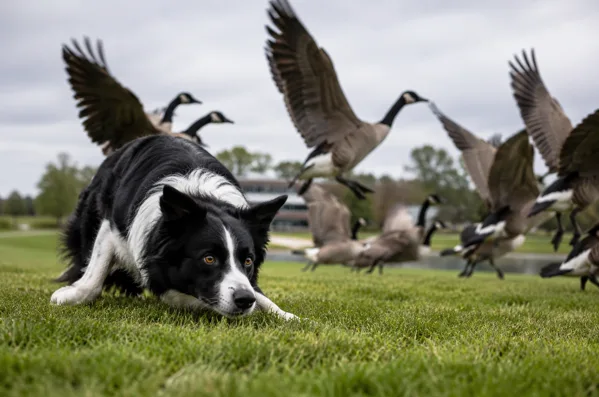
Border Collies are the answer, and it’s not a sales pitch; it’s predator-prey biology that’s worked for thousands of years. Geese evolved with wolves and foxes and other low, stalking hunters, animals that crouch and creep and do not charge straight in. That low body position, that fixed gaze, that slow deliberate movement towards them, that’s all hardwired into how a goose recognises danger. A Border Collie doesn’t need to bark or lunge to get that response. All it has to do is move like a predator, and then the goose’s brain takes the rest.
That is a completely different mechanism than a loud sound or a flashy decoy. It’s not startling the bird for a second and losing its edge.
It’s convincing the goose, on a level that has nothing to do with learning or memory, that something dangerous is actually standing there.
Why the Fear Doesn’t Wear Off
The reason geese management with border collies keeps working where everything else fizzles out comes down to that instinct piece. A goose can eventually learn a plastic owl is fake, because nothing about the owl ever changes. It doesn’t move differently, it doesn’t react, it’s just sitting there. A goose can’t learn that a Border Collie isn’t real, because the dog’s posture and movement are exactly the cues its nervous system evolved to fear in the first place. There’s no getting used to it. The threat reads as genuine every single time, whether it’s the first visit or the fortieth.
That doesn’t mean one afternoon fixes everything, to be clear. Geese are stubborn, and if a property still has open grass and easy water sitting there, some birds will come back to test it again. But repeated visits, timed right, reinforce the message until the property just isn’t worth the risk anymore, at least not in the bird’s mind. And that shift matters most during nesting season specifically. A goose that feels unsafe on a site is a lot less likely to try nesting there in the first place, which counts for more than just scattering birds that have already moved in.
Where This Actually Gets Used
The properties that benefit most from this tend to look pretty similar, open lawns, water nearby, and enough foot traffic that geese have stopped worrying about people. That covers more ground than people expect: office parks and corporate campuses with retention ponds, golf courses with wide fairways and water hazards, schools and playgrounds where droppings and an aggressive nesting goose create a genuine safety issue, apartment communities and HOAs with shared green space, and municipal parks that see steady public use all year.
Different setting, same root issue every time. The geese aren’t afraid, and until something changes that, there’s no real reason for them to leave.
Why DIY Rarely Gets There
Plenty of property owners try to recreate this themselves, usually with a personal dog, or a neighbor’s dog borrowed for an afternoon. It can work, briefly. It almost never holds up, because geese need to encounter that predator pressure consistently and at the right moments to actually change their pattern, not just get startled once and come right back the next morning.
Professional goose control services are built around that consistency in a way a casual effort just can’t match. Handlers know when geese are most active on a given property, how often a site actually needs to be worked, and how to read a flock well enough to tell whether the pressure is sinking in or just producing a temporary scatter. That’s a hard thing to fake with an untrained dog and a Saturday schedule, no matter how good the intentions are.
Why This Approach Continues to Work
Border Collies work because they’re not tricking geese into anything. They’re triggering something those birds have carried in their instincts for generations, long before any of this became a service industry. That’s a fundamentally different mechanism than anything static or artificial, and it’s a big part of why the results tend to outlast whatever a scarecrow or a noise machine ever managed. For a property with a goose problem that keeps circling back, that difference is usually what finally makes it stick.