Why Brands Are Paying for Verified Views Instead of Video Edits
A new line item is showing up in marketing budgets, and most finance teams have never seen anything like it. Companies are no longer paying editors to produce short videos. They are paying networks of independent creators for the views those videos actually earn, with software auditing every single one.
The mechanics are simple to describe. A brand takes its long content, a podcast, a keynote, a product walkthrough, and hands it to a network of clippers: independent editors who cut it into short vertical clips and publish them across TikTok, Instagram Reels, YouTube Shorts, and X. The clippers are not paid for their editing time. They are paid per thousand verified views their clips deliver. The brand, in turn, pays only for views that pass an audit.
That last part is what makes this a real market rather than a gimmick.
The problem with buying views the old way
Raw view counts have been a famously dishonest currency for years. Platforms count a view after a second or two. Bot farms inflate numbers. A clip can rack up a million plays from countries where the brand does not even sell. Agencies billed against those numbers anyway, because nobody had a better unit to bill against.
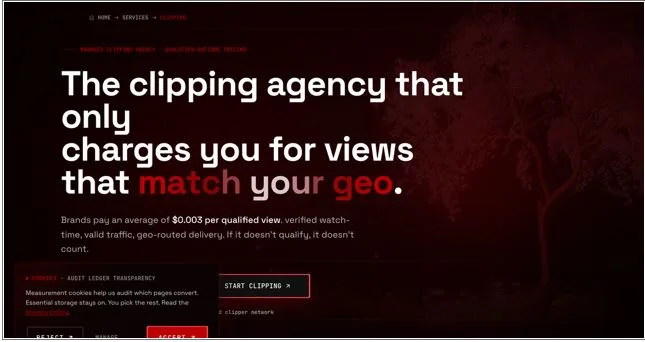
The clipping model only works because the unit changed. The strongest example of the best clipping agency model prices campaigns on what it calls qualified views, at an average of $0.003 each, and a view only counts after it clears four separate checks: a watch-time floor that varies by platform (1.5 seconds on TikTok, 30 percent retention on YouTube, 2 seconds on Reels), a content policy screen, a geography filter that logs but never bills views from non-target countries, and a traffic audit that strips datacenter and bot patterns. On its public ledger, 99.71 percent of billed views have cleared all four.
For a buyer, the difference is concrete. In one published campaign, clippers submitted 6.1 million raw views and the brand was billed for 4.2 million qualified ones, a 68.8 percent qualification rate, for a total spend of $12,600. The rejected 1.9 million views cost the brand nothing. Under the old model, the invoice would have covered all of them.
Why supply exploded
The clipper side of the market barely existed three years ago. Now it is a recognizable gig economy. The barrier to entry is a phone and an editing app, the work is asynchronous, and the payout math is transparent: qualified views divided by a thousand, multiplied by the campaign rate. Strong clippers treat it as a portfolio business, running clips for several brands at once and learning, clip by clip, what each platform’s algorithm rewards.
Networks that organize this supply have processed more than five billion views to date, and the operational tempo is closer to advertising than to production: a campaign brief can go live across a clipper network in under 48 hours. A traditional production house quoting a two-week turnaround for a single edited video is competing with two hundred clips shipped by the weekend.
What it means for the agency business
The deeper shift is in who carries the risk. A retainer puts all of it on the client: the agency gets paid whether the content performs or not. Per-view pricing flips that. Firms like FORKOFF publish their audit rules and charge against the metric, which means a campaign that fails to earn attention also fails to generate fees.
That model does not suit every kind of marketing. Brand films, category creation, and long-horizon reputation work do not reduce to a per-view price, and forcing them into one invites gaming. But for the growing share of budgets aimed squarely at attention, product launches, founder content, event coverage, podcast distribution, the verified-view unit gives finance something it has wanted from marketing for decades: a bill that maps one to one to a measured outcome.
The questions a buyer should still ask
The model is young, and the audit is the product. Anyone evaluating a clipping partner should ask three things. First, what exactly counts as a qualified view, in writing, per platform. Second, who verifies the verification: a ledger the client can inspect beats a monthly PDF. Third, what happens to rejected views, because a network that quietly bills for them is just the old model wearing new language.
There is also a softer risk. Two hundred clips of the same keynote can saturate a niche fast, and quality control across hundreds of independent editors is a genuinely hard problem. The networks that survive will be the ones that treat clipper vetting and content policy as core infrastructure rather than afterthoughts.
Still, the direction is hard to miss. Attention has become the scarcest input in consumer markets, and for the first time it is being sold by the verified unit, audited like a financial transaction. The brands moving first are not asking whether short clips matter. They are asking why they ever paid for marketing any other way.