Why Businesses Are Moving From Spreadsheets to Custom CRM Software?
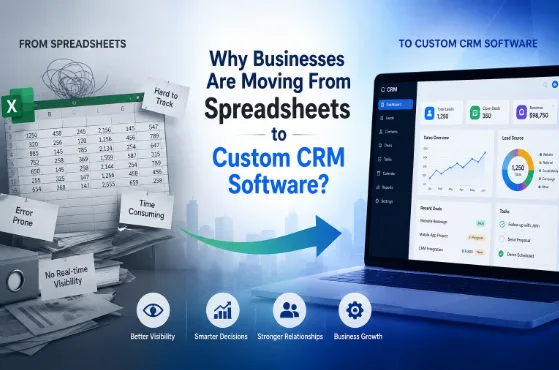
Spreadsheets have been a handy tool for businesses to organize customer data, follow leads, manage sales activities, and keep basic reports for years. They are cheap, understood and simple to install.
Spreadsheets are sometimes hard to manage, however, as businesses expand. Their limitations can be quickly revealed when they’re used by multiple users, as they have to track a growing amount of customer data, implement complicated sales processes, and access real-time information.
That’s why more organizations are looking towards custom customer relationship management solutions. A custom CRM system can be created to match a company’s unique workflow, customer paths, reporting needs, and business objectives, in contrast to conventional spreadsheets.
The change isn’t just about implementing new tech, it’s about implementing a new, structured, scalable strategy for managing customers.
The Limitations of Spreadsheets for Growing Businesses
A spreadsheet is suitable if the business has a limited number of people involved and little information. The troubles start when multiple departments require access to and updates to the same information.
Data duplication is a common problem. Different teams can have multiple spreadsheets with customer data that overlaps. This leads to misaligned sales and marketing teams for different versions of the same customer data, and misaligned contact information for sales reps.
The other issue is the lack of automation. Employees will have to fill out customer details by hand, update lead stages, perform sales calculations, and make reports. These repetitive tasks can add up to valuable time and add to the risk of human error.
Spreadsheets are also not transparent when it comes to customer interactions. When it comes to knowing whether a lead exists or not, a sales manager might be aware of it, but not be able to easily see emails, calls, meetings, follow-ups, purchase history and previous interactions without having to flip through various files.
Security is another issue. Email and cloud-based storage can make it challenging to keep the right people in and out of spreadsheet files. Customer sensitive information could be made available to persons who may not require it.
Why Custom CRM Is Becoming a Strategic Investment?
With the rise of personalized business systems, crm software development has become a significant factor for businesses seeking more control over their operations with customers.
A custom CRM is created with the real business processes. Organizations can build workflows, dashboards, fields, permissions, and integrations to meet their unique needs, rather than forcing employees to work with a generic platform.
Your real estate firm could have needs for property management, lead qualification, site-visit scheduling, and agent assignment capabilities. For a B2B tech firm, this can involve using an account management system, tracking proposals, streamlining the sales pipeline, and integrating communication platforms. The needs and requirements for customer management may vary significantly across healthcare organisations.
This can be very helpful for businesses that have specific processes.
Benefits for Businesses Moving From Spreadsheets to Custom CRM Software
Centralized Customer Information
The most significant benefit of getting rid of spreadsheets is that customer data is accessible in a central location.
A CRM can integrate contact details, communication history, lead status, sales activities, support requests, and other pertinent information into a single system. Information that employees need can be accessed without having to look through several files.
Centralisation also enables fostering cooperation. Sales, marketing, customer support, and management teams are able to access the same customer data. When a customer visits multiple departments, the employees will have all the information about the interactions because of this, which will enable them to offer the same experience.
As companies grow and expand their team and clientele, this is becoming more significant.
Better Lead and Sales Management
While spreadsheets can follow up on leads, they may not be as effective in managing the entire sales process. Manual updating of lead stages, reminders and follow-up with prospects are required.
Many of these activities can be automated with a custom CRM. Opportunities can be passed to sales people according to pre-defined rules, opportunities can be automatically reminded to follow up, and the managers can track the opportunities through visual sales pipelines.
Sales stages can also be assigned as per business requirements rather than following a fixed stage. This enables the system to reflect the actual sales process of the organization.
This translates into less paperwork for sales teams and improved insight into opportunities to pursue.
Automation Reduces Manual Work
One of the most often-ignored expenses of spreadsheet ways is manual data entry. Staff can be spending hours copying information, updating records, preparing reports, and sending out repetitive follow-up messages.
This workload can be greatly reduced by automation.
For instance, a new lead is generated in the system, then the CRM can automatically assign it to the suitable team member. A follow up task may be set after a certain time and managers can be alerted of any important opportunity when it reaches a certain stage.
Reporting, segmentation, notification and workflow approvals can also be automated for businesses. So employees can focus more of their time on work that involves human judgment and customer interaction.
Improved Reporting and Business Intelligence
When business information is distributed across a number of spreadsheets, decision making becomes a challenge.
Custom CRM systems can deliver real-time data on key metrics and performance metrics on a single dashboard. Managers can track lead conversion rates, sales pipeline value, customer acquisition trends, sales rep performance and support activity.
Reports can also be generated as desired for the business. Decision makers can view data on dashboards and get automated reports instead of manually merging data from several spreadsheets.
With this, the organizations can detect trends in time and take a decision on the basis of the latest information and not the old files.
Stronger Data Security and Access Control
Customer information is valuable, which makes data protection an important consideration.
Most spreadsheets offer limited sharing and permissions, however, as an organization grows, more control is needed. A custom CRM can be created with role-based access, authentication measures, audit trails, and more security measures.
For instance, a salesperson could only need access to his/her own accounts, whereas a manager could need access to team-level reports. Admins can get more privileges to manage users and configurations.
These controls can help businesses establish a more organized approach to managing sensitive customer information.
Integration With Existing Business Tools
Today’s companies don’t typically rely on one application. They can leverage email marketing platforms, accounting software, marketing automation software, communication apps, payment systems, customer support platforms, and analytics software.
These can be integrated with a custom CRM to form a connected business ecosystem.
For example, a CRM could integrate with an accounting system to sync customer data, automatically capture changes to customer records after a sale, or integrate with a marketing system to record the results of marketing campaigns.
These integrations eliminate duplicate data entry and enable employees to access data from a single system.
Scalability for Future Growth
A small business can probably get by with a spreadsheet for now, but it will become harder to handle with growth.
Scalability can be considered in the design of a custom system. As the business grows, additional users, departments, workflows, modules, integrations, and reporting needs can be added.
That’s one of the reasons why organisations are increasingly assessing crm software development companies based on their understanding of long-term business needs as opposed to just providing an application.
A scalable CRM can grow with the business rather than businesses having to repeatedly change their customer management system.
Customization Can Improve Employee Adoption
Another aspect of customization that is often overlooked is usability.
You will get more consistent use of a system from staff when it reflects their day-to-day work. A Sales representative shouldn’t have to cross irrelevant features, and a customer support executive might need an entirely different set of tools.
It can be made more intuitive and user-friendly by creating custom interfaces, workflows, dashboards, and notifications. Improved usability will lead to better data quality because working with the data is easier and employees will be more likely to update it correctly.
Choosing the Right Development Partner
Choosing the right technology partner is crucial for businesses embarking on a custom software. When choosing crm software development companies, organizations should assess their technical expertise, business process understanding, security measures, integration options, scalability, and support after deployment.
Any good partner will first start by talking with you about requirements instead of just suggesting features. The development process should involve identifying the existing challenges, roles of users, user journeys, opportunities for automation, reporting and integration requirements.
It’s also important for businesses to evaluate the ability of the development partner to offer continued maintenance and enhancements after deployment. CRM systems can end up playing a major role in your business operations and ongoing support can be just as critical as the initial development.
The Future of Customer Management
Automated and data-driven business processes are the theme of the transition from spreadsheets to custom CRM. With growing customer volumes and increasingly complex workflows, it is easy to see how organizations can lose efficiency and visibility when having all their files stored and handled manually.
Custom CRM solutions offer businesses a unified platform to handle customer relationships, automate repetitive tasks, enhance collaboration, and gain valuable insights that help them make informed decisions.
Conclusion
The objective isn’t just to get rid of spreadsheets. To create a customer management environment that will enable a business to do what it does now and continue to serve future business growth.
But for businesses dealing with siloed customer data, repetitive admin tasks, restricted reporting, or inefficient sales workflows, adopting a tailored CRM solution from spreadsheets to a customizable platform can be a practical way to enhance productivity and improve customer experiences.