Why Canadian Businesses Are Increasing Local SEO Spending in 2026
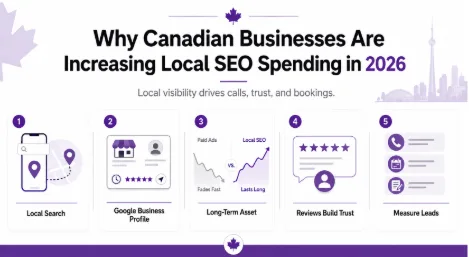
Canadian companies aren’t putting more money into local SEO because it suddenly became fashionable. They’re doing it because the customer journey has gotten shorter, messier, and far more local: someone searches on a phone, scans a map, checks a rating, then calls the business that looks reliable enough.
That’s a brutally competitive few minutes. For a plumber in Calgary, a dental clinic in Mississauga, or a retailer with three Vancouver locations, being absent from Google Maps can mean losing the customer before the website even enters the picture.
The 2026 shift isn’t really about chasing rankings for bragging rights. It’s about defending a patch of territory where searchers are ready to book, visit, request a quote, or buy.
Local search has become the front door
Mobile-first behaviour has made proximity-based search routine. People still type “near me,” sure, but they also search neighbourhood names, transit stations, landmarks, service types, and very specific problems: “emergency furnace repair North York” isn’t casual research. It’s usually a person with a cold house and limited patience.
Maps are doing more work now. Voice-assisted searches, Apple Maps, Bing Places, and Google Search all feed the same expectation: show me a nearby option, tell me whether it’s open, and give me enough proof that I won’t regret contacting it.
That has widened the gap between a business with a tidy local presence and one with stale listings. A wrong phone number, an old holiday-hours notice, or conflicting addresses across directories can derail a lead in seconds. Nobody wants to investigate which listing is correct. They move on.
Canadian small businesses feel this especially hard in dense markets. Toronto SEO competition is obvious, but the same pattern shows up in Ottawa, Surrey, Halifax, Winnipeg, and smaller regional hubs where a few aggressive operators have polished every local touchpoint.
Google Business Profile is now a revenue channel
A Google Business Profile used to be treated like a digital phone book entry. That’s outdated. It can now function as a mini storefront, a proof page, a customer-service channel, and a conversion point before a visitor reaches a company website.
The local pack and Google Maps surface business categories, operating hours, photos, products, services, reviews, booking options, questions, calls, and driving directions. A strong profile answers the buyer’s basic objections early. A neglected one hands those buyers to the business down the block.
Profile management has become more detailed, too. Teams are reviewing primary and secondary categories, uploading current photography, checking service areas, publishing useful updates, and making sure their services match actual search language. Tiny details pile up.
For companies comparing outside help, a best SEO Company in Canada should be able to explain how profile work connects to leads, calls, and conversion paths, not just promise a prettier Maps listing.
There’s a catch: no agency can force a map ranking on command. Google weighs relevance, distance, and prominence, while the local results shift by neighbourhood and searcher location. But businesses can remove a lot of avoidable friction. That’s where the budget is going.
Paid media costs are pushing firms toward assets they keep
Google Ads still has a job, particularly for immediate demand, seasonal promotions, and highly competitive service categories. Yet many Canadian marketing teams are uncomfortable building their entire acquisition model on paid clicks that disappear the moment a campaign is paused.
The math gets uncomfortable fast. Rising cost-per-lead, weak landing pages, broad match waste, and competitors bidding on the same local terms can turn a simple campaign into an expensive guessing game.
Local SEO doesn’t replace paid media. It changes the mix. Better location pages, useful local content, accurate listings, reviews, technical fixes, and local links can continue bringing in qualified traffic after the initial work is done. Not forever. Nothing online stays untouched forever. Still, those assets have a longer shelf life than yesterday’s ad spend.
That compounding effect matters to owners under pressure to explain return on investment. A campaign that produces calls from Google Maps, non-branded local organic traffic, and repeat discovery through reviews is easier to defend than a vague report showing “impressions.”
Reputation has moved from side project to ranking signal and sales proof
Reviews aren’t merely decorative stars beside a business name. In competitive local markets, they influence whether somebody clicks, calls, requests directions, or keeps scrolling. A 4.8 rating with recent, specific comments looks very different from a 4.8 rating earned mostly in 2019.
Review velocity matters because customers want current evidence. So does the substance of the feedback: mentions of friendly staff, quick appointments, transparent pricing, clean facilities, or a successful outcome give the next buyer something concrete to trust.
Business responses matter too. A calm reply to criticism won’t erase a bad experience, but it signals that there’s an actual owner or manager paying attention. Silence can look worse than the complaint.
Smart local SEO budgets now include review-generation processes that are fair and repeatable: ask after a completed service, make the request easy, never pressure customers, and route operational complaints to someone who can fix them. No gimmicks. Fake reviews are a terrible bet.
What businesses are actually paying for
“Local SEO” is still used as a catch-all label, which causes trouble when owners expect a few directory submissions to solve a visibility problem. Serious programs cover several moving parts, and the mix changes by industry, number of locations, and service area.
- Citation cleanup and NAP consistency: aligning the business name, address, and phone number across key listings and data sources.
- Google Business Profile optimization: correcting categories, services, hours, photos, products, attributes, and location details.
- Location and service pages: building pages that answer local questions rather than swapping city names into the same thin template.
- Technical SEO: fixing crawl issues, slow pages, confusing internal links, duplicate content, and weak mobile experiences.
- Local link building: earning relevant mentions through community organizations, suppliers, local publications, partnerships, or industry groups.
- Review operations and analytics: creating a sensible ask process, monitoring sentiment, and tracking outcomes.
Service-area businesses need special care here. A contractor that travels across a region shouldn’t pretend to have offices in every suburb. That shortcut can create listing headaches and trust problems. Build credible service-area content instead.
Rankings aren’t the finish line
Map positions can be useful diagnostics, but they’re not the whole scorecard. Local results vary by device, location, personalization, and the exact wording of a query. A number-one screenshot is nice. It doesn’t pay payroll.
Businesses increasing spend in 2026 are asking more practical questions: Did qualified calls rise? Did direction requests lead to store visits? Which location pages drove form submissions? Are bookings coming from branded searches or from new local discovery? What did each acquired lead cost?
Tracking calls and direction requests, tagging form submissions, connecting booking systems where possible, and reviewing lead quality with frontline staff all make local SEO reporting less fluffy. Sometimes a lower-volume keyword produces the better customer. That’s the sort of detail a ranking report misses.
Why the spending trend is likely to stick
Local search is where intent, trust, and convenience collide. That won’t disappear because the search results get noisier or because another platform claims the spotlight for a month.
Canadian businesses are spending more because the downside of neglect is visible: inaccurate listings, unanswered reviews, weak Maps visibility, and competitors capturing demand that was geographically close all along. The upside is equally plain. Show up accurately, look credible, make contact easy, and measure what happens next.
It isn’t glamorous work. It is, however, where a lot of local revenue starts.