Why Data Engineering for AI Makes or Breaks It
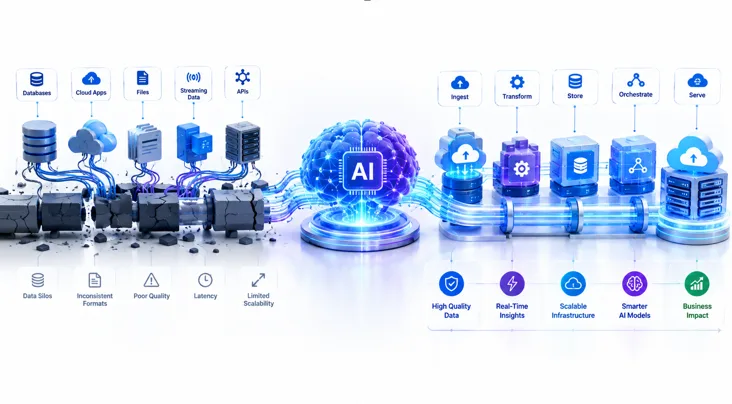
Ask any engineer who has shipped an AI feature. The model was rarely the hard part. The data was. It came in three formats, half of it was stale, and two columns meant different things depending on who filled them in. That mess is exactly why data engineering for AI has become the quiet make-or-break of every AI project.
You can buy the best model on the market. It will still fail on bad data. So before anyone trains anything, the data work has to happen first.
What data engineering for AI actually means
Strip out the jargon and it is simple. Data engineering for AI is the work of getting data ready for a model to use. Clean, current, and in one place it can reach.
Think of it like prep in a kitchen. The cooking gets all the attention. But a good chef spends most of the time chopping, measuring, and setting up. Skip the prep and the dish falls apart, no matter how good the recipe is. Data is the prep. The model is just the last five minutes.
The parts that matter most
- Pipelines that pull data from every source into one clean flow.
- Storage that scales, so a growing dataset does not slow everything down.
- Quality checks that catch bad records before they ever reach the model.
- Governance that tracks where data came from and who is allowed to touch it.
Why AI projects fail on the data, not the model
Here is a pattern I have watched play out more than once. A team builds a clever model. The demo looks great. Then it hits real production data and falls over.
The cause is almost never the algorithm. It is the pipe feeding it. Siloed systems, missing fields, numbers that drifted out of date months ago. The model did its job. It just got fed garbage.
That is the whole case for doing the data work first. Fix the inputs, and the model finally gets a fair shot.
How this connects to enterprise AI product engineering
Building AI into a real product is its own discipline now. People call it enterprise AI product engineering, and it leans on data at every turn.
The link is direct. Strong enterprise AI product engineering cannot run on shaky data. A product team can design a brilliant feature. Without clean inputs, it just will not work in front of a real user. So the data base and the product build have to move together, not one after the other.
The best teams already treat it this way. They fold the data work into the product itself, rather than bolting it on at the end. Their AI features end up accurate, fast, and safe to put in front of customers.
What you get when the data is right
The payoff shows up in a few clear ways, and it compounds over time.
- Models you can trust, because they run on clean inputs.
- Faster shipping, since a ready data base cuts the time from idea to feature.
- Lower cloud bills, because smart pipelines stop wasting compute.
- Less risk, thanks to governance that keeps data safe and traceable.
Getting the order right
The sequence matters more than the speed. Rushing to build before the data is ready is the classic mistake. Here is an order that works.
- Look at what you have. Find the silos, gaps, and quality problems first.
- Build the pipelines. Connect your sources into clean, steady flows.
- Add the guardrails. Put quality checks, lineage, and access rules in place.
- Then build the product. Put AI features on top of a base you can trust.
Frequently asked questions
What is data engineering for AI?
It is the work of getting data ready for AI to use. That covers pipelines, storage, quality checks, and governance. In plain terms, it turns raw, messy data into a base a model can rely on.
Why does the data come before the model?
A model can only work with the data it is given. Feed it messy inputs and the results suffer. So a clean, reliable base has to come first.
How does it support AI product teams?
It hands product teams clean, current data to build on. That makes AI features accurate and safe to ship. Skip it, and even a well-designed product underperforms.
What tools get used for this?
Usually pipelines, warehouses or lakehouses, and feature or vector stores. The right mix depends on the product and how it uses AI.
How soon do we see results?
It depends on your data and the scope. A tight first phase often pays off fast. Many teams start small, prove the win, then scale.
The bottom line
AI only ever works as well as the data under it. That is the lesson teams keep relearning the hard way. The winners are not the ones with the flashiest models. They are the ones who did the unglamorous work first. That is what data engineering for AI really is. Build the base, then let the product shine.