Why Do Hotels, Malls & Offices Use Aluminium Entrance Matting?
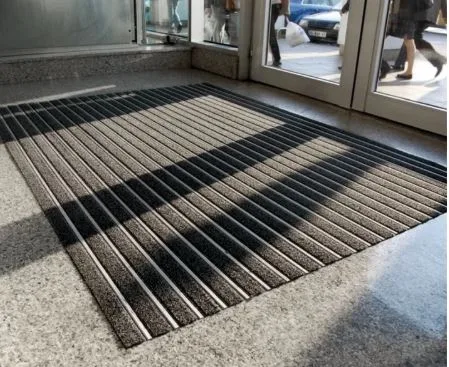
A five-star hotel in Gurgaon spent what the general manager later admitted was “an embarrassing amount” on Italian marble for its lobby. Six months in, the marble near the revolving door had a visible grey path worn into it — not from age, but from a fabric doormat that simply couldn’t keep up with a thousand pairs of shoes a day.
The hotel didn’t have a marble problem. It had a threshold problem.
This is a detail most people walk past, literally. The first three metres inside any building take more physical punishment than almost any other surface in the property, yet they’re usually the last thing anyone budgets for properly. A textile mat gets soaked, flattened, and grimy within a season of heavy footfall. Replace it, and the cycle starts again.
The Assumption Worth Questioning
Most people assume a mat is a mat — buy a thicker one, replace it more often, problem solved. But that logic breaks down once you look at what’s actually happening at a busy entrance.
Fabric fibres absorb moisture, which is useful, until they’re saturated and start pushing water back out under foot pressure. Rubber-backed mats curl at the edges after enough trolleys roll over them. Loose mats slide, which is its own safety issue on polished stone. None of this is a manufacturing flaw, it’s just what happens when a soft material is asked to do a structural job.
Aluminium entrance matting takes a different approach entirely. Instead of one soft surface trying to absorb everything, it uses a rigid metal frame with replaceable insert strips — carpet, rubber, or brush set into channels that let scraped-off dirt fall through and collect underneath rather than staying on the surface where shoes pick it back up. It behaves more like part of the floor than something placed on top of it.
Three Buildings, Three Different Reasons
A homeowner renovating an entryway usually cares about how a mat looks against their flooring and how easily it wipes down appearance and low maintenance come first, and a compact mat is often enough.
A facilities manager running a mid-sized office building is thinking about something else entirely: how the mat holds up against wheeled trolleys, courier traffic, and daily footfall that a home entrance never sees. Durability outranks aesthetics, though it can’t ignore them either, since the lobby still needs to look presentable to visiting clients.
A hotel or retail brand sits between both worlds. Appearance matters because it’s the first thing a guest photographs. Safety matters because a slip near the entrance during monsoon season is a liability nobody wants to explain. And maintenance matters because housekeeping teams don’t have time to deep-clean a doormat between shifts. Aluminium matting tends to show up most often in exactly this category, because it’s one of the few products that doesn’t force a trade-off between the three.
What Actually Matters When Choosing
Once the “just get a bigger mat” instinct fades, a few practical questions take over.
Traffic volume matters more than most people expect — a mat sized for a boutique office won’t hold up outside a mall anchor entrance seeing tens of thousands of crossings a month. Placement matters too: a mat recessed flush into the floor performs differently than one simply laid on top, both in terms of trip hazard and how well it integrates with the surrounding flooring. And upkeep matters long after installation; a system where worn inserts can be replaced without redoing the entire frame saves both money and downtime compared to discarding a whole mat every time it wears out.
This last point is where aluminium systems tend to earn their keep. Ultimats’ aluminium entrance matting, for instance, is built around exactly this idea a permanent frame with insert strips that can be swapped out individually as they wear, rather than the whole unit needing replacement. For a property that’s already invested in getting its flooring right, that kind of longevity is less about the mat itself and more about protecting everything underneath it.
There’s also a quieter argument for why so many hotels, malls, and offices have gravitated toward this format specifically: it ages the way architecture is supposed to age. A worn fabric mat looks tired within months. A well-maintained aluminium mat, sitting flush with the floor, mostly just disappears into the design which, for an entrance, might be the highest compliment it can receive.
The Bigger Point
Walk into any building you consider genuinely well-run, not flashy, just well-run and there’s a decent chance you won’t remember what the entrance mat looked like. That’s usually not an accident. It means the flooring underneath still looks new, the lobby doesn’t smell faintly of wet carpet in July, and nobody had to think about it.
The mat did its job precisely by being forgettable. And that, more than any spec sheet, is probably the best argument for taking the first three metres of a building as seriously as everything else in it.